You can drive safely on UAE highways when you plan the trip and keep a steady speed. UAE highways are wide and fast. The limit on some Abu Dhabi roads reaches 140 km/h. At that speed a small mistake grows fast. Here are the habits that keep you safe.
Quick Answer: To drive safely on UAE highways, check your car before you leave. Keep to the speed on the signs and keep a safe gap. Use the left lane only to pass. Take a break each two hours. Never use your phone while you drive.
The BoloSara24 team read the UAE road safety page on 29 November 2026. It names Federal Decree-Law No. 14 of 2024 on Traffic Regulation. That law came into force on 29 March 2025. It sets the base for speed and safety rules on every UAE road.
Drive Safely on UAE Highways Before You Leave
A safe trip starts at home when you drive safely on UAE highways. Check your tyres, your fuel and your lights before you leave. A tyre with low pressure can burst at high speed. A quick check takes five minutes.
Check your tyre pressure at a petrol station. Read how to check car tyre pressure in UAE for the steps. Look at the tread too. Worn tyres grip less in rain and they take longer to stop the car.
Fill your tank before a long desert stretch. Petrol stations sit far apart on some roads. Check the price first with how to check petrol price in UAE. Pay at the pump with how to pay for petrol in UAE. Keep water in the car for you and for the engine.
Set your route before you move. Type the address into your phone mount while you park. A driver who types while driving isn’t watching the road.
Speed Limits on UAE Highways
Each road has its own limit and the sign on that road is the law. Don’t trust one number for the whole trip. The limit changes at emirate borders and near towns. Watch the signs as you drive.
Abu Dhabi removed its 20 km/h grace margin in 2018. A radar there can fine you for 1 km/h over the posted limit. Dubai roads often allow a margin, but that margin is a camera setting. It can change with no notice. Treat the sign as the limit.
Abu Dhabi once set a 120 km/h minimum speed on the two left lanes of Sheikh Mohammed bin Rashid Road. News reports in April 2025 said that minimum was scrapped. The maximum of 140 km/h stayed. Check the signs on your route and do not trust an old memory of the road.
Driving below a posted minimum speed is also an offence. The federal list puts it at AED 400. A slow car in a fast lane forces others to pass it, and that is where crashes start.
| Rule | Fine | Black points |
|---|---|---|
| Driving below the minimum speed, where one is posted | AED 400 | None listed |
| Not leaving a safe distance behind the car ahead | AED 400 | 4 |
| Using a phone while driving | AED 800 | 4 |
| Not wearing a seat belt | AED 400 | 4 |
These fines come from the federal fines list, Ministerial Resolution No. 178 of 2017. The BoloSara24 team checked the list on the UAE portal. Check your own fine on the official police site before you pay.
Drive Safely on UAE Highways in Traffic
Keep a safe gap behind the car ahead to drive safely on UAE highways. At 120 km/h you need far more room than at 60 km/h. A gap of three seconds is a good base. Pick a sign by the road and count the seconds after the car ahead passes it.
Use the left lane only to pass. Cruise in the right or middle lane. A car that cruises in the left lane at 110 km/h blocks the fast lane. Move right and let faster cars pass.
Watch for trucks in the right lane. A truck can hide a slow car behind it. Do not pull out from behind a truck until you can see the lane ahead is clear.
Omar drives from Dubai to Abu Dhabi each Friday to see his parents. He leaves at 7 in the morning and he reaches them by 8:30. He keeps a three second gap and he passes trucks one at a time. He says the drive feels calm when he stops racing the clock.
Drive Safely on UAE Highways at Night and in Rain
Night driving needs more care when you drive safely on UAE highways. Your lights must work and your windscreen must be clean. A dirty windscreen turns oncoming lights into a blur. Clean it before a night trip.
Rain in the UAE can be heavy and sudden. Slow down when rain starts. The first rain lifts oil from the road and the surface turns slick. Keep a bigger gap and turn your lights on.
Fog can close a highway in winter. If fog drops your view to a few metres, slow down and use your fog lights. Don’t use hazard lights while you move. They hide your brake lights from the car behind you.
Sand can blow across desert roads in a storm. Slow down and keep both hands on the wheel. A gust can push a light car sideways. If you cannot see the road, pull off at a safe place and wait.
Breaks, Fatigue and Emergencies
Take a break each two hours on a long trip. Stop at a rest area, walk for five minutes and drink water. A tired driver reacts as slowly as a drunk driver. Don’t test that fact on a highway.
Do you feel your eyes close for a second? That is a warning. Pull off at the next safe exit and sleep for 20 minutes. A short nap can save your life and the lives of the people round you.
If your car breaks down, move to the hard shoulder if you can. Turn your hazard lights on. Put your warning triangle behind the car. Call the police on 999 if the car blocks traffic or if someone is hurt.
Learn the basic fixes before a long trip. Read how to change a flat tyre in UAE and how to jump start a car battery in UAE. Keep a charged phone, a torch and a bottle of water in the boot.
If a crash happens, stay calm and check for injuries first. Call 999 for an ambulance or the police. Read how to get a traffic accident report in UAE so you know the steps after the crash.
Fuel, Rest Stops and Desert Roads
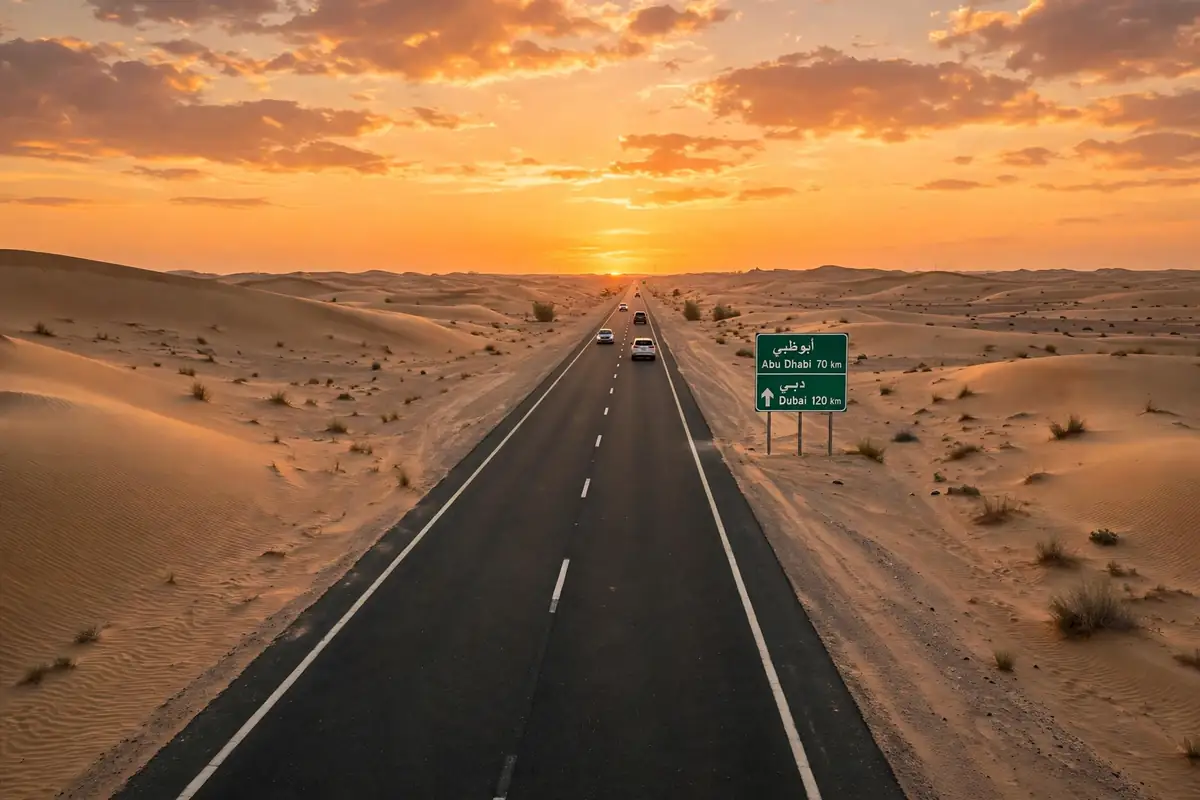
Desert roads run long and straight. A straight road can lull you to sleep. Talk to your passenger or play soft music. Keep your eyes moving between the road, the mirrors and the signs.
Rest stops sit on the main highways between Dubai and Abu Dhabi. Stop at one even if you feel fine. A five minute walk wakes you up for the next hour of driving.
Fuel stations on desert roads can sit 50 km apart. Fill up when your tank drops to half. A half tank rule means you never worry about the next station.
Camels and goats can cross desert roads at dawn and dusk. Slow down near fenced gaps in the desert. An animal on the road at 120 km/h is a crash you cannot brake out of.
Keep your car cool in summer heat. A car that runs hot can break down far from help. Check the coolant at home and watch the heat gauge on the dash. BoloSara24 has more UAE driving guides for long trips. Each one was checked on official pages.
Frequently Asked Questions
What is the top speed limit on UAE highways?
The top limit on some Abu Dhabi highways is 140 km/h. Each road has its own limit, so the sign on your road is the one that counts.
Is there a minimum speed on UAE highways?
Some roads post a minimum speed. Driving below a posted minimum carries a fine of AED 400. Check the signs when you drive safely on UAE highways.
Can I use my phone while I drive on a highway?
No. Using a phone while you drive carries a fine of AED 800 with 4 black points. Set your route before you move.
How often should I stop on a long highway trip?
Stop each two hours. Walk for five minutes, drink water and rest your eyes. A short break keeps you alert for the next stretch.
What should I do in fog on a highway?
Slow down and use your fog lights. Keep a bigger gap. Don’t use hazard lights while you move, as they hide your brake lights.
What is the fine for tailgating on a highway?
Not leaving a safe distance carries a fine of AED 400 with 4 black points. Keep a gap of three seconds or more at highway speed.
Official Sources
UAE Government portal – Road safety – Read the federal traffic law and the list of offences on the official UAE portal.
RTA Dubai – Check RTA driving services and the driver handbook rules for Dubai.
Dubai Police – Check and pay a traffic fine and read the fine list for Dubai.
Ministry of Interior – Check fines across the emirates on the MOI app and site.
Abu Dhabi Police – Check Abu Dhabi traffic rules and fines on the official police site.
Disclaimer
BoloSara24 is an independent site. It is not a government body. It has no link with RTA, Dubai Police, Abu Dhabi Police, the Ministry of Interior, DHA, or any driving school. The facts here were checked on the official pages listed here on 29 November 2026. Traffic rules and fines can change. Check the official page or ask the police in your emirate before you act. This page gives general facts only. It is not legal advice.
Last Updated: 29 November 2026.