Your tyre warning light comes on at 7 in the morning. The tyres look fine. You wonder if the light lies. It rarely does. UAE heat shifts tyre pressure every day. This guide shows you how to check car tyre pressure UAE drivers need for summer heat, where to top up for free, and what the numbers on your door mean.
Quick Answer: Find the pressure on the sticker on your driver door pillar. Check the tyres cold, before you drive or after the car has sat for 3 hours. Use a gauge at a petrol station or a small gauge from a parts shop when you check car tyre pressure UAE heat shifts each day. Fill each tyre to the sticker number, not the number on the tyre wall. Check every 2 weeks and before a long drive. BoloSara24 checked tyre guidance from UAE tyre guides on 29 November 2026. The guides agree on one point. The door sticker is the only correct number.
Find your correct pressure on the door sticker
The right pressure for your car sits on the car itself. Open the driver door. Look at the pillar where the door latches. A small sticker lists the pressure for the front tyres and the rear tyres. Some cars put the sticker inside the fuel flap or on the glove box edge. The owner's manual lists the same numbers.
The sticker often lists two sets of numbers. One set is for a normal load. That means you and one or two passengers. The other set is for a full load. Front and rear numbers often differ. Use the set that matches your load.
A typical family saloon sits near 32 to 36 PSI when cold. A large SUV often sits near 33 to 38 PSI. An electric car often needs more, near 36 to 42 PSI, because the battery adds weight. Your sticker is the final word for your car.
The number on the tyre wall isn't the right pressure. The wall says MAX PRESS 44 PSI or 51 PSI. That is the most the tyre can hold. It isn't the pressure to run. Fill a saloon to 51 PSI and the ride turns harsh. The centre of the tyre wears fast.
One bar equals 14.5 PSI. Your sticker may list bar or kPa instead of PSI. A sticker that says 2.3 bar means about 33 PSI. Most gauges in the UAE show PSI. Read the same unit on the gauge and the sticker. A driver who reads 2.3 bar and sets 23 PSI drives on a flat tyre.
Cold tyres give the true reading
Every pressure number assumes a cold tyre. Cold means the car has sat for at least 3 hours. It also means the car has driven less than about 2 km at low speed. Check in the morning at home for the truest reading.
Heat lifts the pressure. Air in a tyre gains about 1 PSI for every 5 to 6 degrees of heat. Twenty minutes on the highway can lift the reading by 4 to 6 PSI. The gauge at the pump then reads high. The tyres aren't overfilled. They're hot.
Never let air out of a hot tyre to match the sticker. The tyre needs that air once it cools. Let it out now and the tyre runs low in the morning. A low tyre flexes more with each turn. Flexing builds heat inside the tyre. Underinflation is the main cause of summer blowouts on UAE highways.
If you must check hot, add about 4 PSI to the sticker number in your head. A reading near that mark is fine. Top up only when the reading sits clearly below it.
Do you check your tyres only when the light comes on? The light comes on late. A tyre can run 6 PSI low for weeks before the light wakes up. Check on a fixed day each month.
Check car tyre pressure UAE steps at home and at the pump
You need a gauge and 5 minutes. A small digital gauge costs little at a parts shop. Keep it in the glove box.
Step one is to check cold. Park the car in shade or a basement for 3 hours. Morning works best.
Step two is to remove the valve cap. The valve sits on the wheel rim. Twist the small cap off. Put it in your pocket.
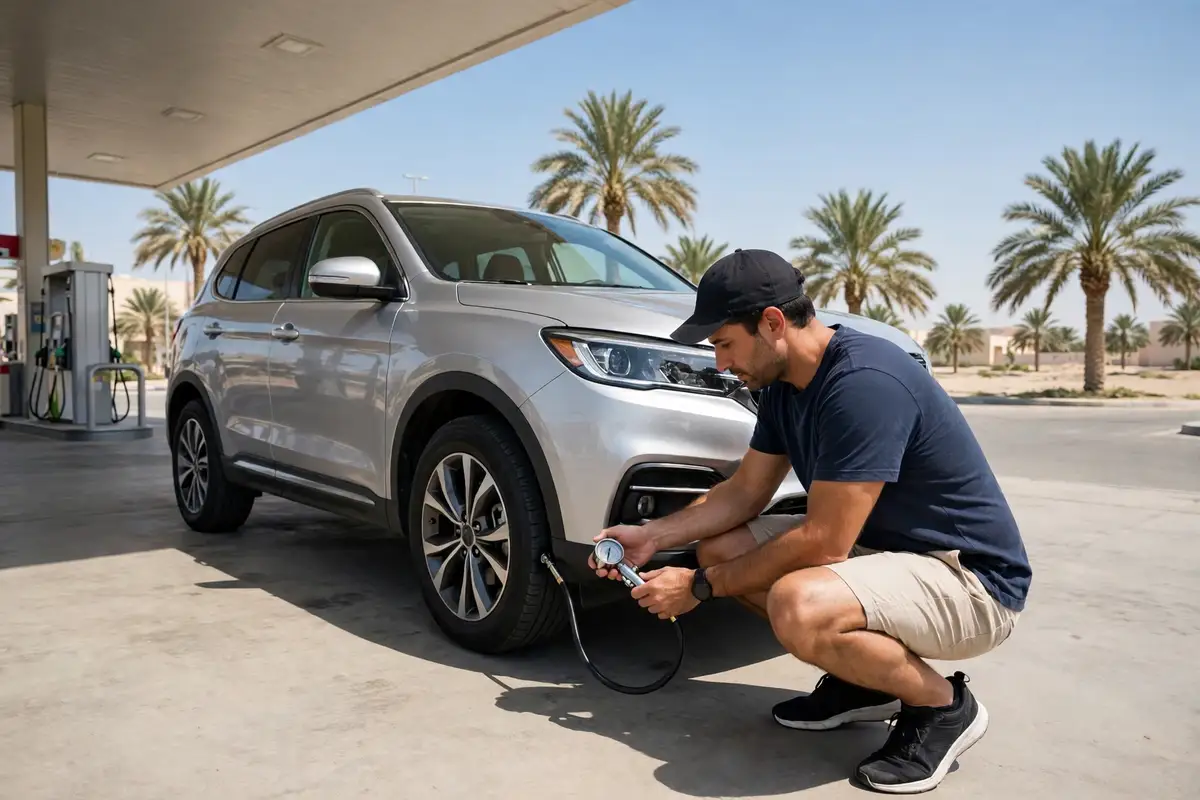
Step three is to press the gauge on the valve. Push it straight and firm. Read the number. Check the same tyre twice. A firm press gives the same number twice.
Step four is to compare with the sticker. Front tyres use the front number. Rear tyres use the rear number. A slow leak shows up as one tyre that always reads lower than the rest.
Step five is to add air or let a little out. Add air in short bursts. Check again after each burst. Let air out by pressing the small pin in the valve centre. Stop at the sticker number.
Step six is to replace the cap. A missing cap lets dust into the valve. Check the spare tyre too. A flat spare helps no one on Sheikh Zayed Road at night.
Tip: Keep a small gauge in the glove box. A gauge you own beats a gauge at a pump. Pump gauges take hard use all day. Your own gauge gives the same reading every time.
Where to top up for free in UAE
Many petrol stations in the UAE offer free air at the pump, so check car tyre pressure UAE drivers top up free at most stations. ADNOC, ENOC, and Emarat stations across Dubai and Abu Dhabi have air points near the fuel pumps. No payment is needed at most stations.
A busy station may have a queue at the air point. Go early in the morning or late at night for a free hose.
Tyre shops top up your tyres for free too. A shop that fits tyres will check all four tyres while you wait. Ask the shop to check the spare as well.
Car washes in the UAE often have air points. Ask the staff to check the pressure while they wash the car. Give them the sticker number.
Warning: Never trust a pump gauge alone when it reads far from your own gauge. Your own gauge is the check that counts. BoloSara24 advises every driver to carry a small gauge in the glove box.
Summer heat and your tyres
UAE summer is hard on tyres. Road surfaces pass 60 degrees on a July afternoon. A low tyre flexes more with each turn. Flexing builds heat from inside the rubber. The tyre can fail without warning at highway speed.
Check the tread as well as the pressure. The tread is the grip on the road. A worn tread slips in rain. Read our guide on how to drive safely in UAE rain before the winter storms.
Check the tyre age too. The sidewall shows a four digit code. The first two digits are the week. The last two are the year. Heat ages rubber fast in the UAE. Ask a tyre shop to check tyres older than 5 years.
A slow puncture is the most common cause of a low tyre. A nail in the tread leaks a little air each day. The tyre looks fine for a week. A tyre shop can plug a small hole in the tread. A hole in the sidewall can't be fixed.
Example: Omar drives a 2020 Toyota Corolla in Dubai. His warning light comes on in January. The morning reading shows 29 PSI on all four tyres. His sticker says 35 PSI. The cold snap dropped the pressure. Omar tops up all four tyres to 35 PSI. The light goes out. The same tyres read 38 PSI on a hot July afternoon. Omar leaves them alone.
Desert sand needs low pressure. Drivers drop the pressure to about 15 to 18 PSI for dune driving. The soft tyre spreads its weight over more sand. Reinflate to the sticker number before you touch tarmac. A tyre at 15 PSI on a highway overheats in minutes. Read our guide on how to drive in UAE desert safely before your first dune trip. Plan a road trip in UAE with a tyre check at the start. A car that breaks down in the desert needs fast help, so read what to do when your car breaks down in UAE.
The TPMS light and what it means
Most new cars in the UAE have a tyre pressure monitoring system. The short name is TPMS. A sensor in each wheel reads the pressure. The dashboard light comes on when a tyre drops about 25 percent below the target.
The light's a warning, not a gauge. It doesn't tell you which tyre is low. Check all four tyres with a gauge when the light comes on. Fill each one to the sticker number. Drive for a few minutes. The light should go out.
A light that stays on after a fill can mean a bad sensor. Sensor batteries last about 5 to 7 years. A tyre shop can test each sensor.
A cold morning can wake the light. A tyre set to 34 PSI on a hot August night can read 30 PSI on a cool January morning in Al Ain or Hatta. Top up to the sticker number.
Common mistakes drivers make
Mistake one is to fill to the number on the tyre wall. The wall number is a maximum, not a target.
Mistake two is to check hot tyres and let air out. The tyre cools down low. Check cold. Leave hot tyres alone.
Mistake three is to trust the warning light alone. The light wakes up late. Check on a fixed day each month.
Mistake four is to forget the spare. A spare at 20 PSI can't carry the car. Check the spare every month. A space saver spare often needs about 60 PSI. Drive no faster than 80 km/h on it.
Mistake five is to mix units. Read the same unit on the sticker and the gauge. One bar equals 14.5 PSI.
Checklist: Find the sticker number. Check cold in the morning. Use your own gauge. Fill to the sticker, not the tyre wall. Check the spare. Check every 2 weeks. Recheck when the weather turns.
The bottom line
Check car tyre pressure UAE drivers need by starting with the door sticker. Check cold in the morning. Never let air out of a hot tyre. Top up at a petrol station air point or a tyre shop. Check every 2 weeks and before a long drive. BoloSara24 wrote this guide from official sources so your tyres stay safe through the UAE summer.
Frequently Asked Questions
What is the correct tyre pressure for my car in UAE?
The sticker on your driver door pillar lists the correct pressure. A typical saloon sits near 32 to 36 PSI cold. Your sticker is the final word.
Should I lower tyre pressure in UAE summer heat?
No. Use the same cold pressure all year. Heat lifts the reading by a few PSI. That lift is normal. The tyre is built for it. Lowering the pressure makes the tyre run hot and risks a blowout.
Where can I top up tyre air for free in UAE?
Many ADNOC, ENOC, and Emarat petrol stations offer free air at the pump. Tyre shops check and top up tyres for free too. Carry your own gauge.
How often should I check tyre pressure in UAE?
Check every 2 weeks and before any long drive. A tyre can lose a little air each month without a puncture.
Why does my TPMS light come on in the morning?
Cold air shrinks. A tyre set right on a hot day reads low on a cool morning. Top up all four tyres to the sticker number. The light should go out.
What pressure should I use for desert driving in UAE?
Drop to about 15 to 18 PSI for soft sand. Reinflate to the sticker number before you touch tarmac.
Official Sources
– RTA Dubai. Check vehicle testing, registration, and road safety rules on the official RTA site. – Dubai Police. Check traffic rules and road safety guidance for Dubai drivers. – Abu Dhabi Police. Check traffic rules and road safety guidance for Abu Dhabi drivers. – ADNOC Distribution. Find ADNOC service stations with air points across the UAE. – Emarat. Find Emarat service stations with air points across the UAE. – Ministry of Interior UAE. Check federal traffic rules and the 999 emergency service.
Disclaimer
BoloSara24 is an independent guide. It has no link with the RTA, Dubai Police, Abu Dhabi Police, ADNOC, Emarat, or any tyre maker or tyre shop. Pressures and rules change. Check your door sticker and the official page before you drive. This guide gives general facts only. It isn't legal or mechanical advice. Ask a trained mechanic for work on your car.
Last Updated: 29 November 2026.