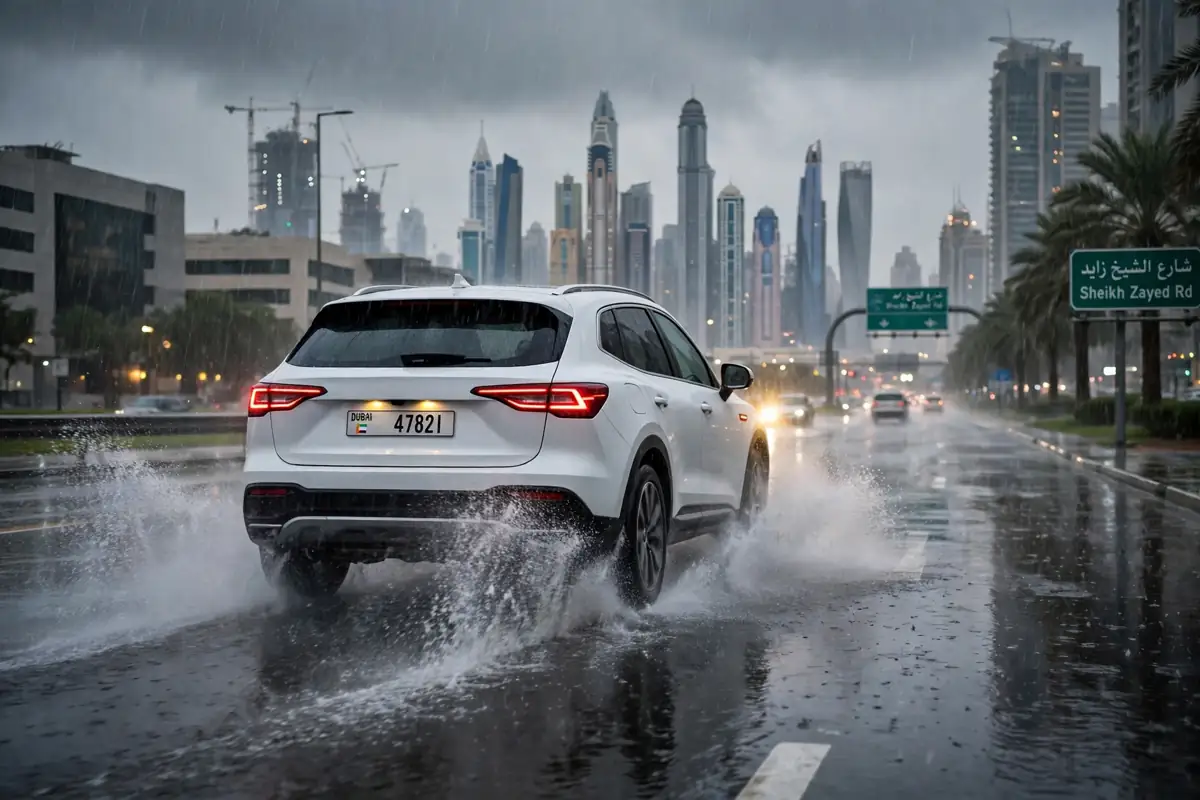
Rain in the UAE feels rare, so it catches drivers off guard. Roads stay dry for months. Dust and oil build up. The first rain lifts that film and turns the road into a slick sheet. To drive safely in UAE rain, slow down early. Switch on dipped headlights. Double your gap. Stay out of standing water. BoloSara24 checked the RTA safety tips page on 29 November 2026. The RTA Light Motor Vehicle Handbook gives the same rules. The facts in this guide come from those official pages and from Abu Dhabi Police rain notices.
Quick Answer: To drive safely in UAE rain, slow down below the posted limit. Use dipped headlights. Leave at least 4 seconds to the car in front. Keep below 80 km/h in standing water. Never drive with hazard lights on while you move. If rain is too heavy to see, pull off the road in a safe place and wait.
Why UAE rain is more risky than it looks
Most UAE rain falls between November and March. It often comes in short, hard bursts. A road can flood in minutes. Underpasses fill fast. In April 2024 the National Centre of Meteorology recorded 254.8 mm of rain in under 24 hours at Khatm Al Shakla in Al Ain. That was the heaviest rain since UAE records began in 1949. Drainage can be overwhelmed in a storm like that. A normal car cannot push through deep water.
The first rain is the most slippery. The RTA handbook says so in plain words. Oil and dirt sit on dry roads for weeks. Rain lifts them to the surface. Your tyres grip less. Your brakes work less well. A turn that feels safe on a dry day can send the car into a skid on a wet day. Slow down most in the first minutes of rain. That is when the road is at its worst.
Heat makes tyres age fast in the UAE. Summer sun cracks rubber and wears tread down. A worn tyre cannot clear water from under it. Check tread before the rain season. New tyres have 7 to 8 mm of tread. The RTA and tyre experts say replace tyres at 3 mm for good wet grip. The legal minimum in the UAE is 1.6 mm. A tyre below that fails the RTA test. Do not wait for the test to tell you. Check with a coin or a gauge at home.
How to drive safely in UAE rain on wet roads
Slow down early. Do not wait till you feel the car slide. Ease off the pedal when the first drops hit the screen. Follow any lower limit on electronic signs. Abu Dhabi switches on variable speed limits in bad weather. The lower limit on the sign is the one that applies. Cameras enforce it. A speed limit in the UAE is a maximum for good weather, not a target for a storm.
Use dipped headlights. The handbook makes lights a rule when visibility is poor in the day. Dipped beam is enough. It is about being seen by other drivers. Do not use high beam in rain. It reflects off wet roads and spray. It blinds the driver in front. Turn your lights on by hand. Do not trust the auto setting in a grey storm.
Double your gap. The handbook says stay at least 4 seconds behind the car in front in the wet. That is twice the 2 seconds for a dry road. Wet roads can more than double your stopping distance. Count it out loud. Pick a sign post. When the car in front passes it, count one thousand one to one thousand four. If you pass the post too soon, back off. A big gap gives you room to brake soft and slow.
Tip: Turn off cruise control on wet roads. Cruise holds a set speed and it can react late on a slick patch. Your foot on the pedal feels the road better. Keep both hands on the wheel. Small, smooth moves keep the car straight. Sudden moves break the grip.
What is aquaplaning and how to stop it
Aquaplaning happens when water builds up in front of a tyre faster than the tread can clear it away. The tyre lifts onto a thin layer of water. It loses touch with the road. Steering goes light and stops working. Brakes stop working too. Speed, worn tyres, low tyre pressure and deep water all raise the risk. To drive safely in UAE rain you must know this risk before it hits you.
Keep below 80 km/h in heavy rain. Above that speed the risk of aquaplaning rises fast. That is the handbook rule. Drive in the tracks of the car in front if you can, but stay at least 4 seconds behind it. Keep to the middle lanes where you can. Water gathers in the outer lanes first. It also gathers near underpasses and low dips in the road.
If the car aquaplanes, do not panic and do not brake hard. Hard braking can lock the wheels and spin the car. Ease off the pedal. Hold the wheel straight. Let the car slow down on its own. When you feel the grip come back, brake or speed up with a soft touch. Then slow down more and stay out of the standing water. A calm hand saves the car. A sharp move loses it.
Check tyre pressure in the cool morning. Use the pressure on the door sticker, not the number on the tyre wall. The wall number is a maximum, not a target.
Flooded roads and underpasses
Never drive into a flooded underpass. You cannot see how deep the water is. You cannot see holes or debris under the surface. A car can stall in water that looks shallow. Water can reach the engine and the exhaust. A stalled car in a flooded underpass is a trap. Turn round and find another way. The RTA says stay away from flooded areas where rain water collects. That is the safest rule in this guide.
Moving water is worse than still water. The RTA warns that cars can be swept away in less than 12 inches of moving water. That is about 30 cm. Never drive through moving water, even if it looks shallow. It can push a car off the road in seconds. A wadi is the worst case. Rain in the hills can send a wall of water down a dry wadi with no warning. Entering a wadi while water flows costs AED 2,000, 23 black points and a 60 day impound. Stay out. No short cut is worth that risk.
If you must cross a small patch of still water, go slow and steady in a low gear. Do not stop in the middle. In a normal car, do not drive through water above half the height of your tyres. After deep water, test your brakes at low speed. Wet brakes may not work right at first. Press the pedal soft a few times till the bite feels normal again.
Note: Do not stop under a bridge or in a tunnel in heavy rain. Other drivers cannot see a stopped car in a dark tunnel. A tunnel can also flood from the low end. Pull off the road in an open, safe place instead. A petrol station forecourt is a good wait spot. It is lit, it is off the road, and you can buy a drink while the storm passes.
Fines to know when you drive safely in UAE rain
Rain does not cancel traffic fines. It adds new risks. Hazard lights while you move cost AED 500 and 4 black points. The RTA says use hazard lights only in a real emergency. A driver who uses them just for rain cannot warn other drivers when a real emergency comes. Keep them off till you stop.
Using a phone while you drive costs AED 800 and 4 black points. Do not film the rain while you drive. A video of a flooded road is not worth a fine or a crash. Pull over first if you must film. Tailgating in the wet costs AED 400, 4 black points and a 30 day impound in serious cases. A black points guide on BoloSara24 lists the full fine table for UAE drivers. Check it before the rain season starts.
Speeding in the wet is the most common rain fine. Cameras do not care that the road is wet. The limit on the sign is the limit. If the sign drops to 80 km/h in a storm, drive at 80 km/h or less. A fine check for Abu Dhabi takes a few minutes online. Pay a fine early and you may get a discount in some emirates. Check the rules for your emirate.
Before the rain: a 10 minute car check
Do this check in November, before the rain season starts. Test your wipers. If they streak or squeal, change them. Fill the washer bottle. Check all lights. Check tyre tread and pressure. Check the brakes. A soft pedal or a pull to one side needs a garage visit now. Check the battery too. A weak battery can fail on a cold wet morning.
Keep a small rain kit in the boot. A torch, a reflective vest, a phone charger and a towel. If you get a flat in heavy rain, do not change a wheel on a busy hard shoulder. Get as far from traffic as you can. Switch hazards on once you stop. Stay safely away from the car and call for help. Your car insurance in the UAE may cover roadside help. Check your policy now. Know the help number before you need it.
Common Mistakes: Drivers make the same mistakes in rain each year. They keep the normal speed. They use hazard lights while they move. They brake hard on a wet road. They drive into a flooded underpass. They film the storm with a phone. Fix those five and you fix most rain risk. Tell a new driver in your family. A driver who learned in a dry country may not know UAE rain rules yet.
The bottom line
To drive safely in UAE rain, slow down in the first rain. Use dipped lights. Leave 4 seconds of gap. Stay below 80 km/h in standing water. Stay out of floods and wadis. Rain season runs from November to March. The first rain is the most slippery. If you cannot see the road, pull off and wait. That wait costs you 20 minutes. A crash costs far more. BoloSara24 will update this guide when RTA or police rules change. BoloSara24 checks official pages each rain season.
Do and Dont: Do slow down early and use dipped headlights in rain. Do leave a 4 second gap and stay in the middle lanes. Do check tyres and wipers before November. Do not use hazard lights while you move. Do not brake hard if the car aquaplanes. Do not drive into flooded underpasses or wadis.
Frequently Asked Questions
What speed should I drive in heavy rain in the UAE?
Stay below 80 km/h in standing water. Above that speed the risk of aquaplaning rises fast. Follow any lower limit on electronic signs. In very heavy rain, slow down more or pull off the road.
Can I use hazard lights while driving in UAE rain?
No. Use hazard lights only when you stop or in a real emergency. Driving with hazards on in rain can bring a fine of AED 500 and 4 black points. Hazards hide your indicators.
What should I do if my car aquaplanes?
Ease off the pedal. Do not brake hard. Hold the wheel straight. Let the car slow down till the tyres grip again. Then brake or speed up with a soft touch and slow down more.
Can I drive through a flooded underpass in the UAE?
No. You cannot see the depth, holes or debris under the water. A car can stall and get trapped. Turn round and find another way. Never drive through moving water.
When is rain season in the UAE?
Most rain falls between November and March. It often comes in short, hard bursts. Roads can flood in minutes. Check the NCM forecast before a long drive in those months.
Does car insurance cover flood damage in the UAE?
Some policies cover flood damage and some do not. Read your policy before the rain season. Take photos of any damage and call your insurer fast if your car is hit by flood water.
Official Sources
RTA Safety Tips: RTA tips for driving in rain, with headlight, distance and flood rules.
National Centre of Meteorology: Official rain and weather alerts for the UAE.
UAE Traffic Fines Schedule: Official fine schedule from the UAE Government portal.
Disclaimer: This guide gives general road safety facts for the UAE. It is not legal advice. Police notices and road signs on the day you drive are the final word. Check the NCM forecast before a long drive in rain.
Last Updated: 29 November 2026.