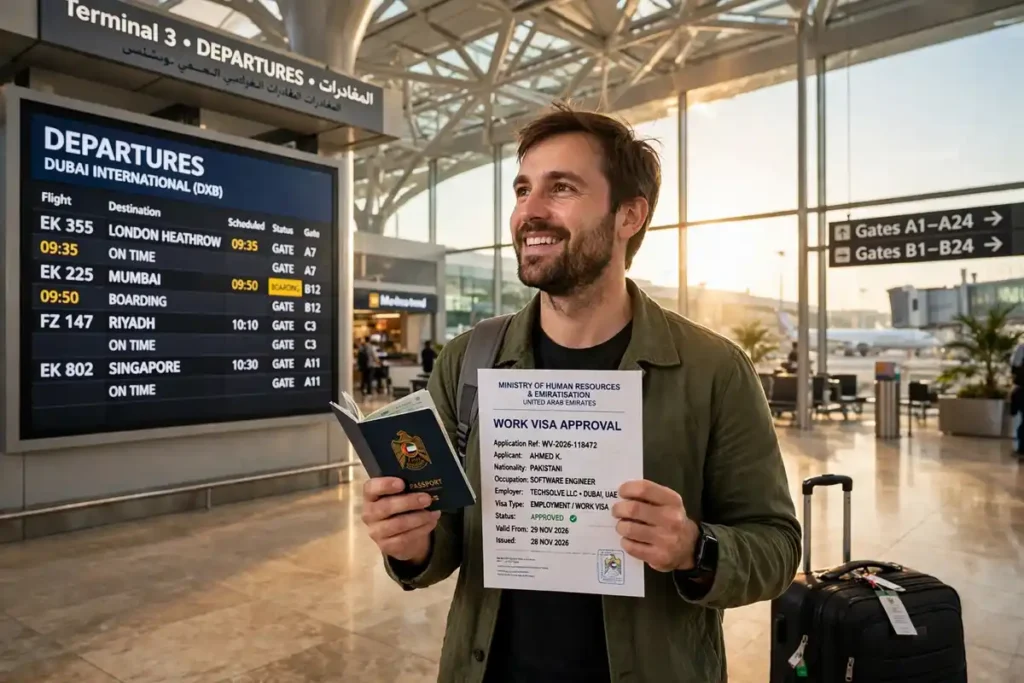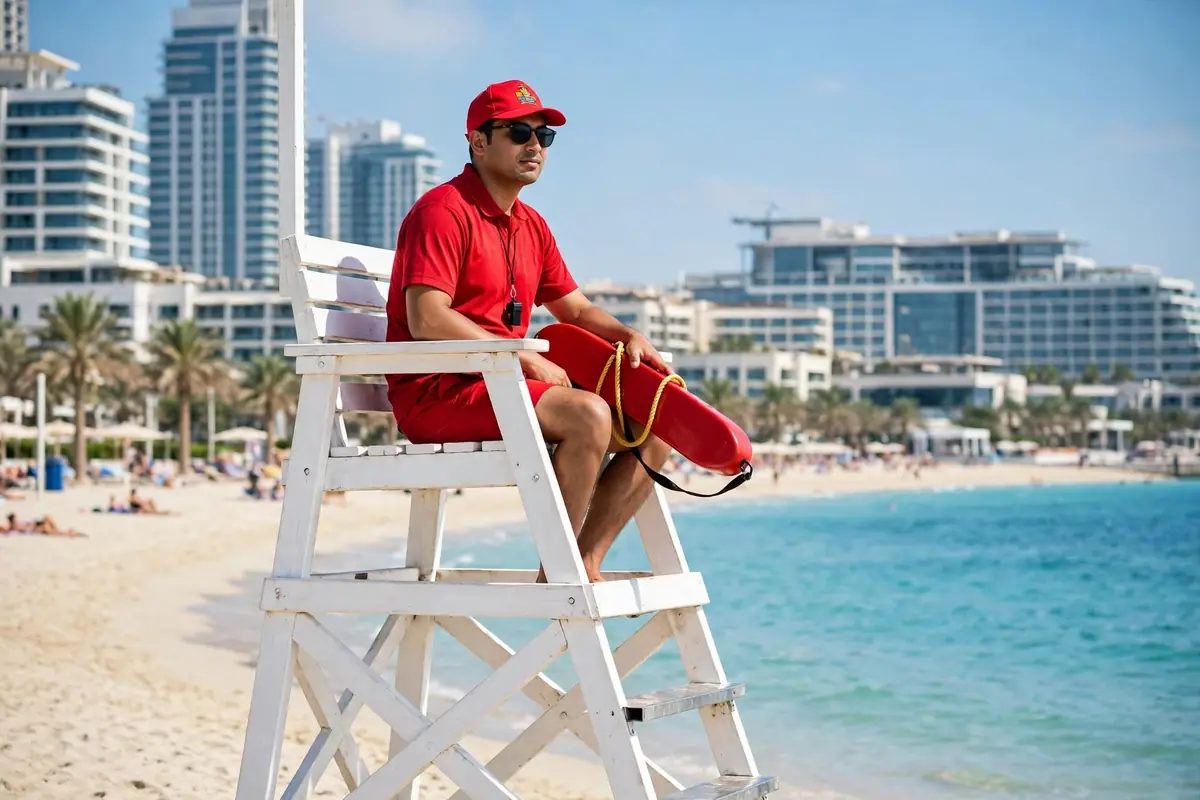
A lifeguard guards pools and beaches for hotels, beach clubs and water parks. A lifeguard from abroad needs two things to work in the UAE. A lifeguard certificate comes first. A work visa comes next.
Quick Answer: A UAE work visa for lifeguards needs a job offer from a hotel, beach club or water park. The sponsor files a MOHRE work permit. You also need an EIAC approved lifeguard certificate and a first aid certificate. You take a medical test after you land. You get your Emirates ID. Your residence visa then runs for two years in most cases.
The BoloSara24 team checked the u.ae work permits page on 29 November 2026. It lists 13 work permit types. It puts the work permit fee between AED 250 and AED 3,450. The fee follows the firm’s MOHRE category. The page was last updated on 19 October 2026.
The lifeguard certificate comes first
Dubai Municipality rules say every public pool must have a lifeguard on duty. The lifeguard must hold a certificate approved by the Emirates International Accreditation Centre. EIAC is the Dubai government body that accredits the certification bodies. Its FAQ page lists lifeguard certification for shallow water, pool and beach as one of its schemes. Dubai Municipality health rules say the same thing in plain words. A pool with no certified lifeguard must stay shut.
Three levels exist. Shallow water lifeguard covers water under 1.5 metres deep. Pool lifeguard covers pools deeper than 1.5 metres. Beach lifeguard covers open water. You can’t work a beach post with a pool certificate alone. Your job decides your level. A hotel pool needs a pool lifeguard. A beach club needs a beach lifeguard. A kids splash pad needs a shallow water lifeguard.
The swim test is strict. A pool lifeguard must swim 100 metres without a stop while a beach lifeguard must swim 200 metres. A shallow water lifeguard must swim 50 metres without a stop. You must tread water for 5 minutes as a pool lifeguard. A beach lifeguard must tread water for 10 minutes. You must dive down and bring up a 4 kg weight. The depth is 3 metres for a pool lifeguard. It is 5 metres for a beach lifeguard.
You also need first aid skills. A first aid certificate from a DCAS approved provider is part of the file. DCAS is the Dubai Corporation for Ambulance Services. The first aid certificate runs for 2 years. Your lifeguard certificate runs for 2 years too. Both need renewal before they lapse.
Can you train after you arrive? Yes, in many cases. Your sponsor can book you on a course with an approved training centre. The course runs for about 5 days. It ends with an EIAC exam. You must pass the swim test on day one to stay on the course. Train hard before you fly. A failed swim test wastes the course fee and the trip.
Note: The certificate age rule is 16 years. You can sit the assessment at 16. The work visa age rule is different. MOHRE sets it at 18 years. A 16 year old can hold a lifeguard certificate. That same person can’t hold a standard work visa yet. The two ages must not be mixed up.
Your papers for the UAE work visa for lifeguards
Your paper pack has two parts with work papers first and certificate papers next. Send both parts together if you can.
- Passport copy with six months left at least
- Recent photo with a white background
- Signed MOHRE offer form
- Lifeguard certificate copy, EIAC approved
- First aid certificate copy, DCAS approved
- Past work letter from a pool or beach where you worked
- The sponsor’s trade licence copy
Do you hold a lifeguard certificate from your home country? It helps your hire but it does not replace the EIAC certificate. Dubai rules want the EIAC approved certificate. Show your home certificate to the sponsor. The sponsor will tell you if a conversion course is needed. Some sponsors pay for the local course. Ask before you sign.
Your name must match on each paper. One spelling on the passport and a second spelling on a certificate causes a delay. Check the spelling twice. Fix it at home before you send the pack.
Sponsor steps in order
Your sponsor is your employer. The sponsor files every step. You supply papers. The sponsor sends them to the right office. You don’t file the work permit yourself.
Step one is the offer and the firm sends the MOHRE offer form. You read it and you sign it. The firm signs it too. The offer is in Arabic and English. You can ask for a third language as well. Urdu is one of the nine tongues MOHRE allows.
Step two is the work permit. The sponsor applies to MOHRE for mainland jobs. A free zone firm applies to its free zone office. MOHRE has 13 permit types. A lifeguard hired from abroad gets the overseas recruitment permit. It runs for two years. The sponsor must hold a valid trade licence. The job must match the licence activity. A hotel hires lifeguards for its pool. A beach club hires them for its beach.
Step three is the entry permit. ICP issues it for Abu Dhabi and the northern emirates. GDRFA issues it for Dubai. The permit reaches you by email. It is valid for 60 days for entry. You fly to the UAE on it.
Step four is the contract. You sign the MOHRE labour contract after you land. MOHRE registers it. Keep a copy on your phone and a paper copy at your room.
Step five is the medical test and Emirates ID. You take the test at an approved health centre. You give fingerprints and a photo for your Emirates ID. Your residence visa is then issued. Your Emirates ID is your proof of residence. The full UAE work visa requirements list the same five stages in one place.
Tip: The Work Bundle joins the work permit, residence visa, medical test and Emirates ID in one flow. The u.ae page says it cut 15 steps to 5 steps. It cut 16 documents to 5 documents. It cut the time from 30 working days to 5 working days. Your sponsor runs it on workinuae.ae. You hold a job offer already. Read how to get a UAE work visa after a job offer.
After arrival: medical test and Emirates ID
The medical fitness test comes after you land. It screens for communicable diseases. The list holds tuberculosis and HIV. You visit a government approved centre in the emirate that issues your visa. Carry your passport and your entry permit. The centre sends the result to immigration. You don’t carry a paper result yourself. The UAE visa medical test requirements and centres guide lists what to carry and what the test covers.
Your Emirates ID biometrics come next at an ICP centre. Staff take your fingerprints and your photo before your Emirates ID card follows. The card runs with your residence visa. Carry it with you at all times. You need it for your bank account and your phone SIM. The Emirates ID for workers guide lists the papers to carry to the centre.
Health cover is part of the file now. Private sector firms must give basic health insurance. The rule covers every emirate since 1 January 2025. Your firm pays for it. The cost can’t come out of your pay.
Your pay must run through the Wage Protection System. The firm pays your salary into your bank account each month. MOHRE can see that the pay arrived. Open your account once your Emirates ID is ready.
Where lifeguards work in the UAE
Hotels hire the most lifeguards. A UAE work visa for lifeguards covers hotel pools, beach clubs and water parks. A big hotel in Dubai can run three pools and a beach. It needs a team on each shift. Beach clubs hire next. They guard the sea front and the pool deck. Water parks hire large teams too. They guard slides and wave pools. Community pools in housing areas hire lifeguards as well. Each site needs a certified lifeguard on duty while the water is open.
Omar is a lifeguard from Karachi. He joined a beach club on Palm Jumeirah in 2026 with a pool lifeguard certificate from home. His sponsor booked him on a beach lifeguard course in Dubai. He passed the 200 metre swim on the first day. He passed the EIAC exam at the end of the week. He now guards the beach front. His story shows the normal path. Home certificate first, local course next, EIAC exam last.
Article 6 of Federal Decree Law No. 33 of 2021 bars the employer from charging you recruitment costs. The employer pays them. The rule covers visa fees and travel costs too. A firm that asks you to pay for your visa breaks the law. A real offer comes on the MOHRE form. It carries a reference number. You can check that number on the MOHRE site. You can also check your work permit status once the firm files it.
A visit visa never lets you work. The u.ae page states this in clear words. You need a work permit before you guard any pool for pay. A firm that asks you to start on a visit visa breaks the law. Walk away from that offer.
BoloSara24 readers ask about the swim test most. Train for it before you fly. A UAE work visa for lifeguards is worth little if you fail the swim test on day one. BoloSara24 checks MOHRE, EIAC and Dubai Municipality for rule changes.
Frequently Asked Questions
Can a lifeguard work in the UAE with a home country certificate only?
No. Dubai rules want an EIAC approved lifeguard certificate. Your home certificate helps you get hired. It does not replace the local certificate. Your sponsor can book the local course. A UAE work visa for lifeguards still needs the local certificate.
How long does a UAE work visa for lifeguards take?
The Work Bundle aims for 5 working days for the first steps. A full file often takes two to four weeks. The lifeguard course adds about a week if you train after arrival.
What does the UAE work visa for lifeguards cost the worker?
The worker pays nothing for recruitment and visa costs. The employer pays them under Article 6 of the labour law. The work permit fee runs from AED 250 to AED 3,450 by firm category.
What swim test must a pool lifeguard pass in Dubai?
A pool lifeguard must swim 100 metres without a stop. You must tread water for 5 minutes. You must dive down and bring up a 4 kg weight from 3 metres deep. A beach lifeguard must swim 200 metres and tread water for 10 minutes.
How long is a Dubai lifeguard certificate valid?
The lifeguard certificate is valid for 2 years under Dubai Municipality rules. The first aid certificate runs for 2 years too. Renew both before they lapse.
Can a lifeguard move to a new hotel in the UAE?
Yes. The new hotel applies for a transfer work permit. MOHRE lists the transfer permit as one of its 13 types. It runs for two years. The old firm must cancel the old permit first. A UAE work visa for lifeguards moves with you when the new firm files the transfer permit. Read the transfer UAE work visa to new employer guide for the steps.
Official Sources
- u.ae work permits page: 13 permit types, age rule, fee range AED 250 to AED 3,450, and the Work Bundle steps.
- MOHRE: work permits, job offers, labour contracts, and workers rights in the UAE.
- Work Bundle on MOHRE: the bundled service for new hires, renewals, and cancellations.
- Work in UAE platform: the single platform where sponsors run the Work Bundle.
- ICP: entry permits, residence visas, and Emirates ID for emirates outside Dubai.
- GDRFA Dubai: entry permits and residence visas issued in Dubai.
- EIAC: the Dubai government body that accredits lifeguard certification bodies, with lifeguard schemes for shallow water, pool and beach.
- Dubai Municipality pool safety guidelines: public pool safety rules and lifeguard duties in Dubai.
Disclaimer
BoloSara24 is an independent site. It has no link with the UAE government or MOHRE. It has no link with ICP, GDRFA, EIAC or Dubai Municipality. It names no employer as a partner. Facts were checked on official sources on 29 November 2026. Rules and fees change. Confirm the latest rule with the official authority before you act. This page is general information. It is not legal advice or immigration advice.
Last Updated: 29 November 2026.