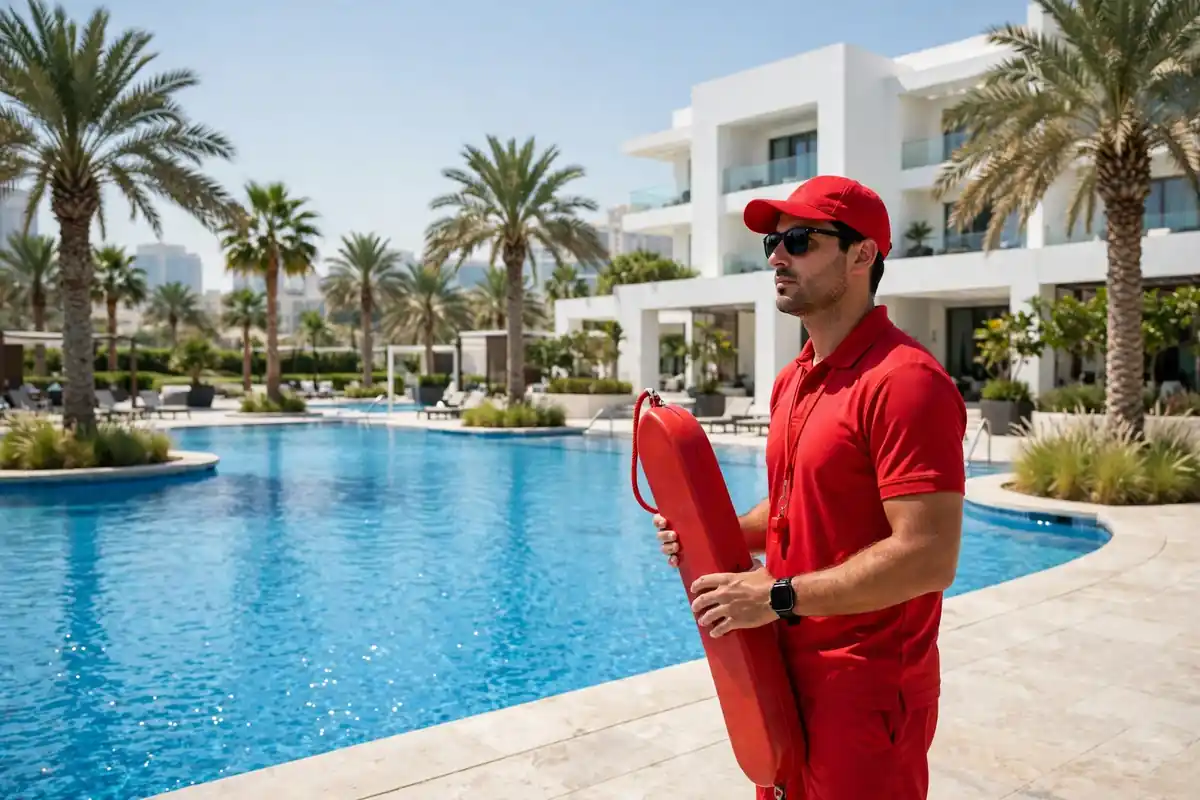
You love the water. You swim well. You want to work as a lifeguard in the UAE. A hotel pool or a public beach could be your workplace. You need one thing first: a lifeguard licence UAE. The licence proves you can swim, rescue and give first aid. Dubai Municipality sets the rules for Dubai. The Emirates International Accreditation Centre (EIAC) backs the certificate. Here are the three levels, the swim tests, the course and the renewal.
In Short: A lifeguard licence UAE comes from an EIAC-accredited certification body under the Dubai Municipality scheme. You must be 16 or over. You train with an approved centre. You pass a swim test, a rescue test and a first aid test. The licence lasts 2 years. Pick your level first: shallow water, pool or beach. Each level has its own swim distance and dive depth.
Lifeguard licence UAE: pick your level
Three levels exist under the Dubai scheme. Each one fits a different water depth. Pick the level that fits the job you want. A wrong level wastes your time and your money.
Shallow water lifeguard fits water under 1.5 metres deep. Think of a splash pad, a lazy river or a kiddie pool. Pool lifeguard fits pools deeper than 1.5 metres. Think of a hotel pool or a community pool. Beach lifeguard fits open water and public beaches. It is the top level. It needs the longest swim and the deepest dive.
You cannot jump straight to beach level. The EIAC-accredited procedure says a beach candidate must hold a pool lifeguard certificate first. The pool certificate can come from the same body or from any other EIAC-accredited body. Pool first, then beach.
BoloSara24 checked the Dubai Municipality hotel guide on 29 November 2026. It says a hotel must provide a lifeguard with an EIAC certificate and a first aid certificate. The fitness centre guide asks for a lifeguard approved by an EIAC-approved company. Law No. 2 of 2026 on Public Safety in Dubai adds the legal base. Article 11 says a shared pool must appoint a qualified lifeguard. Beaches must have qualified lifeguards and rescue gear too.
The swim tests you must pass
Every level starts with a swim test. You must pass it before the course starts. No centre can waive it. The test checks swim distance, surface dive, treading water and rescue skills. The table shows each level.
| Level | Swim without stopping | Surface dive and lift a 4 kg weight | Tread water |
|---|---|---|---|
| Shallow water lifeguard | 50 metres | 1.5 metres deep | Ask your centre |
| Pool lifeguard | 100 metres | 3 metres deep, or the deepest point | 5 minutes |
| Beach lifeguard | 200 metres | 5 metres deep | 10 minutes |
Can you swim 100 metres with no stop? Test yourself in a pool before you pay. Swim front crawl or breaststroke at a steady pace. Rest if you must, then try again next week. The dive test asks you to swim down and lift a 4 kg weight from the bottom. The tread test asks you to stay up with no support. Train for all three before you book.
The test also covers CPR with a partner and the use of masks and fins. You must show you can search in the water and lift a person out. You must show you can work as a team of two on CPR. BoloSara24 checked the published EIAC-accredited procedure on 29 November 2026. It lists the age and swim rules by level. It covers the dive, tread and first aid rules too.
How to get a lifeguard licence UAE
First, pick an approved training centre. Check that it holds EIAC accreditation for lifeguard certification. Ask to see its accreditation scope. The scope must name the Dubai Municipality Public Health and Safety Department scheme. A centre with no EIAC link cannot give you a valid Dubai licence. In Abu Dhabi, the approving body is the Abu Dhabi Quality and Conformity Council, known as ADQCC.
Second, book the course for your level. Most full courses run about 5 days: 4 days of training and 1 day for the test. Ask your centre for its exact plan. Third, finish the first aid course. Your first aid certificate must come from a provider approved by the Dubai Corporation for Ambulance Services (DCAS). It must stay valid for 2 years. Fourth, sit the test. Fifth, get your certificate.
How to Apply: You can join a course on your own or through a firm that hires you. Bring your papers to the first day. Bring your first aid certificate or book it with the centre. Bring water, a towel and a spare swim kit. Eat well the night before. A tired body fails a swim test.
Omar is 19. He lives in Dubai and wants a beach guard job at JBR. He swims well but he holds no certificate. He booked a pool lifeguard course first. He passed the 100 metre swim and the 5 minute tread. He passed his first aid test too. His pool certificate came next. He will book the beach conversion after six months of pool work.
Papers you need
Required Documents: Take these papers to the centre for your lifeguard licence UAE. Your passport, Emirates ID, labour card or visa. A photo. Proof of training from your training provider. A first aid or basic life support certificate from a DCAS-approved provider. Your age must be 16 years on the day of the test. You need no school certificate. You need basic English to follow the course.
Check your first aid certificate before you book. The certification body accepts only a first aid certificate from a DCAS-approved provider. Only EIAC-approved certificates count. Ask your first aid provider for its DCAS approval number if you are not sure.
BoloSara24 checked the FSG criteria document on 29 November 2026. It lists the same papers: ID, photo, proof of training and first aid.
Lina is 22. She works at a hotel in Abu Dhabi. Her hotel pool needs a licensed guard on every shift. She trained with an ADQCC-approved centre in the capital. Her papers were her Emirates ID, a photo and her first aid certificate. She passed the pool test in one week. Her hotel now rosters her on the pool deck.
What the course teaches
The course mixes pool work and class work. You learn to spot a person in trouble. You learn poolside rescues with tubes, rings and poles. You learn spinal care and how to lift a person out with no extra harm. You learn CPR, first aid and AED use. You learn the rules of the pool you will guard.
The Dubai pool safety guide asks for more than a certificate. Guards must hold a valid pool lifeguard certificate through EIAC or an EIAC-accredited company. They must know basic life support, first aid and AED use. The guide also asks pools to keep rescue gear close. A rescue tube for each guard on duty. A life ring or throw bag and a reaching pole on each side of the pool.
Requirements: You must be 16 or over to hold a lifeguard licence UAE. You must pass the swim test for your level. You must hold a valid first aid certificate from a DCAS-approved provider. You must pass the written test and the water test. You must sign the code of ethics from the Public Health and Safety Department. The code bars any substance that harms your work. It also bars extra duties while you guard swimmers.
How long it lasts and how to renew
Validity: Your lifeguard licence UAE lasts 2 years. The first aid certificate lasts 2 years too. Mark both dates on your first day. A lapsed certificate means you cannot guard. A pool that rosters a guard with a dead certificate breaks Dubai Municipality rules.
Renewal: Book your renewal before the expiry date. The scheme gives no extra days after expiry. Renewal means a fresh assessment of your swim and rescue skills. Keep your training record up to date. Keep your first aid certificate valid too. A gap in either one can block your renewal.
Stay sharp between renewals. Swim each week. Practise your rescues and repeat your first aid drills.
What it costs
Fees: Fees for a lifeguard licence UAE change by centre. No single official price exists for the course. Ask the centre for its full price before you book. The price should cover training, the test, first aid and the certificate. Ask what a retest costs if you fail one part. Ask if the price includes the EIAC certificate fee. Get the answer in writing.
BoloSara24 found no single official price for the course, so ask the centre for its full price in writing.
Never pay a centre that will not show its EIAC accreditation. Never pay for a licence with no course and no test. A licence with no test is fake. Report it to Dubai Municipality.
Common mistakes with lifeguard licences
Common Mistakes: Don’t book a beach course with no pool certificate. The scheme will not let you test. Don’t train with a centre that holds no EIAC accreditation. Your lifeguard licence UAE will not count. Don’t let your first aid certificate lapse. Don’t book the test with no swim practice. Don’t pay for a licence with no course. Don’t guard a pool with a dead certificate.
Do and Dont: Do check the centre’s EIAC scope before you pay. Do test your swim before you book. Do keep your first aid certificate valid. Do renew before the expiry date. Don’t share your certificate with another person. Don’t lend your name to a pool you never guard. Don’t skip the code of ethics. Sign it and keep a copy.
UAE work visa for lifeguards explains the visa side for guards from abroad. Swimming classes for kids in Ras Al Khaimah can help a young swimmer build skill early. Swimming classes for kids in Sharjah lists more options. Best beaches in Dubai shows where beach guards work. Best beach clubs in Dubai lists club pools that hire guards.
Frequently Asked Questions
How do I get a lifeguard licence in the UAE?
Pick an EIAC-accredited training centre. Pass the swim test for your level. Finish the course and the DCAS-approved first aid course. Pass the test. Your lifeguard licence UAE then lasts 2 years.
How old must I be to become a lifeguard in Dubai?
You must be 16 years old on the day of the test. The EIAC-accredited procedure lists 16 as the age for pool and beach levels. The procedure names no upper age limit.
How far must I swim for a pool lifeguard licence?
You must swim 100 metres without stopping. You must also tread water for 5 minutes. You must dive down and lift a 4 kg weight. The dive goes to 3 metres deep, or to the deepest point of the pool.
How long does a lifeguard licence last in the UAE?
A lifeguard licence UAE lasts 2 years. Your first aid certificate lasts 2 years too. Renew before the expiry date. The scheme gives no extra days after expiry.
Can I go straight for a beach lifeguard licence?
No. You must hold a pool lifeguard certificate first. The EIAC-accredited procedure says a beach candidate must finish the pool requirements first. The beach test then asks for a 200 metre swim, 10 minutes of treading water and a 5 metre dive.
Do I need a first aid certificate to be a lifeguard?
Yes. You need a first aid or basic life support certificate. It must come from a provider approved by the Dubai Corporation for Ambulance Services. The Dubai Municipality guide asks guards to know first aid, basic life support and AED use.
Official Sources
Emirates International Accreditation Centre (EIAC). The official EIAC site. EIAC accredits the bodies that certify lifeguards under the Dubai Municipality scheme.
Dubai Municipality Technical Guidance for Hotels and Resorts. The official Dubai Municipality guide. It asks hotels to provide a lifeguard with an EIAC certificate and a first aid certificate.
Dubai Municipality Technical Guidelines for Fitness Centres. The official Dubai Municipality guide. It asks for a lifeguard approved by an EIAC-approved company.
Law No. 2 of 2026 Concerning Public Safety in Dubai. The official Dubai law text. Article 11 says shared pools must appoint a qualified lifeguard and beaches must have qualified lifeguards.
EIAC-accredited certification procedure for lifeguards (DRASSA). The published procedure of an EIAC-accredited certification body. It lists the age and swim rules by level. It covers the dive, tread and first aid rules too.
EIAC accreditation scope for lifeguard certification (Cobra Sports). The EIAC scope document. It lists pool, shallow water and beach lifeguard certification under the Dubai Municipality scheme.
Disclaimer
BoloSara24 gives general information only. We are an independent site. We are not a government body. We are not Dubai Municipality, EIAC or DCAS. We do not train lifeguards. We do not issue licences. Rules, levels and test standards can change. Check the live rule with the official authority before you book a course. This is not legal advice.
Last Updated: 29 November 2026.