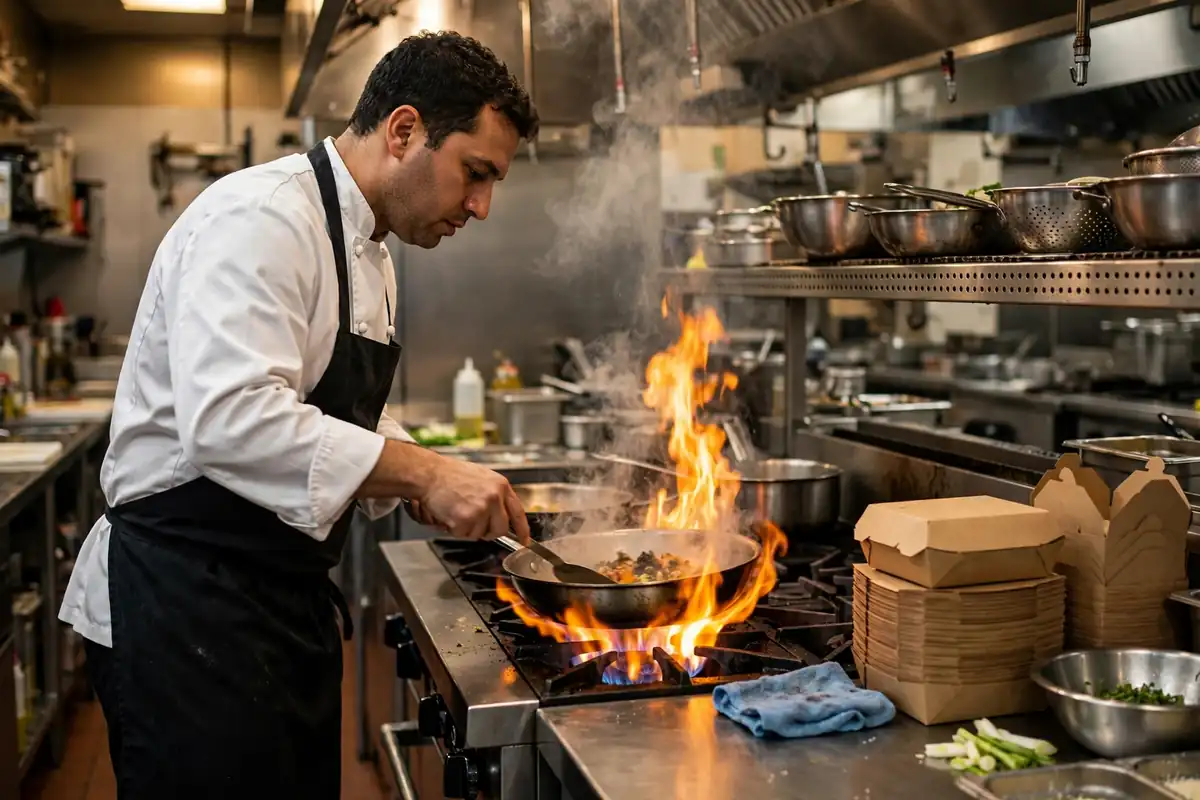
No tables. No waiters. Just a kitchen and a phone full of orders. That is a cloud kitchen. It costs far less than a restaurant. It’s a neat fit for the UAE love of food delivery. But a delivery-only kitchen still needs two licences, a food safety permit and a trained person in charge. This guide shows how to start a cloud kitchen business in UAE, step by step.
Quick Answer: A cloud kitchen needs a trade licence from DET or a free zone. It also needs a Food Establishment Permit from Dubai Municipality. HACCP food safety controls are mandatory and every kitchen needs a certified Person in Charge. Rent a shared kitchen or build your own. BoloSara24 checked the Dubai Municipality food rules on 29 November 2026.
What a cloud kitchen business in UAE is
A cloud kitchen is a commercial kitchen that cooks for delivery only, with no seats for guests. It has no seats for guests. Orders come from Talabat, Deliveroo, Noon Food or your own app. Riders collect the food at the door. Some kitchens run one brand. Some run five brands from the same stoves.
Dubai Municipality treats a cloud kitchen business in UAE exactly like any other food business. The same Food Code applies, the same inspections apply and the same Person in Charge rule applies. A kitchen with no dining room doesn’t get soft treatment on food safety. That’s the first fact to accept before you spend a dirham.
The model suits a cloud kitchen business in UAE for one clear reason. Delivery demand is huge. A kitchen in Al Quoz or Ras Al Khor can serve the whole city through an app. You pay for stoves and riders, not for a prime street front and a dining hall. Your rent goes to cooking space, not to tables.
Think of Omar, a chef in Dubai. He ran a small restaurant in Jumeirah for three years. Rent ate his profit every month. He closed the dining room, kept the kitchen and moved to delivery only. His rent fell by more than half. His orders grew because the delivery apps showed his food to the whole city. The kitchen did not change. The business around it did.
The four approvals you need
A cloud kitchen business in UAE sits on four papers. Each one opens the next. Get them in order and you open on time.
First comes the trade licence. The Department of Economy and Tourism issues it on the mainland. A free zone authority issues it inside a zone. The activity on the licence must name food preparation and delivery. The wrong activity words cause trouble at inspection time and can block your bank account. Check the activity wording before you pay for the licence.
Second comes the Food Establishment Permit from Dubai Municipality. The Food Safety Department issues it. Your kitchen layout needs approval first: ventilation, drainage, grease traps, storage and hand wash points. The municipality inspects the site before the permit is issued. Don’t build anything before the layout is approved. A wall in the wrong place can cost you a rebuild.
Third comes Civil Defence approval. Fire safety inspectors check the cooking hood, the suppression system, the exits and the gas lines. A kitchen without a fire approval cannot open. Plan this check into your fit-out time.
Fourth comes registration on the FoodWatch platform, now moving to DMChecked. Dubai Municipality runs this digital food safety platform. Registration is free and mandatory. You record your suppliers, your temperature logs and your inspection history there. Your Person in Charge runs it day to day.
Note: There is no single paper called a “cloud kitchen licence”. You build it from these four approvals. Any agent who sells you one magic licence is selling you a story.
Kitchen rules that decide your opening day
The Dubai Food Code sets the rules your kitchen must meet. Three of them decide if you open on time or wait for a second inspection.
The Person in Charge rule comes first. Every food business in Dubai must have a Person in Charge, known as the PIC. The PIC holds a certified food safety qualification. The PIC runs the food safety checks, the temperature logs and the staff hygiene. Without a PIC, you can’t open. BoloSara24 suggests you send your PIC for training early. Courses take days, not hours.
Occupational health cards come second. Every food handler in your kitchen needs one. The card proves a medical check and a basic food hygiene course. A handler without a card cannot work on the line. Plan the cards into your hiring time.
HACCP controls come third. HACCP is a system that finds food safety hazards and controls them. Your kitchen needs temperature logs for fridges and freezers, approved supplier records, traceability and a cleaning plan for every batch. Delivery-only kitchens draw close attention on temperature control during delivery. Hot food must stay hot. Cold food must stay cold. The rider bag is part of your food safety chain.
Pest control, waste handling and grease trap cleaning sit under the same code. A grease trap must be cleaned on schedule and the waste must go to an approved recycler. Inspectors check these records. Keep every receipt and every log in one folder, paper or digital.
Costs of a cloud kitchen business in UAE
The kitchen itself moves your startup cost more than any licence fee. Two paths exist. Pick the one that fits your cash.
Rent a shared kitchen first if your cash is tight. Shared kitchen operators in Al Quoz and Ras Al Khor rent equipped bays by the month. Market guides place shared kitchen rent from about AED 5,000 to AED 15,000 a month, based on size and location. The operator holds the master food permit for the site. You still need your own trade licence and your own PIC. Renting lets you test a brand for six months without building a kitchen.
Build your own kitchen only with cash and a proven brand. You pay for the fit-out, the equipment, the layout approval and the inspections. Government fees for a mainland setup run from about AED 17,000 to AED 45,000 in market guides. Kitchen rent and equipment sit on top of that figure. A Meydan Free Zone route lists from about AED 12,500 a year. These are market ranges, not official quotes. Ask DET for an exact licence quote and Dubai Municipality for the exact permit fee before you sign any lease.
Watch the hidden costs. Delivery app commission takes a cut of every order. Riders cost money when your own fleet runs. Packaging costs money on every single order. A menu that earns AED 30 per order pays AED 9 in commission and AED 5 in packaging. Delivery adds AED 8 more. That leaves AED 8 before rent and wages. Run that maths on every dish before you launch it.
Run it day to day
Opening day is the easy part for a cloud kitchen business in UAE. The daily grind decides if the kitchen lives.
List on the big apps first. Talabat and Deliveroo bring the orders. They also take commission. Your own app or WhatsApp orders cost less per order but need your own marketing. Most kitchens run both: the apps for volume and their own channel for margin.
Keep your menu short. A cloud kitchen with 40 dishes cooks slowly and wastes food. A kitchen with 12 dishes cooks fast, buys less stock and wastes less. Each dish should share ingredients with two others. Fewer ingredients mean less waste and faster prep.
Watch your ratings every morning. A rating below 4 on a delivery app cuts your orders. BoloSara24 readers ask about app commission most, so run the maths on every dish. Read every bad review. A cold dish means a packing problem and a late dish means a prep problem. Fix the cause, not the review.
Keep the FoodWatch records live and log temperatures twice a day. Record every supplier delivery and keep the cleaning schedule signed. An inspector can visit any day. A kitchen with clean live records passes fast. A kitchen with blank logs fails slow.
What to remember
A cloud kitchen is a real food business with a smaller room. The trade licence and the Dubai Municipality permit come first. The PIC and the HACCP system keep you open. Rent a shared kitchen to test your idea cheap before you build your own. Build your own only when the brand earns. And run the maths on every dish before it goes on the menu. That is how to start a cloud kitchen business in UAE and stay open past year one.
Frequently Asked Questions
Do I need a licence for a cloud kitchen in the UAE?
Yes. A cloud kitchen business in UAE needs a trade licence from DET or a free zone authority, plus a Food Establishment Permit from Dubai Municipality. You also need Civil Defence approval and FoodWatch registration. All four are mandatory before you cook a single paid order.
What is a Person in Charge in a cloud kitchen?
The Person in Charge, or PIC, is the certified food safety lead for the kitchen. Dubai Municipality requires every food business to have one. The PIC holds a food safety qualification and runs the temperature logs, supplier checks and hygiene controls.
Is HACCP mandatory for cloud kitchens in Dubai?
Yes. HACCP-based controls are mandatory for cloud kitchens, the same as for any food business in Dubai. Your kitchen needs temperature logs, approved supplier records, traceability and a cleaning plan under the Dubai Food Code.
How much does it cost to start a cloud kitchen in Dubai?
Market guides place government fees for a cloud kitchen business in UAE from about AED 17,000 to AED 45,000 on the mainland, with kitchen rent and equipment on top. Shared kitchen rent runs from about AED 5,000 to AED 15,000 a month. Ask DET and Dubai Municipality for exact quotes before you sign a lease.
Can I run several food brands from one cloud kitchen?
Yes, if your licence activity covers them and Dubai Municipality approves the kitchen layout for the work. Many operators run two or three brands from one kitchen to share rent and staff costs.
Can I cook a cloud kitchen menu from home?
No. A cloud kitchen must run from a licensed commercial kitchen that Dubai Municipality has approved and inspected. Home cooking for paid delivery needs a separate home business route and its own approvals. Check with Dubai Municipality before you cook for sale.
Official Sources
– Dubai Municipality: For Food Traders and Establishments – Food Code, food establishment requirements and the FoodWatch platform pages from Dubai Municipality.
– Dubai Municipality: Food Related Permits and Approvals Services (PDF) – Official permit guide: FoodWatch registration, Person in Charge rules and permit conditions.
– Invest in Dubai: Company set-up options – DET licence types and the portal where you apply for a mainland trade licence.
– UAE Government portal: eCommerce – Online selling rules for a cloud kitchen that takes orders through its own app or website.
Disclaimer
BoloSara24 is an independent information site. It is not a government body, not DET and not Dubai Municipality. Facts here were checked on the official pages listed above on 29 November 2026. Fees and rules can change. Confirm every fee with DET and Dubai Municipality before you sign a lease or pay. This article gives general information only. It is not legal or financial advice.
Last Updated: 29 November 2026.