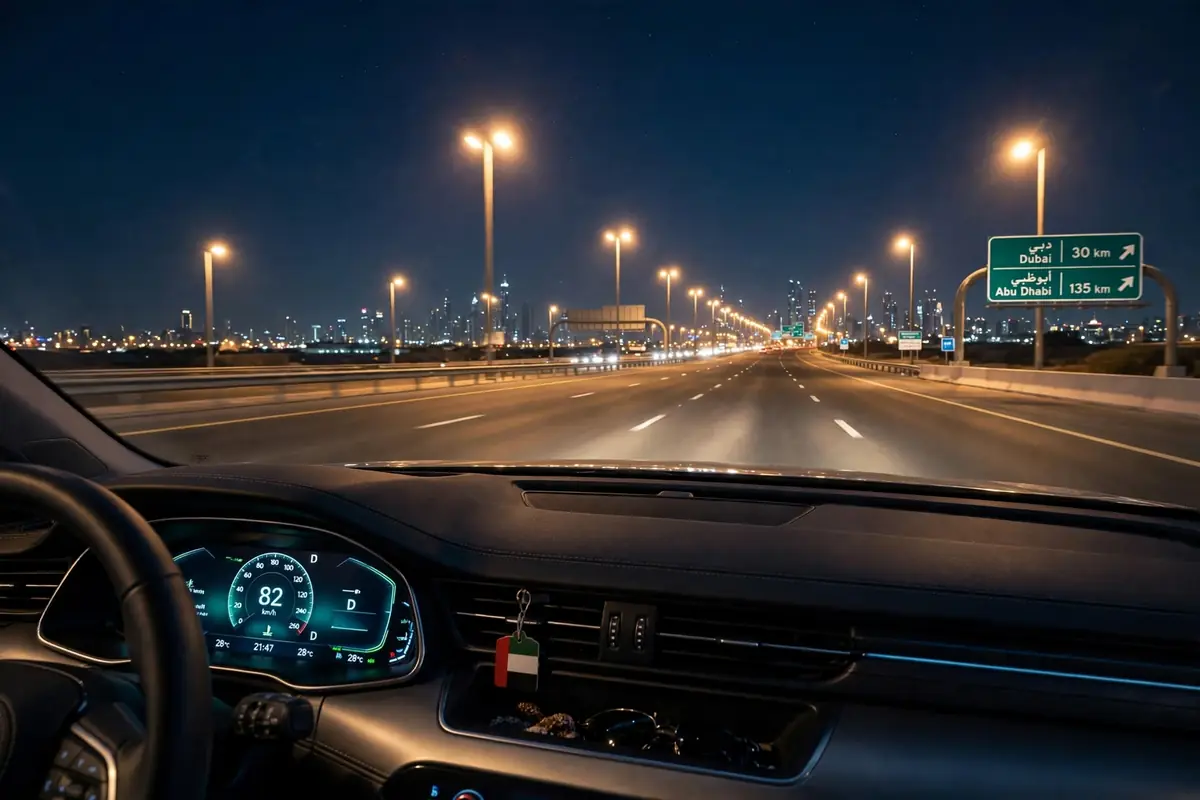
Night falls fast in the UAE. The desert cools. The roads thin out. But night driving brings its own risks. Low light hides hazards. Tired eyes miss signs. Fog can drop in minutes. This page shows the steps that help you drive at night safely UAE wide.
Quick Answer: To drive at night safely UAE roads need slow speeds and low beam lights. Keep a long gap to the car ahead. Stop when you feel sleepy. Never use high beam in fog. Never use hazard lights while you drive. Rest beats risk every time.
Drive at night safely UAE: see and be seen
Your lights are your eyes at night. Turn them on at dusk. Don’t wait for full dark. Clean the headlights once a week because dust and sand dim them fast. Clean lights help you drive at night safely UAE wide. A dirty lens can cut your light in half. Wipe the lights with a cloth before a night trip.
Use low beam in towns and on lit roads. Low beam lights the road without blinding other drivers. Use high beam only on dark open roads with no cars ahead. Dip the beam the moment you see lights ahead. A blinded driver cannot see the road.
Abu Dhabi Police state this rule in plain words. Use low beam lights in fog. Don’t use high beam lights in fog. The light bounces off the fog and blinds you. The same rule holds for dust. Low beam cuts through. High beam turns the air white.
Check your brake lights and indicators too. A dead brake light hides your braking from the car behind. A dead indicator hides your turns. Test them before a night trip. Ask a friend to stand behind the car. Or check them in a shop window reflection.
Clean the windscreen inside and out. A dirty screen scatters light from other cars. The glare tires your eyes fast. Clean glass gives a clear view. Replace wipers that smear. Streaks turn lights into stars.
Slow down and keep a long gap
Speed feels safe at night when roads look empty. It is not. You see less at night. Your eyes need more time to read the road. A hazard that you spot at 100 metres in daylight may show at 50 metres at night. Slow down and give your eyes time.
Abu Dhabi Police urge drivers to slow down at night and in fog. They urge drivers to double the safety gap to the car ahead. The BoloSara24 team read their fog guidance on 29 November 2026. The guidance repeats the same points in every notice. Slow down. Double the gap. Don’t overtake. Use low beam.
Keep at least a four second gap at night. Pick a fixed point on the road. Count the seconds from the car ahead to that point. Four seconds is a good night gap. Six seconds is better in fog or rain. A long gap buys time to stop.
Don’t overtake at night unless you can see far ahead. A dark road hides oncoming cars. A bend hides them too. Wait for a straight stretch with clear sight. If you doubt the gap, stay behind. Patience costs seconds. A bad overtake costs far more.
Watch for animals on desert roads. Camels cross highways at night. They are dark and tall. They stand still in the beam. Slow down near camel crossing signs. A camel strike can kill. The same care holds for goats near farms.
Fog and dust after dark
Fog forms most often between late night and early morning. Winter brings the worst fog. The National Centre of Meteorology posts fog alerts. Check the forecast before a night trip. A red alert means you should wait.
Abu Dhabi Police give clear fog rules. Reduce speed bit by bit and don’t brake hard. Drive at a speed that fits what you can see and use low beam lights. Don’t use hazard lights while you drive. Hazard lights hide your brake lights and your indicators. Other drivers cannot read your moves.
Park off the road if fog gets too thick. Pull fully onto the shoulder. Turn off the engine if you stop long. Turn on the hazard lights only when parked. Wait for the fog to lift. A short wait beats a crash.
Stay in your lane in fog and don’t change lanes to pass. Lane lines guide you when you cannot see far. Follow the lines, not the car ahead. The car ahead may drift. The lines stay true.
Wind can lift dust across desert highways at night. Dust cuts sight like fog. The same rules hold. Slow down. Use low beam. Keep a long gap. Don’t overtake. Stop off the road if the dust gets thick.
Want more bad weather tips? Read our guide on how to drive safely in UAE fog. Rain trips need our guide on how to drive safely in UAE rain. Know the limits with our UAE speed limits and fines page. A breakdown at night needs our guide on what to do when a car breaks down in UAE. Desert night drives need our guide on how to drive in the UAE desert safely.
Fatigue rules for drive at night safely UAE trips
Fatigue kills more night drivers than fog does. Your body wants sleep after midnight. Your eyes close for seconds without your say. A three second sleep at 100 km per hour covers 83 metres. That is a blind drive past a whole football field.
The UAE traffic law now sets a clear fatigue rule. The executive regulations state that a driver must not drive while tired or worn out. The same rules cap driving at nine hours in a 24 hour period. The Federal Traffic Council can change this limit. The BoloSara24 team read these rules on the UAE Legislation site on 29 November 2026. The rules sit in Cabinet Decision No. 174 of 2026. They take effect on 1 January 2027.
Plan rest into every long night drive and stop every two hours. Walk around the car, drink water and wash your face. A ten minute stop wakes your brain. A coffee helps for a short while, but it is not a cure for sleep. Only sleep cures sleep.
Share the drive on long trips. Two drivers can swap every two hours so the fresh driver watches the road while the tired driver rests. Agree the swap plan before you leave. Don’t argue about it at midnight.
Know the warning signs. You yawn again and again, your eyes feel heavy and you miss a turn. You cannot recall the last few minutes. You drift over the lane line. These signs mean stop now, so pull off at the next safe place and sleep for 20 minutes. A short nap restores focus.
Don’t fight sleep with loud music or cold air because these tricks fail fast. The body wins in the end. A 20 minute nap at a petrol station beats a crash. Arrive late. Arrive alive.
Night driving in towns and on highways
City nights bring their own risks. Pedestrians cross roads in dark clothes. Delivery bikes weave through traffic. Taxis stop without warning. Watch the pavements as much as the road. A person can step out between parked cars.
Slow down near malls, schools and labour camps at night, where people cross in groups after work. These city rules help you drive at night safely UAE wide. Give them space. Stop fully at crossings. The law gives walkers the right of way at marked crossings. The new traffic rules ban walkers from crossing roads where the limit tops 80 km per hour. But a walker may still try. Stay alert.
Highways feel empty at night. Trucks use them most. Give trucks room. Don’t sit in a truck blind spot. Pass a truck with care. Flash your lights once before you pass. Don’t cut in front of a truck after you pass. A truck needs far more room to stop than a car.
Watch for sudden slow traffic near exits. Cars brake hard for a missed exit. Keep your gap long near every exit. Don’t rush to catch an exit. Take the next one. A missed exit costs five minutes. A crash costs far more.
Tip: Keep your phone out of reach while you drive. A text at night pulls your eyes off a dark road. The fine for phone use while driving is AED 800 with four black points. The real cost can be far higher.
What to do next
Check your lights tonight. Clean the windscreen. Set your mirrors. These five habits help you drive at night safely UAE wide. Plan rest stops for any drive past two hours. Check the fog forecast before you leave. Drive slow, keep a long gap and stop when you feel sleepy. These five habits cover most night risks. BoloSara24 will keep this page fresh as the traffic rules change.
Frequently Asked Questions
How can I drive at night safely in UAE?
To drive at night safely UAE drivers slow down, use low beam lights and keep a long gap. Stop every two hours. Rest when you feel sleepy. Never use high beam in fog and never use hazard lights while you drive.
Should I use high beam lights at night in UAE?
Use high beam only on dark open roads with no cars ahead. Dip the beam when you see lights ahead. Never use high beam in fog. The light bounces off the fog and blinds you.
What is the driving hour limit in the UAE?
The executive regulations cap driving at nine hours in a 24 hour period. Drivers must not drive while tired or worn out. The rules take effect on 1 January 2027.
What should I do if fog gets thick at night?
Slow down bit by bit and use low beam lights. Don’t overtake and don’t use hazard lights while you drive. Park fully off the road if the fog gets too thick. Turn on hazard lights only when parked.
How often should I rest on a long night drive?
Stop every two hours for at least ten minutes. Walk around the car and drink water. Share the drive if you can. Sleep for 20 minutes if you feel drowsy.
Can I use hazard lights while driving in fog?
No. Abu Dhabi Police state that drivers must not use hazard lights while they drive in fog. Hazard lights hide brake lights and indicators. Use them only when parked off the road.
Official Sources
Abu Dhabi Police, fog driving guidance: Slow down, double the gap, low beam lights and no hazard lights while driving.
Abu Dhabi Police, caution in foggy conditions: Park off the road in dense fog and avoid overtaking in low sight.
UAE Legislation, executive regulations of the traffic law: Fatigue rules, nine hour driving cap and vehicle light rules.
UAE Government Portal, road safety page: Traffic law rules, accident reporting apps and fine payment channels.
Disclaimer: BoloSara24 is an independent guide. It has no link with Abu Dhabi Police, the UAE Government or any traffic body. Road rules and weather change. Check the official pages above before you drive. This page gives general facts only. It is not legal, financial or driving advice.
Last Updated: 29 November 2026.