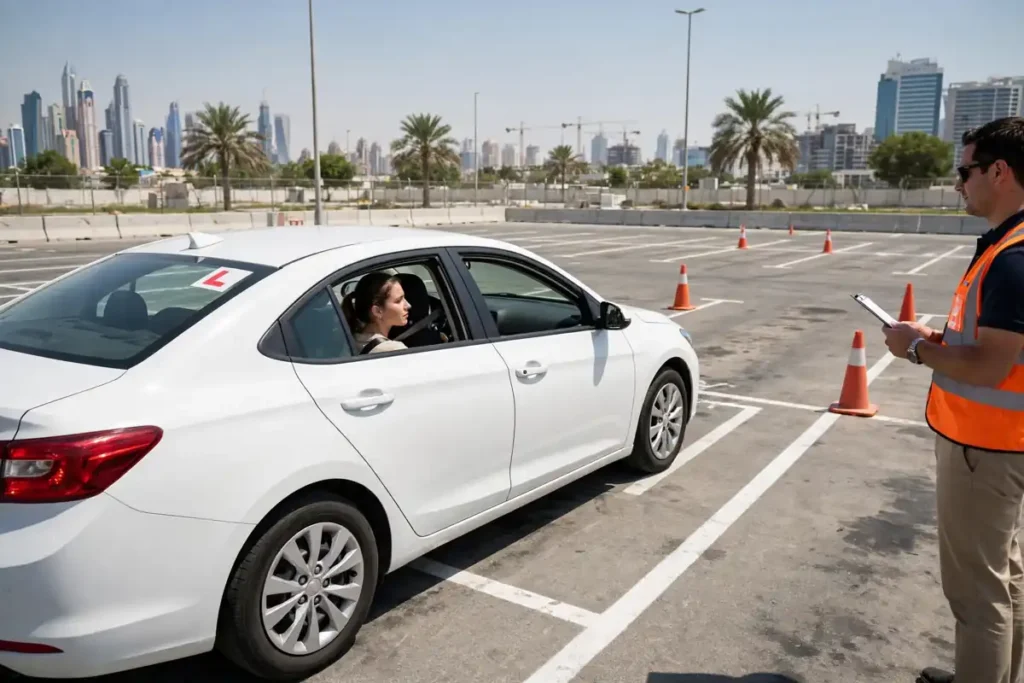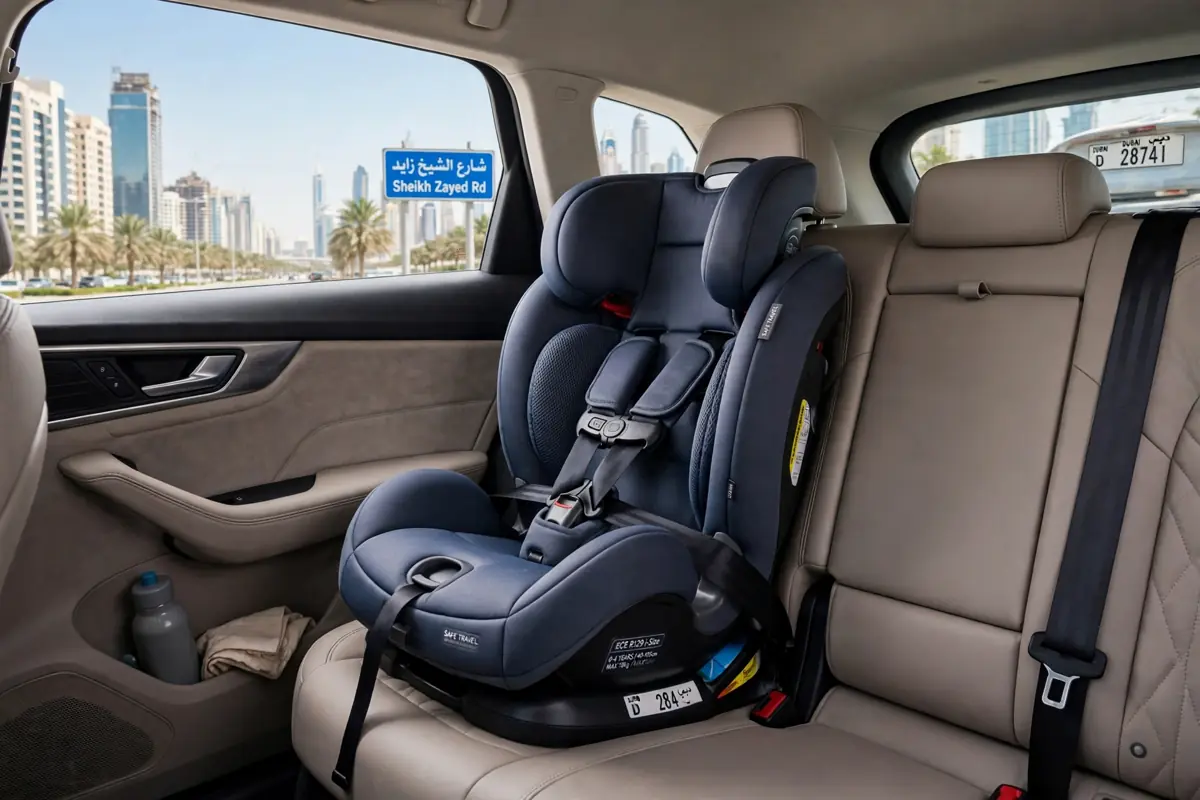
A child in a car is not a small adult. A seat belt made for an adult cuts across a small body in the wrong place. A crash throws a loose child forward with great force. A proper child seat holds the child in place and spreads that force over strong bones. UAE child car seat rules are clear and they are enforced. A child aged 4 or younger must ride in a child seat. A child under 10 years old or shorter than 145 cm must not sit in the front seat. Break either rule and the fine is AED 400. BoloSara24 checked the official fine schedule on the UAE Government portal on 29 November 2026. The numbers in the BoloSara24 guide come from that schedule.
Quick Answer: UAE child car seat rules say a child aged 4 or younger must use a child safety seat in the back seat. A child must be over 10 years old and at least 145 cm tall to sit in the front seat. Each breach costs AED 400. Every passenger must wear a seat belt.
What the law says about UAE child car seat rules
The law sits in the Federal Traffic Law and in Ministerial Resolution No. 178 of 2017. That resolution lists the fines. Item 49 fines a driver AED 400 for letting a child under 10 sit in the front seat. It also applies to a child shorter than 145 cm. Item 50 fines a driver AED 400 for not fixing a child seat for a child under 4 years old. Item 51 fines a driver AED 400 with 4 black points for a driver who does not wear a seat belt. It also applies to a passenger with no belt. Those three items are the core of the child rules. Learn them by heart.
The front seat test has two parts. Age and height. A child must be over 10 years old. A child must also be at least 145 cm tall. Some reports read the rule as either test. The fine schedule reads it as both. The safe way is simple. Meet both tests before a child sits in front. A child who is 11 but only 140 cm tall stays in the back. A child who is 150 cm tall but only 9 years old stays in the back too. Both tests protect the child. An airbag hits a short child in the face and neck. A belt rides up on a small body. The back seat is safer for a growing child.
Who pays the fine? The driver does. It does not matter who the parent is. It does not matter who put the child in the front seat. The driver is in charge of the car. Check every child before you start the engine. That check takes 10 seconds. A fine and a hurt child cost far more.
Which seat for which age
Child seats come in three main types. A baby seat faces the rear. It fits a baby from birth to about 1 year old, or up to 13 kg. It cradles the head and neck. A crash pushes the baby into the seat, not out of it. A toddler seat faces forward. It fits a child from about 1 to 4 years old, or 9 to 18 kg. It has its own harness. A booster seat lifts an older child so the adult belt fits right. It fits a child from about 4 years old till the child reaches 145 cm or turns 10. Use the seat that fits the child today, not the seat the child will grow into next year.
Weight and height matter more than age alone. Read the seat label. It gives a weight range and a height limit. If the child is over the limit, move up a size. If the child is under the limit, stay in the smaller seat.
Tip: Buy a seat that meets a known safety standard. Look for the ECE R44 or R129 mark on the label. R129 is the newer standard. It tests side impact too. A seat with no standard mark may look fine and fail in a crash. Keep the receipt and the manual. The manual shows how to fit the seat in your exact car model.
How to fit the seat right
A good seat fitted badly is a bad seat. Most fitting mistakes are simple. The seat moves more than 2 cm side to side. The harness is loose. The chest clip sits too low. The seat belt path is wrong. Fix each one and the seat works as it should. Push the seat into the car seat with your knee while you tighten the belt. Test it with a firm shake. It should move less than 2 cm at the belt path.
Use ISOFIX if your car has it. ISOFIX is a set of metal anchors built into the back seat. The child seat clicks onto them. It is faster to fit and harder to fit wrong. If your car has no ISOFIX, use the seat belt path shown in the seat manual. Thread the belt exactly as the manual shows.
Put the seat in the back, in the middle if you can. The middle back seat is the furthest from a side crash. If you have two child seats, put them in the two outer back seats. Never put a rear facing baby seat in the front seat. A front airbag can kill a baby in a rear facing seat. If you must put a child seat in front in a rare case, switch the airbag off first. Check your car manual too. In the UAE the law still bars a child under 10 from the front. So the back seat is the right place in almost every trip.
Check the harness each time. It should sit flat and snug on the shoulders. You should not be able to pinch a fold at the shoulder. The chest clip should sit at armpit level. Take off thick coats before you strap a child in. A coat leaves a gap under the harness.
UAE child car seat rules for older children
Many parents drop the seat too early. A child aged 5 or 6 still needs a booster in most cars. The adult belt is made for a body at least 145 cm tall. A shorter child gets the belt across the neck and belly. In a crash that belt can cut into the neck and hurt the belly organs. A booster lifts the child so the belt sits on the shoulder and the hip bones. Those bones are strong. They take the crash force well.
Test the fit without a booster. Sit the child in the back seat. The back must rest flat. The knees must bend at the seat edge. The belt must sit low on the hips and across the middle of the shoulder, not the neck. If any point fails, the child still needs a booster. Most children need one till age 10 or 145 cm.
Note: A booster is cheap and light. It fits in a taxi boot and in a rental car. Keep one at home for grandparents and for school runs. A rental car in the UAE may not come with a child seat. Ask the rental firm before you book. Bring your own seat if they have none. Your child rides in your seat, not in a stranger’s old seat.
Buying a child seat in the UAE
Buy a new seat if you can. A used seat may hide a past crash. Its foam may be crushed and its harness stretched. Check the expiry date on the label. Most seats expire after 6 to 10 years. Plastic weakens in UAE heat. A basic baby seat starts near AED 300. A good toddler seat costs AED 600 to AED 1,200. A booster costs AED 150 to AED 400. Try the seat in your car before you buy it.
Common mistakes parents make
The most common mistake is a loose harness. Parents leave it loose so the child feels free. A loose harness lets the child move forward in a crash. Snug the harness each time. The second mistake is a seat that moves too much. Shake it after you fit it. If it moves more than 2 cm, tighten it again. The third mistake is the front seat. A child begs to sit in front. A crash does not care that the trip was short. Keep the child in the back every time.
Common Mistakes: Parents make the same five mistakes with UAE child car seat rules. They use a seat that is too big or too small. They leave the harness loose. They put a rear facing seat in front. They let a child under 10 sit in front. They buy a used seat with no history. Fix those five and your child rides far safer. Share this list with anyone who drives your child. A driver who knows the rules keeps your child safe.
A taxi ride needs a seat too. Bring a light booster for taxi trips. A taxi in the UAE will wait while you fit the seat. Plan 2 extra minutes.
What happens after a crash
Replace a child seat after any crash, even a small one. A seat can hide damage after a crash. The maker says so in the manual. Your car insurance in the UAE may pay for a new seat. Ask your insurer. Keep the crash report and the seat receipt. A car insurance claim in the UAE needs those papers. Do not keep using a crashed seat to save money. A seat is cheaper than a hospital stay.
Teach your child the habit early. Make the seat a rule from day one. No seat, no ride. That rule works in your car, in a taxi, and in a grandparent’s car.
The bottom line
UAE child car seat rules are simple. A child aged 4 or younger rides in a child seat in the back. A child sits in front only after age 10 and 145 cm. Each breach costs AED 400. Fit the seat snug. Use the right size. Keep the child in the back every trip. A seat costs a few hundred dirhams. A crash costs far more. Buy the right seat, fit it right, and use it every time. BoloSara24 will update this guide when the law changes. BoloSara24 checks the official fine schedule each year.
Do and Dont: Do use a child seat for a child aged 4 or younger. Do fit the harness snug and check the seat moves less than 2 cm. Do keep a child under 10 in the back seat. Do not put a rear facing seat in front of an airbag. Do not let a child ride loose for a short trip. Do not buy a used seat with no crash history.
Frequently Asked Questions
At what age does a child need a car seat in the UAE?
A child aged 4 or younger must use a child safety seat. The seat must suit the child’s weight and height. After age 4, a booster seat is the right step till the child reaches 145 cm or turns 10.
Can a child sit in the front seat in the UAE?
Only after the child is over 10 years old and at least 145 cm tall. Both tests must be met. A child who meets only one test stays in the back seat.
What is the fine for not using a child car seat in the UAE?
The fine is AED 400. It applies to a missing child seat for a child under 4 and to a child under 10 in the front seat. The driver pays the fine.
Which child seat should I buy for my baby?
Buy a rear facing baby seat from birth to about 1 year old, or up to 13 kg. Look for the ECE R44 or R129 mark. Try the seat in your car before you buy it.
Can I use a child seat in a taxi in the UAE?
Yes. Bring a light booster or a travel seat for taxi trips. Fit it before the taxi moves. Plan 2 extra minutes for the fit.
Should I replace a child seat after a crash?
Yes. Replace the seat after any crash, even a small one. Hidden damage can weaken it. Your insurer may pay for a new seat. Keep the crash report and the receipt.
Official Sources
UAE Traffic Fines Schedule – Official fine schedule from the UAE Government portal, items 49, 50 and 51 cover child seats and seat belts.
RTA Safety Tips – RTA safety tips for drivers, with seat belt and vehicle check rules.
National Centre of Meteorology – Official UAE weather alerts for safe travel planning with children.
Disclaimer: This guide gives general facts about UAE child car seat rules. It is not legal advice. The fine schedule and the law are the final word. Check the official schedule before you drive with a child.
Last Updated: 29 November 2026.