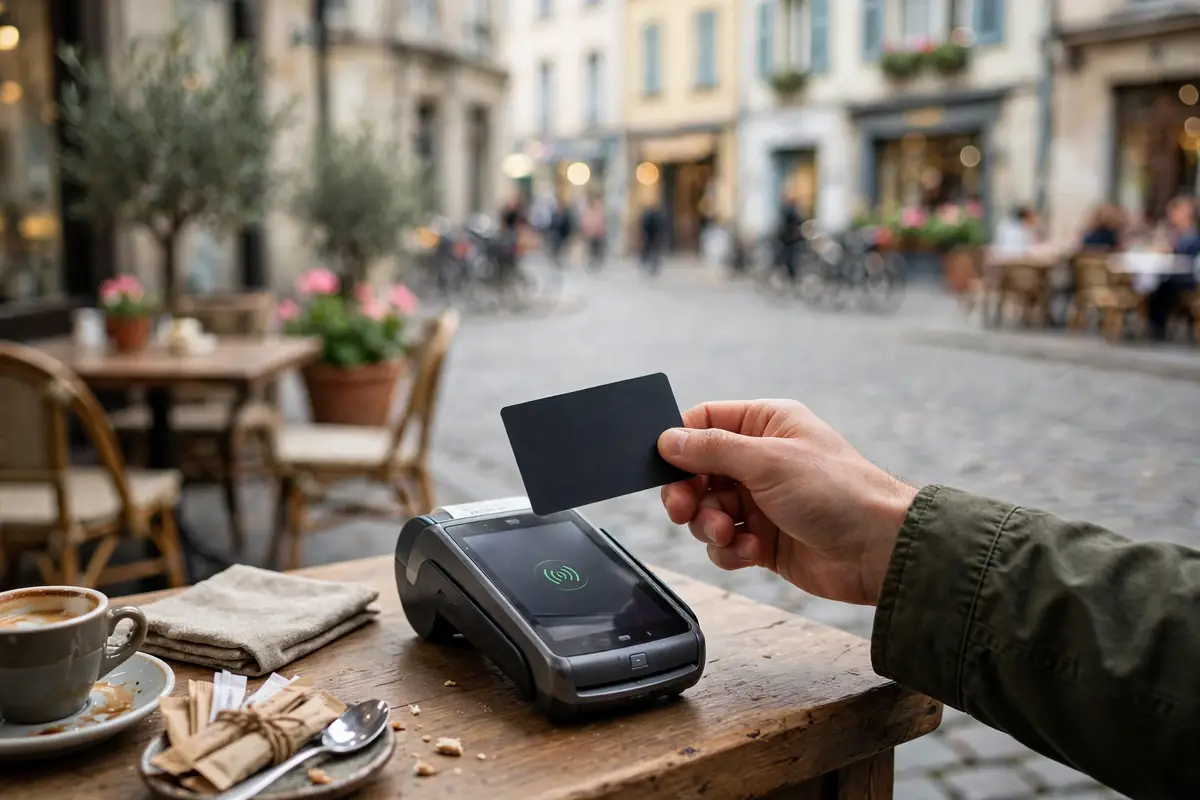
Foreign transaction fees on UAE bank cards are the extra cost of paying abroad. They apply when you pay in a currency that is not the dirham. The fee hides in the rate, in the bank charge, and in the card network charge. You can find the real cost before you travel, and you can cut it to zero with the right card. You don’t need a bank visit to find it.
Quick Answer: To check foreign transaction fees on UAE bank cards, open your card page or fee schedule. Look for the foreign currency fee, the card network charge, and the cash withdrawal fee abroad. Most UAE cards charge about 3.14% in total on foreign spend. The FAB Travel Card lists no international transaction fee and no hidden scheme or bank charges. Ruya Bank lists 3% in foreign exchange fees on international card transactions. Always pay in the local currency, never in dirhams, when a shop abroad offers you the choice.
What makes up the fee on a foreign payment
Three costs join to form the fee you pay abroad. First, the card network turns the foreign sum into dirhams at its own daily rate. Visa and Mastercard set this rate each day, and no bank can change it. Second, the network adds its own charge for the cross-border job. Third, your bank adds its own markup on top.
The network charge often shows as about 1.15% on a statement. Mastercard sets it as two parts: 0.9% for the cross-border part and 0.2% for the change of currency. Read how to exchange currency at a UAE bank to see how banks set rates before you fly. VAT sits on top of that, which is why the sum lands near 1.15%. The bank can’t remove this charge, but it can choose to pay it for you. A card that truly costs 0% abroad is a card where the bank pays the network charge too.
The bank markup is the part that differs from card to card. It is the number a card calls its foreign transaction fee. A card with a 2.14% bank fee plus the 1% network fee lands near 3.14% in total. That is the figure most UAE cards now charge on foreign spend. Gulf News reported in 2025 that several UAE banks lifted the overseas fee from 2.09% to 3.14%.
Layla flies to Paris for ten days and spends AED 7,000 on hotels, food, and shopping. At 3.14%, her fees add AED 219.80 to the trip. At 0%, she pays nothing extra. The gap pays for a good dinner in Paris. The card she packs matters as much as the hotel she books.
How to check foreign transaction fees on UAE bank cards
Start on your bank card page. Search the page for “foreign” or “international” and read the fee lines. The page must show the foreign currency fee as a percent. If the page hides it, open the Key Facts Statement or the schedule of fees. That’s when the Key Facts Statement helps. The Key Facts Statement is the short sheet the bank must give you. It lists the fee in plain words.
Next, check the cash fee abroad. A card can charge 0% on shop payments and still charge 3.15% on cash from an ATM abroad. Ruya Bank lists 3% in foreign exchange fees on international card transactions, and a separate cash withdrawal fee abroad. Read both lines before you pack cash plans.
Then check the card network charge line. A card that says “0% foreign transaction fee” can still pass on the 1.15% network charge. The ADCB Traveller waives its own bank fee but still passes on the network charge. It lands near 1.15% in total. The FAB Travel Card waives both parts, so it lands at 0% in total. The difference sits in the small print, not in the headline.
BoloSara24 checked the FAB Travel Card page and the Ruya Bank fees and charges page on 29 November 2026. FAB lists no international transaction fee and no hidden scheme or bank charges. The annual fee is AED 1,500, and the minimum monthly salary is AED 20,000. Ruya lists 3% in foreign exchange fees on international transactions.
Tip: Read the Key Facts Statement, not the ad. The ad says 0%. The Key Facts Statement says what 0% leaves out.
The dirham trap at the till abroad
A shop or ATM abroad can offer to charge you in dirhams instead of the local currency. This is called dynamic currency conversion. It sounds kind, but it costs you. The shop sets its own poor rate, which can add 5% to 7% to the bill. Then your bank can still add its 3.14% fee on top, because the payment still crosses a border. That fee is part of the foreign transaction fees on UAE bank cards. It applies even when the shop bills you in dirhams.
Always pick the local currency. Don’t let the machine pick dirhams for you. In Paris, pick euros. In London, pick pounds. In New York, pick dollars. The card network then turns the sum into dirhams at its fair daily rate. You pay only your card fee on top.
Do you spend more abroad on hotels, or on food and shopping? Hotels often let you prepay in dirhams from the UAE, which skips the fee. Food and shopping happen on the street, where the card fee bites each time. A 0% card saves most on the small daily spends, not on the hotel.
Cards that cut the fee to zero
BoloSara24 finds the FAB Travel Card the clearest 0% card in the UAE. These cards cut foreign transaction fees on UAE bank cards to 0% or near 0%. It charges no international transaction fee on spends abroad or online in a foreign currency. No hidden scheme or bank charges apply. The annual fee is AED 1,500, and the bank asks for a minimum monthly salary of AED 20,000. It pays 12% back in FAB Rewards on flight and hotel bookings, with a monthly spend rule and a cap.
Other cards waive the bank fee but not the network charge. The ADCB Traveller and the FAB Z Card both sit near 1.15% in total, because the network charge still applies. Our guide to the best travel credit card in UAE compares travel cards side by side. That is still far better than 3.14%. On AED 7,000 of foreign spend, 1.15% costs AED 80.50, while 3.14% costs AED 219.80.
A forex card can help too. Our guide on how to get a forex card in UAE lists prepaid cards. They lock a rate before you fly. A prepaid travel card suits a trip with a fixed budget. You load the sum you plan to spend and no more.
| Card or fee type | Foreign fee in total | Annual fee | Best for |
|---|---|---|---|
| FAB Travel Card | 0% | AED 1,500 | Frequent flyers |
| ADCB Traveller | About 1.15% | AED 1,575 | Travellers who want rewards |
| FAB Z Card | About 1.15% | Free in year one | Low salary cardholders |
| Most UAE cards | About 3.14% | Varies | Everyday use at home |
| Ruya debit and credit | 3% foreign exchange fee | Varies | Ruya account holders |
Five checks on foreign transaction fees on UAE bank cards before you fly
Check one: open your card fee page. Note the foreign fee, the network charge, and the ATM cash fee abroad. Write the three numbers down.
Check two: ask your bank if your card waives the fee on any spend, like travel bookings. Some cards waive the fee only for flights and hotels. A best cashback credit card in UAE can also pay some of the fee back. It pays cashback on spends at home.
Check three: turn off the dirham option in your head now. At the till, pick the local currency each time, even when the machine pushes dirhams.
Check four: carry a second card with a low fee as a backup. If one card fails abroad, the backup saves the day, and a low-fee backup saves money too.
Check five: read your statement after the first foreign spend. The statement shows the rate and the fee as its own line in most cases. If the fee looks wrong, call the bank with the statement in front of you. For moves inside the UAE, read how to transfer money between UAE banks.
BoloSara24 is an independent guide. It isn’t a bank or a government body. BoloSara24 runs these five checks on every card it reviews. Fees change, and each card sets its own rules. Check the live fee page for your own card before you travel.
Frequently Asked Questions
How do I check foreign transaction fees on UAE bank cards?
Open your card page on the bank site and look for the foreign currency fee. Then open the Key Facts Statement or schedule of fees for the network charge and the ATM cash fee abroad. The three numbers together give the real cost.
What is the foreign transaction fee on most UAE bank cards?
Foreign transaction fees on UAE bank cards run about 3.14% in total on foreign spend. That sum is the bank fee plus the card network charge. Gulf News reported that several UAE banks lifted the fee from 2.09% to 3.14% in 2025.
Which UAE card has no foreign transaction fee?
The FAB Travel Card lists no international transaction fee and no hidden scheme or bank charges. It needs a minimum monthly salary of AED 20,000 and carries an annual fee of AED 1,500. Check the live card page before you apply.
Does a 0% foreign fee card really cost 0% abroad?
It depends on the card. Some cards waive only the bank fee and still pass on the 1.15% network charge. The FAB Travel Card waives both, so it costs 0% in total. Read the Key Facts Statement to see which parts the card waives.
Should I pay in dirhams or the local currency abroad?
Always pay in the local currency. A shop that charges you in dirhams sets its own poor rate. That rate can add 5% to 7% to the bill. Your bank can still add its fee on top.
Do foreign transaction fees apply to online shopping too?
Yes. An online shop that bills you in dollars, euros, or rupees counts as a foreign currency payment. This holds even when you sit at home in the UAE. The same fee applies, so a 0% card saves money on online shopping too. Read how to use a UAE bank card abroad for more tips on card use outside the UAE.
Official Sources
– FAB Travel Card — No international transaction fee, no hidden scheme or bank charges, annual fee AED 1,500.
– Ruya Bank Fees and Charges — 3% foreign exchange fees on international card transactions, from the bank fee schedule.
– Central Bank of the UAE Consumer Protection Standards — The disclosure rules that ask banks to show fees in plain words.
Disclaimer
BoloSara24 is an independent guide. It isn’t a bank or a government body. Card fees change, and each card sets its own rules. Check the live fee page and the Key Facts Statement for your own card before you travel or apply. These facts are general only and are not financial advice.
Last Updated: 29 November 2026.