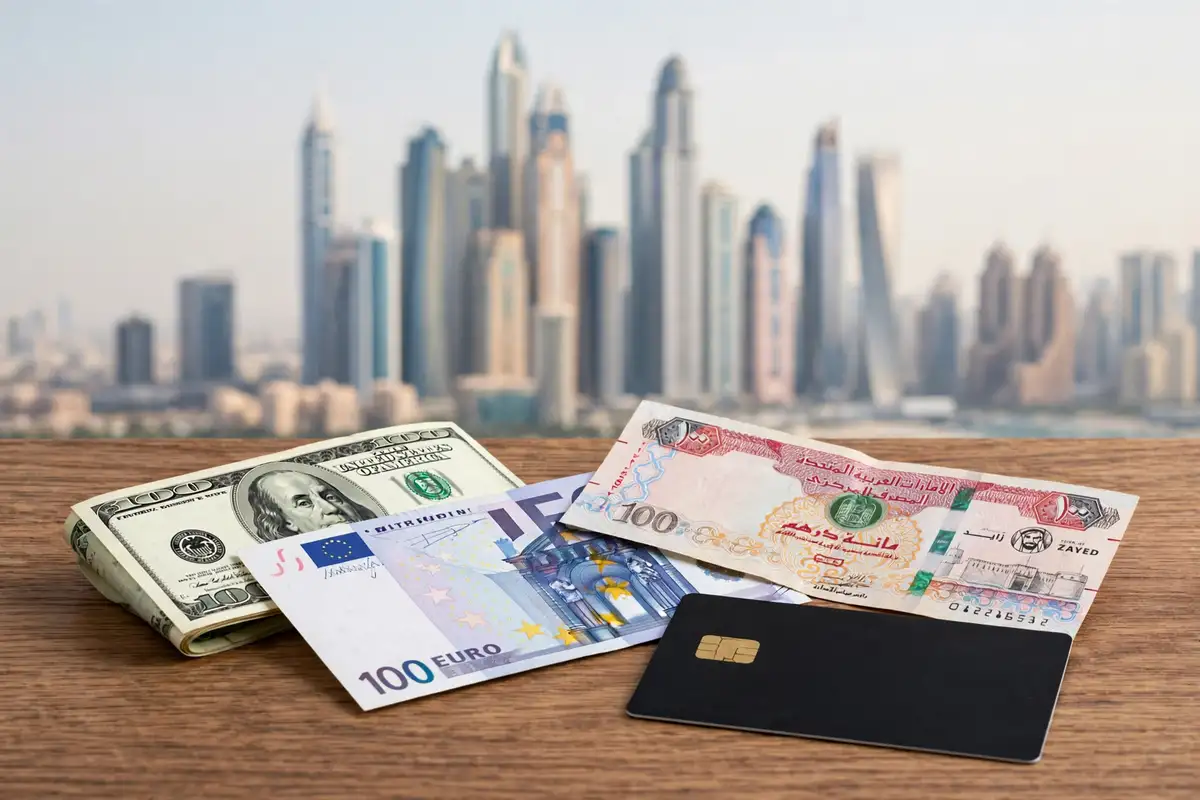
A foreign currency account UAE lets you hold money in a currency that is not the dirham. You can keep US dollars, euros, or pounds in a UAE bank. You can send and receive that currency with no forced change into dirhams.
Daniel works in Dubai and his firm pays him in US dollars. His rent and bills run in dirhams. Daniel opened a USD account with his bank. His pay lands in dollars and stays in dollars. He changes money to dirhams only when he needs to pay a bill. He saves the cost of a change on every pay day.
Quick Answer:
A foreign currency account UAE holds one or more foreign currencies in a UAE bank, with USD, EUR, and GBP the most common. Emirates NBD offers its Currency Passport Savings Account in 12 currencies, with USD, EUR, GBP, AUD, CAD, and SAR on the list. You need a passport, your Emirates ID, and proof of income or funds. Ask your bank for its fee list, because minimum balance rules change by account type.
BoloSara24 checked the Emirates NBD savings account page on 29 November 2026. The page lists the Currency Passport currencies and the 0.15% interest for select currencies. The team also checked the Emirates NBD Key Facts Statement for current and savings accounts, which lists the foreign currency current account in more than 20 currencies.
What a Foreign Currency Account UAE Is
A foreign currency account holds money in one currency. A USD account holds dollars. A EUR account holds euros. The bank doesn’t change the money into dirhams unless you ask it to.
A multi currency account is the wider version. It holds several currencies under one login. Emirates NBD calls its version the Currency Passport Savings Account. It holds up to 12 currencies in one account. It’s the one frequent travellers pick. You can move money between the currencies inside the same account.
The two types suit different people. A single currency account suits a person who earns or pays in one currency. A multi currency account suits a person who deals in three or four currencies each month.
Which Currencies Can You Hold
USD, EUR, and GBP are standard at every large UAE bank. AUD, CAD, CHF, and JPY are common at most banks too. Some banks add SAR, AED, and Asian currencies like SGD and HKD.
Emirates NBD lists its foreign currency current account in more than 20 currencies in its Key Facts Statement. The list runs from AUD and CAD to EUR, GBP, JPY, SAR, SGD, and USD. The Currency Passport Savings Account lists 12 currencies: AUD, BHD, CAD, CNH, GBP, HKD, JOD, KWD, OMR, SAR, SGD, and USD.
ADCB offers its business current accounts in AED, USD, EUR, and GBP. Its personal foreign currency accounts cover up to 19 currencies in some lists. Check your own bank page for the exact list. A currency that one bank offers may not sit on the list at a second bank.
Good to Know:
The dirham is pegged to the US dollar at 3.6725. A USD balance in the UAE carries low exchange risk against the dirham. A EUR or GBP balance moves with the world rate each day. That move is the real risk of a foreign currency account.
Our guide on how to get the best exchange rate in UAE shows how to time a change between currencies.
Who Can Open a Foreign Currency Account UAE
UAE residents can open one with ease. You’ll need a valid visa, an Emirates ID, and an account with the bank in most cases. New customers open a dirham account first, then add the foreign currency account. BoloSara24 notes that non residents face a higher bar, with more papers and longer checks.
Non residents can open one too, but the bar is higher. Banks ask for a passport, proof of address from the last 3 months, a reference letter from your home bank, and proof of the source of your funds. The bank must also see a link to the UAE, like a business, a property, or a planned move.
Businesses open foreign currency accounts for trade. A firm needs a valid trade licence, the memorandum of association, passports and Emirates IDs of owners and signatories, and proof of business activity. The bank checks the expected trade volumes before it approves the account.
Age and income rules follow the bank. Most banks ask for a minimum age of 21 for a personal account. Some premium accounts ask for a higher balance or a salary transfer. Ask your bank for its own list.
Foreign Currency Account UAE Documents
Residents need four papers in most cases. First, a valid passport with the visa page. Second, the original Emirates ID. Third, a salary certificate or a recent payslip. Fourth, proof of address, like a tenancy contract or a utility bill.
Non residents need more. Add a bank reference letter from your home bank. Add proof of the source of funds, like a sale deal, a salary slip, or a tax paper. Add a CV or a short work history in some cases. Every paper must be clear and current.
Businesses need a trade licence, the memorandum of association, a board resolution for account opening, and the passports and Emirates IDs of all signatories. The bank may ask for client and supplier details too. Keep every paper in English or Arabic.
Tip:
Take originals and copies to the branch. The bank checks the original and keeps the copy. A blurry phone photo of a passport can stall the file for a week. Carry clean copies.
Our guide on how to open a bank account in UAE lists the standard papers for a first account.
How to Open a Foreign Currency Account UAE
Step 1: Pick the bank and the currency. Check the currency list first. Pick the bank that holds the currencies you use. Check the minimum balance and the monthly fee for that account type.
Step 2: Pick the account type. A current account suits daily use and payments. A savings account suits holding money and earns some interest. A fixed deposit suits money you will not touch for months. Emirates NBD pays 0.15% on select currencies in its Currency Passport Savings Account.
Step 3: Gather the papers. Use the list above. Check each paper date. A utility bill older than 3 months will fail the check.
Step 4: Apply in the app or at a branch. Existing customers can open a foreign currency account in the bank app in many cases. Mashreq lets existing online customers pick a currency and get the IBAN at once. New customers apply at a branch.
Step 5: Pass the bank checks. The bank runs its customer checks and anti money laundering checks. It may ask for the source of a large first deposit. Answer with papers, not words. A salary slip or a sale deal ends the question.
Step 6: Fund the account. Move money in from your dirham account or by transfer from abroad. Check the minimum balance rule. Some accounts charge a fee if the balance falls short.
Note:
Some banks ask for a minimum balance near AED 3,000 in value for a foreign currency savings account. The exact figure changes by bank and by account type. Read the Key Facts Statement for the account you pick.
Our guide on minimum balance for bank account in UAE covers the balance rules and the fees that apply when a balance falls short.
Fees and Costs to Watch
Five costs sit on a foreign currency account. First, the monthly account fee, if the account has one. Second, the fall below fee when the balance drops under the minimum. Third, the transfer fee for sending money abroad by SWIFT. Fourth, the exchange margin when you change one currency to a second one. Fifth, the cash fee for foreign currency cash at a branch.
The exchange margin is the quiet cost. Banks buy and sell currency at different rates. The gap between the two rates is the margin. A small margin on a large transfer is still real money. Compare the margin at two banks before a big transfer.
VAT of 5% applies to most bank fees in the UAE. Check the fee list for the VAT line. A fee of AED 100 costs AED 105 with VAT.
Our guide on best savings account in UAE compares account types and their costs.
What a Foreign Currency Account UAE Is Good For
Four uses stand out. First, pay in dollars. A person who earns in dollars and pays a US supplier can pay straight from the USD account. No change, no margin, no wait.
Second, save for a goal abroad. A parent who pays UK school fees can hold pounds and pay the school in pounds. The rate risk sits in one place and the parent can watch it.
Third, hold money for travel. A traveller can keep euros for a Europe trip and spend from the EUR balance. The bank card draws on the right currency.
Fourth, run a business that trades abroad. A firm that buys in dollars and sells in dirhams can hold both currencies and pay suppliers in dollars. BoloSara24 notes that trade firms gain the most from this account type.
Do you earn in dirhams and spend in dirhams only? Don’t open one unless a real foreign currency need exists. The fees and the rate risk may cost more than the account saves.
Risks You Must Know
The main risk is the exchange rate. A EUR balance worth AED 40,000 today may be worth AED 38,000 next month if the euro falls. The money didn’t move. Its value in dirhams did. That’s worth a check before you open the account.
The second risk is the fee trap. A low balance account can eat itself in monthly fees. A USD account with a small balance and a monthly fee loses money each month. Keep the balance above the fee line or close the account. BoloSara24 advises readers to keep the balance above the fee line.
The third risk is the dormant account. An account with no use for a long time may go dormant. The bank may then ask for fresh papers to wake it up. Use the account at least once in a while or close it cleanly.
Our guide on how to open a salary account in UAE covers the main account that most residents use day to day.
Frequently Asked Questions
What is a foreign currency account UAE?
It is a UAE bank account that holds money in a currency that is not the dirham, like USD, EUR, or GBP. You can send, receive, and hold that currency with no forced change into dirhams.
Which currencies can I hold in a foreign currency account UAE?
USD, EUR, and GBP are standard at every large UAE bank. Emirates NBD lists more than 20 currencies for its foreign currency current account, and 12 currencies for its Currency Passport Savings Account.
What papers do I need to open a foreign currency account UAE?
Residents need a passport with a visa page, an Emirates ID, a salary certificate or payslip, and proof of address. Non residents also need a home bank reference letter and proof of the source of funds.
Is there a minimum balance on a foreign currency account UAE?
Yes, in most cases. The figure changes by bank and by account type. Some foreign currency savings accounts ask for near AED 3,000 in value. Read the Key Facts Statement for the exact figure.
Can a non resident open a foreign currency account UAE?
Yes, but the bar is higher. Banks ask for a passport, proof of address, a home bank reference letter, proof of the source of funds, and a clear link to the UAE.
Does a foreign currency account UAE pay interest?
Some do. Emirates NBD pays 0.15% on select currencies in its Currency Passport Savings Account. Current accounts in foreign currency pay little or no interest in most cases.
Official Sources
Emirates NBD, Priority Savings Accounts – Lists the Currency Passport Savings Account in 12 currencies and the 0.15% interest for select currencies.
Emirates NBD, Private Banking Foreign Exchange Solutions – Lists the foreign currency current account and the Currency Passport account with their currency lists.
ADCB, Business Current Accounts – States multi currency choice in AED, USD, EUR, and GBP for business accounts.
Disclaimer: BoloSara24 is an independent guide. It has no link with any bank or the Central Bank of the UAE. Facts were checked on the official bank pages named above on 29 November 2026. Currencies, fees, and rules change, so confirm them with your bank before you act. This is general information, not financial or legal advice.
Last Updated: 29 November 2026.