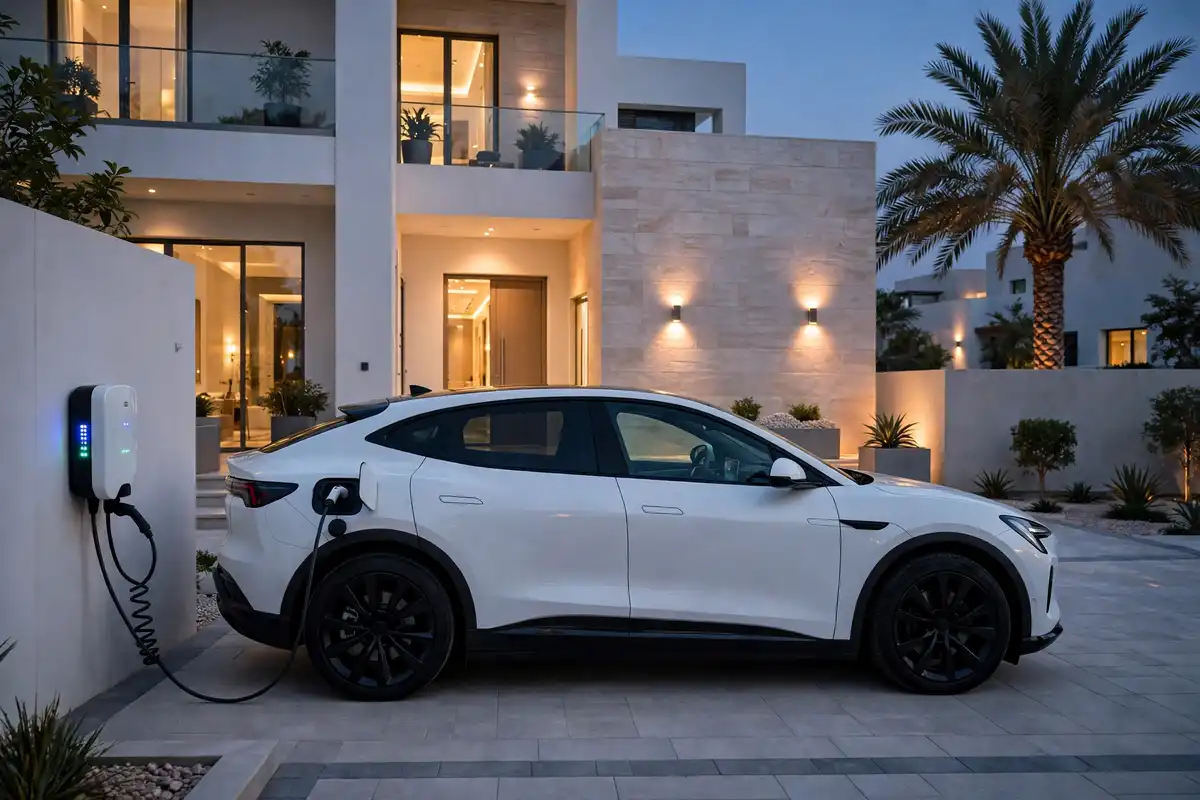
You can charge electric car at home UAE drivers do it every night. You plug in at your own parking bay. You wake up to a full battery. You skip the queue at a public station. You pay the home rate on your own bill.
Quick Answer: You can charge electric car at home UAE homes use a wall box on a fixed circuit. A DEWA approved contractor fits the unit in Dubai. You need a load check first. A simple villa job takes 7 to 14 days. Home power costs about AED 0.29 to AED 0.44 per kWh. Public AC power costs AED 0.70 per kWh.
BoloSara24 built this guide from DEWA pages and live installer quotes. To charge electric car at home UAE drivers need a plan that fits their home. This guide shows that plan step by step.
BoloSara24 checked the DEWA EV pages on 29 November 2026. DEWA runs the EV Green Charger plan in Dubai. The plan covers public points and home rules. DEWA says any EV charging point needs DEWA approval first. That rule comes from Directive Number 1 of 2017. It covers homes and firms alike.
Charge Electric Car at Home UAE in Short
Home charging suits most UAE drivers. Your car sits at home for hours each night. That time is free charging time. You do not need a fast public point each day. A slow overnight charge fills most cars.
A 60 kWh battery needs about AED 18 to AED 28 at home. The same fill at a public AC point costs about AED 42. The gap adds up fast. A driver who charges twice a week can save over AED 100 a month. A driver who charges daily can save much more.
What Charger Types Fit a UAE Home
UAE cars use the Type 2 plug for AC power. That plug is the norm across Dubai and Abu Dhabi. Your wall box should match that plug. Check your car manual first. Check the plug shape on your car port. A wrong plug wastes your money.
A 7.4 kW wall box runs on a single phase supply. It adds about 35 km of range each hour. It fills a 60 kWh car in about 8 hours. That pace suits overnight charging. Most villas in Dubai have a single phase supply. Most flats have one too.
An 11 kW wall box runs on a three phase supply. It adds about 55 km of range each hour. It fills a 60 kWh car in about 5 to 6 hours. You need a three phase board for this unit. Ask your contractor to check your board first.
DEWA Approval and the Contractor Rule
DEWA approval sits at the heart of the job in Dubai. DEWA says you must get approval before you fit any EV charging point. The rule covers a private home charger too. You do not apply alone. Your contractor starts the job through DEWA.
Use a DEWA approved contractor only. Ask for proof of approval before you book. Ask for the contractor name on the DEWA list. A good contractor files the papers for you. A good contractor runs the load study. A good contractor books the final check.
The load study checks your home supply. It checks your main breaker size. It checks your board spare space. It checks your cable route. It tells you the safe charger size. A villa with a big board can take 11 kW. A villa with a small board may need a board upgrade first.
Tip: Get three quotes in writing before you pick a firm. Each quote must list the charger, the cable, the labour and the fees. A lump sum hides the real cost. An item list lets you compare firms in a fair way.
The charger must meet DEWA technical rules. The work must meet the wiring rules DEWA sets. Your contractor knows these rules. Ask for a test sheet after the fit. Keep that sheet with your home papers. It proves the job met the rules.
Note: DEWA lists no cash grant for a home charger on its own pages. BoloSara24 read the DEWA EV pages on 29 November 2026. No subsidy, rebate or grant appears there for a private home unit. Do not trust a sales pitch that promises DEWA cash back. Ask for the DEWA page that states it.
What a Home Charger Costs in UAE
Cost changes with your home and your cable run. A short run in a villa costs less. A long run to a far bay costs more. A board upgrade adds cost too. Ask for a site visit before you agree a price.
Installers in Dubai quote about AED 2,400 to AED 5,000 for a simple villa fit. That band covers the wall box, the cable and the labour. It also covers a load study and load control. A long cable run or a board change can push the total past AED 5,000. Some firms quote labour near AED 800 to AED 1,000 for a simple job. The wall box itself adds about AED 2,000 or more.
Public AC power costs AED 0.70 per kWh plus VAT. Public DC power costs AED 1.20 per kWh plus VAT. Home power costs AED 0.29 to AED 0.44 per kWh before VAT. Home charging wins on price in every slab. The saving grows with each charge.
| Charger size | Power | Range per hour | Full 60 kWh charge |
|---|---|---|---|
| Portable cable | 3 kW | About 15 km | About 20 hours |
| Wall box | 7.4 kW | About 35 km | About 8 hours |
| Wall box | 11 kW | About 55 km | About 5 to 6 hours |
| Wall box | 22 kW | About 110 km | About 3 hours |
Ahmed lives in a villa in Dubai Hills. He drives 80 km a day to work in Jebel Ali. He fits a 7.4 kW wall box near his bay. He plugs in at 10 pm each night. His car fills by 5 am. He pays about AED 20 per full charge at home. He used to pay about AED 42 at a public AC point. He saves about AED 400 a month. His install cost AED 3,800 in total. His saving pays that back in about 10 months.
Steps to Fit a Charger at Home
Step one: check your car and your supply. Note your car AC limit. Note your board phase and breaker size. Take a photo of your board and your bay. Send both to each contractor.
Step two: pick a DEWA approved contractor. Ask for three written quotes. Ask each firm for its DEWA proof. Ask each firm for a one year work warranty. Pick the firm with a clear item list, not the lowest lump sum.
Step three: book a site visit. The contractor checks the cable route. The contractor checks the board. The contractor runs the load study. You get a fixed price after this visit. Do not pay in full before this visit.
Step four: let the contractor file with DEWA. The contractor starts the connection job through DEWA. DEWA checks the plan and the load. Approval can take 3 to 5 days in a simple job. A board upgrade can take longer.
Step five: fit the wall box. A simple fit takes 3 to 4 hours. The team runs the cable. The team fits the breaker and the box. The team tests the earth and the trip. You watch a full test charge with your own car.
Step six: test and keep the papers. Test the app and the timer. Test a full overnight charge. Keep the test sheet, the warranty and the DEWA papers. Keep the installer phone number on your fridge.
Villas, Flats and Rented Homes
Villa owners have the easy path. You own the wall and the bay. You pick the contractor. You file through DEWA. You pay the bill. The charger stays with your home if you move out. Take that cost into your plan.
Flat owners need one more paper. You need a No Objection Certificate from building management. The NOC must cover your bay and your cable route. The cable runs from your own meter to your bay. The NOC can take 2 to 4 weeks. Start it early. Some buildings say no to a cable run through a shared car park. Ask before you buy the wall box.
Renters need two yes votes. You need your landlord to agree. You need building management to agree. Put the deal in writing. State who pays for the fit. State who keeps the charger at the end of the tenancy. A written deal stops a fight later.
Charging Tips That Save Money and Time
Charge to 80 percent for daily use. A full 100 percent charge suits a long trip only. An 80 percent cap keeps your battery in good shape. Most car apps let you set that cap. Set it once and leave it.
Common Mistakes: People buy the biggest wall box first. Their car can take only 7.4 kW on AC power. The big box adds cost and adds nothing. People skip the load study too. Their breaker trips on a hot night. People fit a charger with no DEWA paper. DEWA can ask them to remove it. People use a long extension cord. That cord can heat up and fail.
Do and Dont: Do use a DEWA approved contractor in Dubai. Do get a load study before you buy. Do get three item quotes in writing. Do keep your test sheet and warranty. Dont buy a wall box before you check your car AC limit. Dont run a cable across a shared path. Dont trust a cash back promise with no DEWA page behind it.
Charge Electric Car at Home UAE Costs Each Month
Work out your real monthly cost before you buy. Take your daily km and divide by 6. That gives a rough kWh per day. A car that uses 15 kWh per 100 km needs 12 kWh for an 80 km day. That costs about AED 3.50 to AED 5.30 a day at home. A month of that drive costs about AED 105 to AED 160. Petrol for the same drive costs far more.
Read more on BoloSara24: electric car charging stations in UAE, how to buy a used car in UAE, how to check car history in UAE, how to close a DEWA account in UAE, how to renew car insurance in UAE.
Frequently Asked Questions
Do I need DEWA approval to charge electric car at home UAE?
Yes. DEWA says you need approval before you fit any EV charging point in Dubai. Your DEWA approved contractor files the job. The rule comes from Directive Number 1 of 2017. It covers private home chargers too.
How much does a home EV charger cost in Dubai?
A simple villa fit costs about AED 2,400 to AED 5,000. That band covers the wall box, cable, labour and load study. A long cable run or a board upgrade can push the total higher. Ask for an item quote after a site visit.
How much does it cost to charge an EV at home in Dubai?
Home power costs AED 0.29 to AED 0.44 per kWh before VAT, plus a fuel surcharge. A 60 kWh fill costs about AED 18 to AED 28. The same fill at a public AC point costs about AED 42.
Can I fit a home charger in a flat in UAE?
Yes, with a No Objection Certificate from building management. The cable runs from your own meter to your bay. The NOC can take 2 to 4 weeks. Some buildings refuse a cable run through a shared car park, so ask first.
What size home charger do I need?
Most homes do fine with 7.4 kW on a single phase supply. It fills a 60 kWh car in about 8 hours overnight. An 11 kW box needs three phases. Check your car AC limit first, as a bigger box cannot beat that limit.
Does DEWA give a grant for a home EV charger?
No grant appears on the DEWA EV pages BoloSara24 read on 29 November 2026. DEWA runs the public Green Charger network. It lists no cash back for a private home unit. Ask any seller for the DEWA page that states a grant.
Official Sources
DEWA EV Charging: DEWA page on the EV Green Charger plan, approval rule and charging points.
DEWA EV Account and Charging Card Management: DEWA service guide on EV accounts, cards and the AED 500 refundable deposit.
DEWA EV Charging Points News: DEWA news on over 740 charging points across Dubai.
Disclaimer: BoloSara24 gives general facts only. Rules and rates can change. Check the DEWA page or ask your contractor before you pay for a charger.
Last Updated: 29 November 2026.