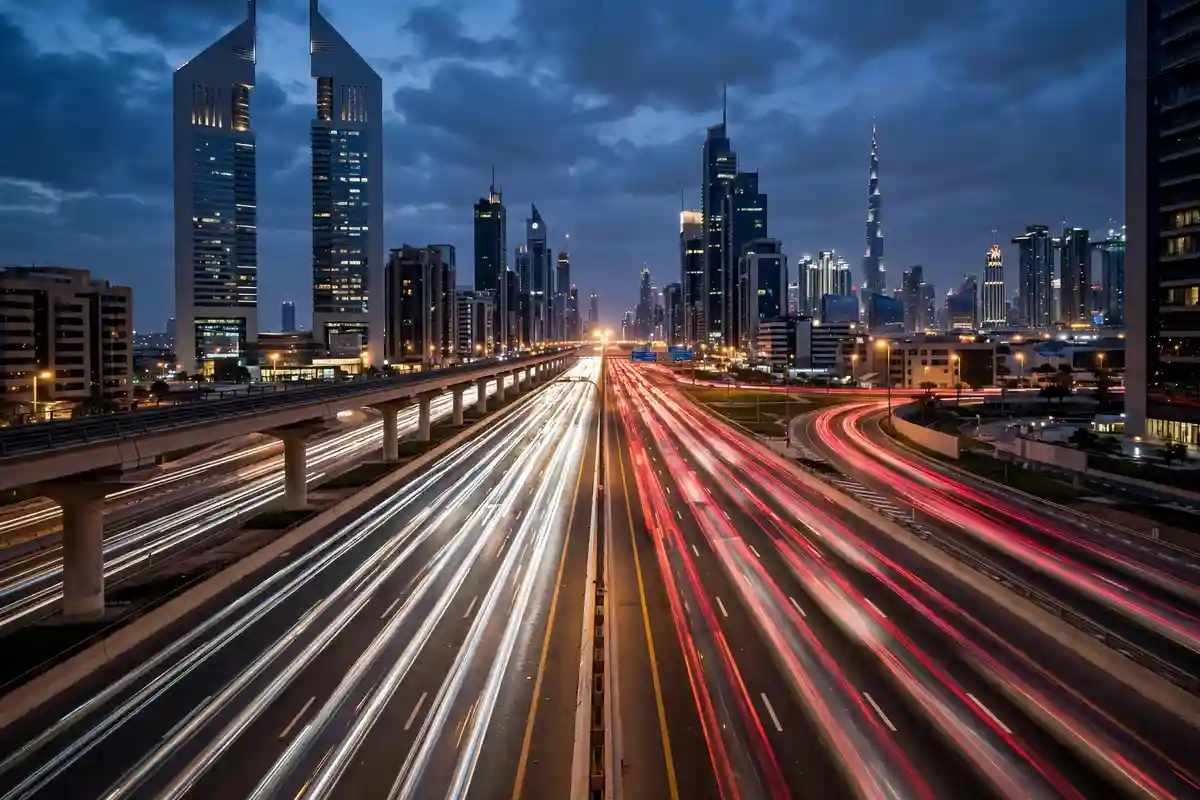
Dubai traffic can turn a 20-minute drive into an hour. The fix is rarely a faster car. It’s a better time, a better road, or a quick check before you leave. These tips help you avoid traffic jams Dubai UAE drivers face each day. They use the same numbers the traffic reports publish.
Quick Answer: To avoid traffic jams Dubai UAE drivers beat, drive outside 7 to 10am and 5 to 8pm. Check Waze or Google Maps before you leave. Take Al Khail Road instead of Sheikh Zayed Road when the map shows red. Leave 30 minutes early or late around the evening peak. The evening rush is far worse than the morning one.
When Dubai traffic is worst
TomTom tracks Dubai traffic all year. Its 2025 report gives the hard numbers. Dubai drivers lost 72 hours to rush-hour traffic in 2025. That is 3 days and 50 minutes per driver. The average congestion level hit 42.7%, up 2.7 points on 2024. A 10 km drive took 19 minutes 10 seconds on average.
The evening peak is the real problem. TomTom splits the two rush hours, and the gap is wide.
| Rush hour | 10 km drive | Congestion | Average speed |
|---|---|---|---|
| Morning | 18 min 41 s | 42.3% | 32.1 km/h |
| Evening | 26 min 33 s | 94.4% | 22.6 km/h |
The evening rush takes 8 minutes longer for the same 10 km. Congestion more than doubles. The average speed drops by almost a third. TomTom says congestion builds through the afternoon and peaks around 6pm. Friday runs lighter than Monday to Thursday, and the weekend runs lighter still.
One day stood out in 2025. Tuesday 11 November was the worst day. Congestion hit 73% for the full day and 168% at 5pm. Drivers covered only 4 km in 15 minutes at that hour. Big event days can do the same, so check the map before you trust your usual time.
Example: Layla drives from JVC to DIFC each weekday. Her morning trip takes 25 minutes. Her evening trip home takes 40 minutes on the same road. She now leaves the office at 7:30pm instead of 6pm. The drive drops back to 25 minutes.
Best times to avoid traffic jams Dubai UAE
Time is the biggest lever you have. A 30-minute shift can save a 20-minute jam. It helps you avoid traffic jams Dubai UAE drivers face twice a day. Use these windows as a guide.
- Before 7am. Roads run clear. School traffic has not started yet.
- 10am to 4pm. The midday gap is the calmest part of a weekday.
- After 8pm. The evening peak fades fast after 8pm.
- Friday morning. Friday runs lighter than other weekdays.
- Weekends. Saturday and Sunday are the lightest days to drive.
The worst windows are 7 to 10am and 5 to 8pm on weekdays. Salik charges its peak toll from 6 to 10am and 4 to 8pm, Monday to Saturday. Parkin charges peak parking from 8 to 10am and 4 to 8pm. The price signal matches the traffic signal.
School runs add a sharp spike. The roads near schools crawl at drop-off and pickup times. If your route passes a school, leave before the school rush or after it clears. Ramadan changes the pattern too. The evening peak moves later, and the roads near malls fill after iftar. Check the map each day in Ramadan instead of trusting the normal pattern.
Can you shift your work hours? Ask your manager. A 7am start and a 3:30pm finish dodges both peaks. Even one work-from-home day a week cuts your weekly jam time by a fifth. The BoloSara24 team checked the TomTom 2025 figures on 29 November 2026 before writing.
Roads that help avoid traffic jams Dubai UAE
The map matters as much as the clock. Two roads can run side by side with very different speeds. Learn the pairs.
Sheikh Zayed Road carries the most traffic in Dubai. Al Khail Road runs parallel to it and often moves faster at peak. Al Wasl Road works well for trips to Downtown and Jumeirah. It runs slower than a highway but steadier than Sheikh Zayed Road at peak.
E311, Sheikh Mohammed Bin Zayed Road, is the worst corridor in the city. It links Dubai with Sharjah and the northern emirates. RTA data puts about 1.2 million vehicles a day crossing from Sharjah into Dubai across five corridors. If you drive from Sharjah, leave early or late.
Salik gates shape your route too. Ten gates stand across Dubai. Each crossing costs AED 6 at peak and AED 4 off peak, plus 5% VAT since 1 June 2026. That is AED 6.30 at peak. A route with two gates costs AED 12.60 at peak, so a free road can still win. Check the Salik toll gates in UAE before you pick a route.
Tip: Set your nav app to show two or three routes, not one. Compare the times, not the distance. The shortest road can be the slowest at peak. A longer road with fewer lights can still win, even when it looks slow on the map.
Apps that warn you before you leave
Check the road before you touch the steering wheel. A 30-second check saves a 30-minute jam. It is the fastest way to avoid traffic jams Dubai UAE drivers face at peak. These apps do the job.
- Waze. Live jams, crashes and police alerts from other drivers. It reroutes you on its own when a jam builds ahead.
- Google Maps. Live traffic colours and time estimates. It shows the fastest route and the time for each option.
- RTA Dubai app. Dubai roads, Salik, fines and parking in one place. It’s the official RTA app.
- S’hail. RTA trip planner for Metro, Tram, bus and taxi. It shows the fare and the time for each option.
- Dubai Drive app. Salik, fines, fuel and parking. It suits drivers who want RTA services in one app.
Open the app 10 minutes before you leave, not at the wheel. Look at the colour of your route: green means free flow and red means a jam. If your road shows red, pick the next route the app offers. If all routes show red, wait 20 minutes and check again.
Set a departure alert in Waze or Google Maps if the app offers one. Waze and Google Maps can tell you when to leave. The alert shifts with live traffic. A 6pm meeting may need a 5:15pm start on a clear day. On a bad day, it may need a 4:45pm start. The app knows the difference between a clear day and a bad day. You don’t need to guess.
Radio helps too. Dubai radio stations run traffic bulletins in the morning and evening drive. Turn the radio on for the last 5 minutes before you leave. A crash on Sheikh Zayed Road may have happened after your app check. The bulletin catches it.
Skip the car when the roads jam
The best way to beat a jam is to leave the car at home. Dubai public transport runs on its own lanes and rails. It doesn’t wait in the queue.
The Metro is the fastest option at peak. Trains run every 3 to 4 minutes at peak, so the wait stays short. The morning Metro peak runs about 7 to 9:30am. The evening peak runs 5 to 8pm. The trains are full at those times, but they keep moving. Check the Dubai Metro timings for first and last trains.
Buses fill the gaps the Metro misses. The public bus in the UAE runs across the city. The Dubai bus on demand UAE service covers short hops inside 20 zones for AED 5. A bus plus Metro trip often beats a car at peak. Plan it in S’hail before you leave. The app shows the fare and the time for each option.
Carpool when you must drive. RTA promotes Sharekni, a carpool app. One car with four people takes three cars off the road. It also splits fuel and Salik costs four ways. Ask colleagues who live near you.
Note: Parking costs more at peak too. Parkin charges peak rates from 8 to 10am and 4 to 8pm. A premium bay costs AED 6.30 an hour at peak with VAT. Read the Dubai parking fees guide before you park in a busy area. A Metro trip can cost less than the parking alone.
The money side of peak driving
Peak driving costs more than off-peak driving, in tolls and in fuel. The tolls and the parking both rise at busy hours. Fuel burn rises too.
| Cost | Peak | Off peak |
|---|---|---|
| Salik per crossing | AED 6.30 | AED 4.20 |
| Premium parking per hour | AED 6.30 | AED 4.20 |
| Standard parking per hour | AED 4.20 | AED 2.10 |
The table shows rates with 5% VAT since 1 June 2026. A commuter who crosses two Salik gates twice a day pays AED 25.20 at peak. The same crossings off peak cost AED 16.80. That’s AED 8.40 a day, or about AED 42 a week. Off-peak trips help you avoid traffic jams Dubai UAE drivers sit in each evening. BoloSara24 checked the Salik and Parkin rates on 29 November 2026.
Fuel adds more. Stop-start traffic burns more fuel than a steady cruise. Read the save fuel driving guide for habits that cut burn.
Do the maths on your own week. Count your Salik crossings, your parking hours and your fuel. Then count what a Metro card would cost for the same trips. Many drivers find the Metro cheaper than the car once tolls and parking are counted.
Common mistakes that keep you in jams
Most drivers repeat the same errors, so fix these four.
- Leaving at the same time every day. Traffic changes by day. Monday is worse than Friday. Check the map each morning.
- Trusting one road. Sheikh Zayed Road is not always fastest. Let the app compare routes.
- Skipping the check. A 30-second look at Waze beats a 30-minute jam. Check before you leave, not after you join the queue.
- Driving into an event. Concerts, matches and sales jam the roads near the venue. Check the event calendar before a Friday night drive.
One more trap: the school run. Parents who drive children to school add thousands of cars to the same roads at the same hour. A school bus or a short Metro ride frees your morning.
Frequently Asked Questions
What are the worst traffic hours in Dubai?
Weekday mornings run 7 to 10am and evenings run 5 to 8pm. The evening peak is worse. TomTom 2025 data puts a 10 km drive at 26 minutes 33 seconds in the evening. The morning drive takes 18 minutes 41 seconds. Congestion peaks around 6pm.
Which app is best to avoid traffic jams Dubai UAE drivers face?
Waze is best for live jams and reroutes from other drivers. Google Maps is best for time estimates across routes. The RTA Dubai app covers Dubai roads, Salik and parking in one place. Use Waze or Google Maps before you leave, and let it reroute you on the road.
Is Sheikh Zayed Road always the slowest road in Dubai?
No. Sheikh Zayed Road is the busiest road, but it is not always the slowest. At off-peak hours it moves fast. At peak, Al Khail Road moves faster than Sheikh Zayed Road. Check the map each time. The fastest road changes by hour and by day.
How much does Salik cost at peak hours?
Each Salik crossing costs AED 6 at peak and AED 4 off peak, plus 5% VAT since 1 June 2026. That makes AED 6.30 at peak and AED 4.20 off peak. Peak runs 6 to 10am and 4 to 8pm, Monday to Saturday. Crossings from 1 to 6am are free, and Sundays cost a flat AED 4.
Does the Metro really beat driving at peak?
Yes, on most cross-city trips at peak. Trains run every 3 to 4 minutes and skip the road queue. The Metro is full at peak, but it moves on rails while cars wait.
What is the best time to drive to Dubai Mall on a weekend?
Weekday mornings run lighter than evenings near the mall and Downtown. Check Waze before you leave, and use the Metro to Dubai Mall station when the roads show red.
Official Sources
TomTom Traffic Index Dubai report: the TomTom page with 2025 congestion figures, rush-hour times and speeds. BoloSara24 checked it on 29 November 2026.
Dubai Government portal: Salik toll rates and parking rules.
RTA Journey Planner: plan a trip by Metro, bus or tram.
RTA home page: Dubai transport news.
Disclaimer: BoloSara24 is an independent guide. It has no link with RTA, TomTom, Salik or Parkin. Traffic, tolls and parking rates can change. Check the live map and the official pages on the day you drive. These facts are general only. This is not legal, financial or transport advice.
Last Updated: 29 November 2026.