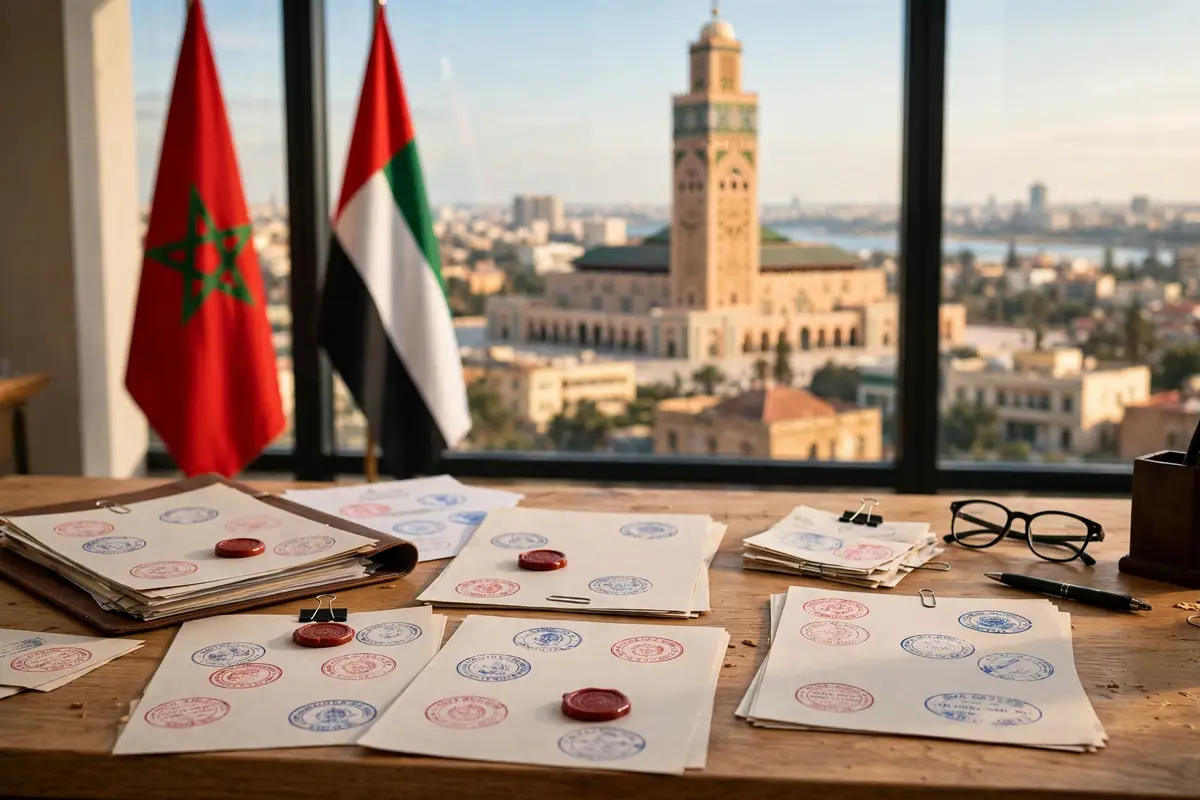
Youssef holds a business degree from a university in Casablanca. A company in Dubai offered him a job. The company asked for the degree, legalised for the UAE. Youssef first asked for an apostille. That was the wrong stamp. Morocco joined the Apostille Convention in 2016, but the UAE is not a party to it. His degree needs the full chain instead. Each step follows in order, so no stamp is missed. Here is how to legalise documents for UAE from Morocco, step by step.
To legalise documents for UAE from Morocco, you start with the body that issued the paper. Then the Moroccan foreign ministry legalises it. Then the UAE Embassy in Rabat stamps it. Last, MOFA in the UAE adds its stamp. A Moroccan apostille alone will not work for the UAE. BoloSara24 checked the chain on the MOFA pages and the Moroccan legalisation steps on 29 November 2026.
Quick Answer: To legalise documents for UAE from Morocco, get the paper issued or notarised at source. Then get it legalised by the Moroccan Ministry of Foreign Affairs. Next, the UAE Embassy in Rabat stamps it for use in the UAE. Last, MOFA in the UAE adds its stamp. MOFA charges AED 150. The MOFA step takes one to three business days through an approved courier.
Why an apostille will not work
Morocco joined the Apostille Convention on 27 November 2015. The Convention came into force for Morocco on 14 August 2016. A Moroccan paper can carry an apostille for use in member countries abroad. The UAE is not on the table. An apostille works only between member countries. The UAE is outside that group, so the UAE won't accept an apostille on its own.
The chain for the UAE is the old consular route. Each office checks the stamp of the office before it. No step can be skipped. A paper that jumps a step comes back and costs you weeks. Don't pay for an apostille if the paper is bound for the UAE. It will not help you. You must legalise documents for UAE from Morocco through the full chain, not with one stamp.
The chain follows the country that issued the paper, not your nationality. A French birth certificate for your child goes through France, not through Morocco. A Moroccan degree goes through Morocco. Check the place of issue on each paper before you start.
Step one: get a fresh paper in Morocco
A public paper starts at the body that issued it. A degree starts at the university. A birth certificate starts at the civil status office. You can order a birth extract online through the Watiqa service and receive it by registered post. A marriage paper starts at the civil status office or with the adouls. An adoul deed is a traditional Moroccan notarial deed. It counts as a public paper once the adouls draw it up.
A private paper starts with a notary or with the adouls. A power of attorney, a work certificate, or a private contract needs a signature first. The notary or the adouls draw it up and you sign it there. A paper you signed at home will not pass. The signer must be seen to sign it. Take your passport or your national ID card to the signing.
Get a recent original. A torn, faded, or old copy can be refused at any step. Do you hold a fresh copy? Ask the issuing body for a fresh copy with a clear seal. Check the name on it before you leave the counter. The name must match your passport letter for letter, with no difference at all. One wrong letter can stall the whole chain.
Ask the UAE office which papers it wants. Some employers want the degree only. Some want the degree and the police clearance paper. Some want the marriage paper too for a family visa. Attest only the papers they name. Each paper pays its own fee at each step.
Step two: the Moroccan foreign ministry
The Ministry of Foreign Affairs, African Cooperation and Moroccans Living Abroad legalises the paper next. Its offices legalise the signatures of public officials. They legalise the seals of the interior and justice ministries too. The ministry checks that the signature on your paper matches its records. Then it adds its legalisation stamp.
A sworn translation may be needed at this point. Moroccan papers are in Arabic or French. A sworn translator turns the paper into the language the next office wants. The translator must be accredited to the courts. For a paper bound for a country outside the Convention, the King's Prosecutor authenticates the sworn translator signature. Ask the translator if this step fits your paper. The translator will know.
Tip: BoloSara24 suggests you scan every page before the original leaves your hands. Keep the scans in one folder with the receipts. If a paper goes missing on the way, the scans prove what you sent.
Step three: the UAE Embassy in Rabat
The UAE Embassy in Rabat is the next stamp. The embassy attests the paper only after the Moroccan foreign ministry has legalised it. The embassy adds its seal next to the ministry stamp. That seal tells the UAE authorities that the paper went through all the Moroccan steps.
The embassy works through the MOFA digital route. You sign in to the MOFA site with UAE Pass and pick the Attestation Service. You pick Morocco as the country of issue. You fill in the request and pay online. An approved courier then calls to collect the original paper within 24 hours.
A paper issued in another country must go to the UAE mission in that country. The Rabat embassy will not attest it. Each paper must also be legalised on its own. Papers bundled together under one stamp are not accepted. Send each one alone.
Step four to legalise documents for UAE from Morocco: MOFA in the UAE
MOFA is the last stamp in the classic chain. It attests the paper once the Moroccan foreign ministry and the UAE Embassy in Rabat have stamped it. Where the digital route applies, the embassy step already holds the MOFA attestation too.
MOFA charges AED 150 for each personal document. A degree, a birth certificate, and a police clearance paper all fall in the personal group. Commercial papers cost AED 2,000 each. The MOFA system shows the full total before you pay. That total is the one that applies.
The MOFA step takes one to three business days through an approved courier service provider in the UAE. Digital attestation of a UAE-issued document takes within two hours during official working hours. The MOFA service page states both times. Plan for the courier time when you hold a paper original.
MOFA needs the original paper. It must be in Arabic or English, or it must come with a legally certified translation. Moroccan papers in French need a legal Arabic translation. The translation comes after the attestation steps. A legal translator in the UAE certifies it. Don't laminate the paper. MOFA checks the seals and signatures on the paper. It does not check the course content or the facts in it.
Papers that follow their own path
A police clearance paper is the Casier judiciaire, Bulletin N°3. The Ministry of Justice issues it through its central criminal records office in Rabat. Local first instance courts issue it too. You can ask for it online through the ministry criminal records portal. It still needs the full chain. The online printout alone will not pass in the UAE.
A marriage paper needs care. A Moroccan marriage contract is often an adoul deed. It must be drawn up by the adouls first. For a family visa, the UAE asks for an attested marriage certificate in Arabic or with a certified Arabic translation. Get the translation after the chain ends.
Common mistakes when you legalise documents for UAE from Morocco
BoloSara24 sees the first mistake most often: the apostille trap. Some people get an apostille because Morocco is a member of the Convention. The UAE then refuses it. An apostille works only between member countries of the Convention. The UAE is not one of them. Follow the full chain.
The second mistake is the wrong country. A paper issued in France or Spain must go through that country, not through Morocco. The chain follows the place of issue. Check the place on each paper before you start.
The third mistake is a bundled paper. Papers stapled together under one stamp are not accepted by the Rabat embassy. Each paper must be legalised on its own. Separate them before you lodge them.
The fourth mistake is a translation made too early. A translation done before the chain ends will miss the later stamps. Translate it after MOFA attests it.
The fifth mistake is to laminate the paper. MOFA does not accept laminated papers. Keep the original flat and dry through the whole chain.
The sixth mistake is the wrong order. Some people take the paper to the UAE Embassy before the Moroccan foreign ministry. The embassy will refuse it. The ministry stamp must come first.
For other papers, read how to attest a police clearance certificate in UAE. Also read how to attest a diploma certificate in UAE. Workers can also read the full document attestation in UAE guide. And read how to attest a marriage certificate in UAE. Moroccan citizens moving for work can read the UAE visa for moroccan passport holders guide. The apostille for UAE documents guide helps too.
What to do after MOFA attests your paper
Keep the attested original safe. Scan every page and stamp first. Hand it over only when the employer asks for it in person.
Check the attested paper before you file it away. Read the name, the dates, and the stamps. A faint stamp can cause a refusal, so ask the office about it before you travel.
Once you legalise documents for UAE from Morocco, the paper stays attested. You don't need to attest it again for a new job in the UAE. Keep it with your passport and your Emirates ID. BoloSara24 suggests you keep a file for all your papers. Then a new employer won't catch you searching at the last minute.
Frequently Asked Questions
How do I legalise documents for UAE from Morocco?
To legalise documents for UAE from Morocco, get the paper issued or notarised at source. Then get it legalised by the Moroccan Ministry of Foreign Affairs. Next, the UAE Embassy in Rabat stamps it. Last, MOFA in the UAE adds its stamp.
Is a Moroccan apostille enough for the UAE?
No. Morocco joined the Apostille Convention in 2016, but the UAE is not a party to it. An apostille alone will be refused. Follow the full chain through the Moroccan foreign ministry, the UAE Embassy in Rabat, and MOFA.
What is the Casier judiciaire Bulletin N°3?
It is the Moroccan police clearance paper. The Ministry of Justice issues it through its central criminal records office in Rabat and local courts. You can ask for it online. It still needs the full legalisation chain.
How much does it cost to legalise documents for UAE from Morocco?
MOFA in the UAE charges AED 150 for a personal document. The Moroccan offices charge their own fees, and the embassy charges its own fee. Check each fee when you lodge the paper, as no office publishes one total for the whole chain.
Can the Rabat embassy attest a paper issued in another country?
No. A paper issued in another country must go to the UAE mission in that country. The Rabat embassy attests Moroccan papers only. Each paper must also be legalised on its own, not bundled with others.
When should I translate my Moroccan documents?
After the attestation steps. A legal translator in the UAE turns the finished paper into Arabic. A translation made before the chain ends will miss the later stamps.
Official Sources
Ministry of Foreign Affairs: the official MOFA attestation service page. It lists the AED 150 personal fee, the one to three business day courier time, and the UAE Pass login. Ministry of Foreign Affairs FAQs: the official MOFA FAQ page. It sets out the three steps for a document issued abroad and the personal and commercial fee groups. Moroccan Ministry of Foreign Affairs: the official Moroccan foreign ministry site. It is the home of the ministry that legalises Moroccan papers for use abroad.
Disclaimer
BoloSara24 is an independent guide. It isn't part of MOFA, the UAE Embassy in Rabat, or the Moroccan foreign ministry. Facts were checked on the official pages listed above on 29 November 2026. Fees, steps, and rules can change. Confirm the latest detail on the MOFA page and the Moroccan ministry page before you apply or pay. This article is general information only. It is not legal, financial, or immigration advice.
Last Updated: 29 November 2026.