An electric car is only as good as its charging. This BoloSara24 guide shows how to install home EV charger UAE the right way. Public stations work. Home charging works better. You plug in at night. You wake to a full battery. You pay the home electricity rate. This guide shows the right way. It covers the charger types and the approvals. It also covers the costs and the steps from survey to first charge.
Quick Answer: Pick a wallbox that matches your car and your home supply when you install home EV charger UAE. Hire a DEWA-approved electrical contractor in Dubai. Get a building NOC first if you live in an apartment. The contractor fits the charger behind your own meter. The power goes on your normal DEWA bill. Never fit a charger yourself. Don’t use a loose extension cord either.
How home charging works in the UAE
A home charger sits behind your own electricity meter. That fact shapes every plan to install home EV charger UAE. It draws power from your home supply. The electricity you use for the car appears on your normal utility bill at the normal home rate. No separate EV tariff applies to a home wallbox. The DEWA EV Green Charger card works on the public network. It does nothing for a wallbox at home.
DEWA runs the EV Green Charger public network in Dubai. It covers malls, petrol stations, and public car parks. DEWA lists four public charger types. An ultra-fast charger runs at 150 kW DC. A fast charger runs at 43 kW AC and 50 kW DC. A public charger runs at 2 x 22 kW AC. A wall-box runs at 22 kW AC with a single Type 2 socket. Those figures describe public units. A home wallbox is smaller. It’s sized to your car and your supply.
Public charging has a published price. From 30 September 2024, registered users pay AED 0.7 per kWh plus VAT for AC charging at public stations. DC charging costs AED 1.2 per kWh plus VAT. That price comes from Cabinet Decision No. 81 of 2024. Home charging costs far less per kWh because home electricity rates are lower. That gap is the main reason to fit a wallbox. A driver who charges at home every night can save a large sum across a year.
Our team read the DEWA EV charging pages on 29 November 2026. The pages list the charger types above and the public tariffs. They also state that a Green Charger card reaches the owner within three working days of creating an EV account. DEWA customer care can be reached on 04 601 9999. Check the live pages before you buy.
Charger types and what fits your car
Three ways exist to charge an EV at home. The first is a portable cable in a normal 13 amp socket. It gives about 3 kW. It adds roughly 15 to 20 km of range per hour. It costs little. It is slow. It suits a driver who covers short distances each day. DEWA warns against extension cords for charging. A loose cord can overheat. Use a fixed socket close to the car.
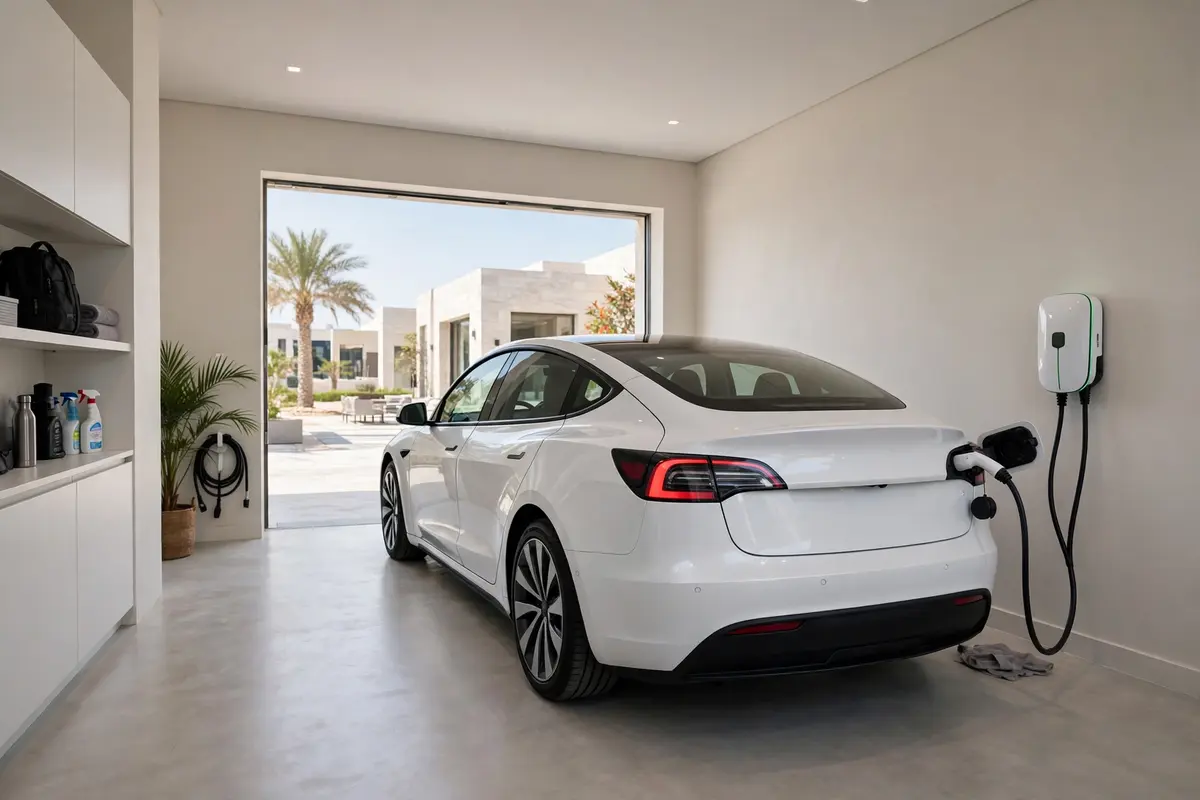
The second way is a Level 2 AC wallbox. This is the right choice for most homes. A wallbox runs at 7 kW on a single-phase supply. It runs at 11 kW or 22 kW on a three-phase supply. A 7 kW wallbox adds about 35 to 45 km of range per hour. An 11 kW wallbox adds about 55 to 65 km per hour. Most cars charge overnight in 6 to 8 hours on a wallbox. The UAE standard socket is Type 2. Most cars sold in the UAE use a Type 2 AC inlet. Check your car manual before you buy a charger.
The third way is DC fast charging. It does not belong in a home. A DC fast charger needs a huge supply and costs a fortune. Home owners shouldn’t ask for one. A wallbox is the home answer.
Check your car’s AC limit before you pick a wallbox. Many cars take 7.4 kW AC at most. Some take 11 kW. A 22 kW wallbox on a car that takes 7.4 kW still charges at 7.4 kW. You pay for power you can’t use. Read the car spec sheet. Match the wallbox to the car.
Check your home supply first to install home EV charger UAE
Open the distribution board. The main switch shows the supply size. A villa with a 63 amp main switch has less spare power. A villa with a 100 amp main switch has more. Count the heavy loads. Air conditioning is the biggest. A villa with four AC units may have little spare power on a hot afternoon. A load study answers the question properly. A qualified electrician measures the real load and the spare capacity. The study takes an hour. It stops a costly mistake.
Single-phase and three-phase supplies differ. A single-phase home caps a wallbox near 7.4 kW. A three-phase home can run 11 kW or 22 kW. Most new villas in Dubai have three-phase supply. Older villas may not. The main switch tells the story. A switch two modules wide is often single-phase. A switch three or four modules wide is often three-phase. Ask your electrician to confirm. Do not guess from the switch alone.
Approvals and who must fit the charger
DEWA says a home charger should be fitted by a DEWA-approved electrical contractor. That rule shapes every plan to install home EV charger UAE. The contractor works behind your meter. The contractor knows the DEWA rules. The contractor files any needed application. Ask for proof of DEWA approval before you book. A contractor who cannot show it is the wrong contractor. Self-installation isn’t allowed for a fixed wallbox. An unlicensed handyman can void your home insurance. It can also put your family at risk. A wallbox draws a high current for hours. Bad wiring can start a fire.
DEWA’s EV charging regulation covers private chargers too. The current version says anyone who fits private charging equipment must follow the DEWA procedure. The install must also comply with the technical regulations. Your contractor makes the application. Ask for the application reference number once it is filed. Keep it with the charger papers.
Apartment owners need one more paper. A No Objection Certificate from building management or the Owners Association comes before work starts. The NOC covers the cable route, the bay, and the metering. The charger must connect behind your own meter. A shared meter cannot feed a private charger. Some buildings allow a cable from your unit to your bay. Some do not. Ask building management first. A wallbox fitted without an NOC can be ordered out.
Tip: In Abu Dhabi, the distribution company for your area handles the connection. ADDC covers Abu Dhabi city and AADC covers Al Ain. A dedicated meter may be required there.
Install home EV charger UAE step by step
Step one to install home EV charger UAE is the survey. The contractor visits your home. He checks the board and the supply. He also checks the cable route and the parking bay. He measures the cable length. He checks the wall where the charger will sit. He asks about your car and its AC limit. A good survey takes 30 to 60 minutes. It ends with a written quote. The quote should list the charger, the cable, and the breaker. It should also list the labour and any load upgrade. Get two or three quotes. Compare the same scope.
Step two is the approval. The contractor files the DEWA application where needed. The building NOC is arranged in parallel for apartments. Work must not start before the NOC is in hand.
Step three is the install. The electrician fits a dedicated circuit from the board to the charger. A dedicated breaker protects that circuit. The cable runs in conduit. Outdoor parts need weatherproof ratings. UAE summer heat passes 50 degrees. The wallbox and the isolator should carry an IP65 rating. The cable route should avoid sun and water where possible. The electrician tests the charger with your car before he leaves.
Note: Published installer guides list a standard villa wallbox job at AED 2,400 to AED 5,000 fitted. That band is a typical market range from published guides. It covers the load study, the charger, and the install on a short cable run. Long cable runs, board work, and apartment car parks cost more and are quoted after a survey. Ask for a written quote for your home. Never budget on a headline figure alone.
Costs and mistakes to avoid
The wallbox is one cost. The install is another. The cable is a third. A long cable run adds hundreds of dirhams. A board upgrade adds more. Ask for each line in the quote. A single lump sum hides the real cost.
Running costs are simple. The charger uses home electricity. Check your DEWA tariff band on your bill. The saving against petrol is large for most drivers. Public stations stay useful for long trips. They are a backup, not a daily need.
The first mistake is buying the charger before the survey. A charger bought online may not fit your supply. Survey first. Buy second. The second mistake is the cheapest quote with no load study. A wallbox that trips the main breaker every night isn’t a bargain. The third mistake is a loose extension cord. It is a fire risk. Fit a fixed circuit.
The fourth mistake when you install home EV charger UAE is skipping the building NOC in an apartment. A charger fitted without it can be removed at your cost. The fifth mistake is ignoring the warranty. A wallbox warranty of two to three years is normal. Buy from a supplier with a UAE service team. Readers who compare EVs can read our guide to the best electric cars in UAE. Our guide to buy a new car in UAE helps too. BoloSara24 readers ask us about EV costs each week. BoloSara24 also covers the power side. Our guide to DEWA new connection in UAE explains a fresh supply. Readers who want the full country picture can read our guide. It covers how to charge an electric car at home in UAE. Insurance matters too. Our guide to car insurance for electric cars in UAE explains the cover EV owners need.
Warning: Never charge a car with a damaged cable. A cracked plug or a cut cable can shock or burn. Replace the cable before the next charge. A damaged wallbox should be switched off at the breaker until an electrician checks it.
Frequently Asked Questions
Do I need DEWA approval to install a home EV charger in Dubai?
Yes, in practice. DEWA’s EV charging regulation says private charging equipment must follow the DEWA procedure to obtain approval. Your DEWA-approved contractor makes the application. Ask for the reference number.
How much does a home EV charger cost in the UAE?
Published installer guides list a standard villa job at AED 2,400 to AED 5,000 fitted. That is a typical market range. Long cable runs, board work, and apartment installs cost more. Get a written quote after a survey.
Can I install an EV charger in an apartment parking bay?
Yes, if building management agrees. You need a No Objection Certificate from the building or the Owners Association. The charger must connect behind your own meter. Some buildings do not allow it. Ask first.
What size wallbox should I buy for my car?
Match the wallbox to your car’s AC limit. Many cars take 7.4 kW. Some take 11 kW. A 22 kW wallbox on a 7.4 kW car still charges at 7.4 kW. Read the car spec sheet before you buy.
Does a home EV charger raise my DEWA bill a lot?
It adds the car’s electricity use to your normal bill at home rates. A driver who covers 40 km a day uses about 8 kWh a night. Home rates are lower than public charging tariffs. Most drivers save money against petrol.
Can I use the DEWA Green Charger card for my home wallbox?
No. The Green Charger card works on the public DEWA network. A home wallbox runs on your own meter and your normal bill. The card does nothing at home.
Official Sources
DEWA: EV Charging: The EV Green Charger programme, charger types, and public tariffs.
DEWA: EV Account and Charging Card Management: How to create an EV account and get a Green Charger card.
Disclaimer
BoloSara24 is an independent guide. It is not DEWA, a utility, or a licensed electrical contractor. This article gives general information about home EV charging in the UAE. It is not electrical or legal advice. Rules, tariffs, and fees can change. Confirm the live rules with DEWA or your distribution company and hire a licensed contractor for the install.
Last Updated: 29 November 2026.