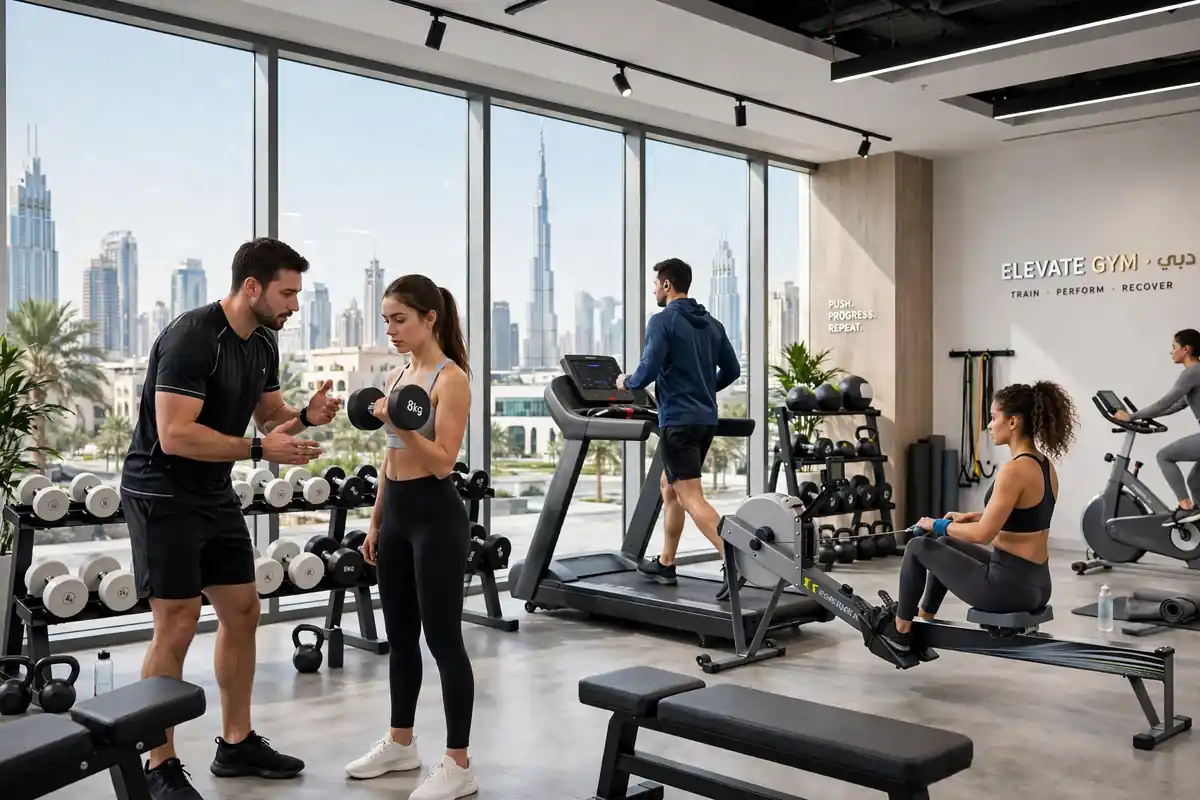
Morning in Dubai starts early at the gym. Runners hit the treadmills before work. A trainer counts reps in the corner. A new member signs up at the desk. Fitness is big business here, and it keeps growing.
A gym is not a normal shop. You cannot just rent a hall, buy machines, and open the doors. Four bodies watch over a gym in Dubai. DET issues the trade licence. Dubai Sports Council approves the sports side. Dubai Municipality checks health and safety. Civil Defence checks fire safety. Miss one and the doors stay shut.
Here is the full path from the first plan to the first member. It names the approvals, the papers, the trainer rules, and the costs you can plan for.
Quick Answer: A gym business in UAE needs a DET trade licence with a fitness centre activity. It also needs Dubai Sports Council approval, Municipality health clearance, and Civil Defence fire approval. Every trainer must hold a recognised qualification and register with the Sports Council. Plan six to twelve weeks for approvals and a bigger budget for fit-out and machines.
What Kind of Gym Will You Open
Pick your model before you spend a dirham. A full service gym has cardio machines, weights, classes, and showers. A boutique studio runs small group classes in one room. A personal training studio serves one client at a time. A ladies only gym serves women in a private space. Each model needs a different size, a different team, and a different budget.
Your model also shapes your licence activity. DET lists fitness centre and sports training activities. Pick the activity that matches what you will really do. A studio that adds boxing classes later may need an activity change. Get the activity right on day one.
Think about the floor. A gym needs strong floors, high ceilings, and good air flow. Machines weigh a lot. Members sweat a lot. A hall with low ceilings and weak air conditioning will fail the Municipality check. Visit the site with a contractor before you sign the lease.
Omar planned a boutique studio in JLT. He first looked at a cheap office unit. The ceiling was low. The floor could not take heavy racks. His contractor told him to walk away. Omar found a ground floor retail unit instead. It cost more rent. It passed every check first time.
The Four Approvals in Order
Four approvals stand between you and opening day. The order saves you time.
First, DET gives initial approval for the trade name and activity. You apply through Invest in Dubai or the Dubai REST app. Initial approval is a no-objection note. It doesn’t let you trade.
Second, Dubai Sports Council reviews your plan. The Council regulates sports establishments in Dubai under Executive Council Resolution No. 1 of 2020. It checks your concept, your floor plan, your programmes, and your coaches. Get this approval before you finish the fit-out. A late change to the floor plan costs money.
Third, Dubai Municipality checks health and safety. It checks hygiene, air flow, showers, and pest control. It also checks the changing areas. It inspects the site after fit-out.
Fourth, Civil Defence checks fire safety. It looks at alarms, extinguishers, exits, and emergency lights. Run this check in parallel with the Municipality check to save time.
Only then does DET issue the final trade licence. The licence runs for one year. You renew it each year with fresh approvals where needed.
BoloSara24 checked the Dubai legislation portal on 29 November 2026. Executive Council Resolution No. 1 of 2020 sets the rules for sports establishments in Dubai. The Dubai Sports Council registers coaches and staff under the rules it makes. That is why trainer papers matter so much in a gym file.
Trainer Rules You Cannot Skip
Trainer papers delay more gym openings than any other item. Plan for them early.
Personal trainers usually need a recognised Level 3 personal training qualification. REPs UAE Level 3 is the common standard. NASM, ACE, and ACSM hold similar standing. Group instructors usually need Level 2. Every coach also needs a current CPR and first aid certificate.
Every trainer must register with Dubai Sports Council through your gym. A trainer cannot start work before that registration is done. Ask each trainer for papers before you offer them a job. A trainer with no papers is a trainer you cannot use.
Check the papers yourself. Look at the issue date. Look at the expiry date. A lapsed CPR certificate blocks the whole file. Keep copies of every certificate in one folder. The Council may ask for them at any time.
Tip: Hire your head coach first. A good head coach knows the Council rules. They can check the other trainers papers for you. They can also shape the class timetable before you buy machines.
What a Gym Business in UAE Costs
No two gyms cost the same. Size, site, and machines drive the total. Advisers report licensing alone at about AED 30,000 to AED 60,000 for a Dubai gym. A small boutique studio needs AED 300,000 to AED 600,000 in its first year. A mid-size fitness centre needs AED 600,000 to AED 1,200,000. Treat these as planning ranges from adviser reports, not as official fees.
Machines eat the biggest share. A full set of cardio machines, racks, free weights, and mats can cost AED 200,000 or more. Buy quality machines with a service deal. Cheap machines break. Broken machines sit idle and members leave.
Fit-out comes next. Floors need rubber mats and shock pads. Showers need good drains. Air conditioning must handle a full class at peak hour. Get three quotes from contractors who have built gyms before. A contractor who has never built a gym will miss the floor loading and the air flow.
Staff costs run every month. Trainers, front desk staff, and cleaners all need visas through MOHRE. You need an establishment card before you can hire. MOHRE lists its establishment card service at 2 working days.
| Gym type | First year range (AED) | Main cost driver |
|---|---|---|
| Personal training studio | 160,000 to 400,000 | Rent and a few machines |
| Boutique studio | 300,000 to 600,000 | Fit-out and class kit |
| Mid-size fitness centre | 600,000 to 1,200,000 | Full machine set and staff |
The table shows adviser ranges. Confirm each fee with DET and the Sports Council before you pay.
Pick the Site With Care
Site choice makes or breaks a gym. Members pick the gym near home or near work. Site choice shapes any gym business in UAE more than ads do. A gym far from homes and offices stays empty.
Look for parking. Members drive to the gym. No parking means no members at peak hour. Look for a ground floor or a lift that fits machines. A narrow stair blocks delivery of a treadmill.
Check the lease terms. Register the lease on Ejari. The registered lease is part of your licence file. A lease shorter than one year can cause trouble at renewal time.
Check the neighbours too. A gym makes noise. Weights drop. Music plays. A site above a quiet office or under flats can bring complaints. Talk to the building manager before you sign.
Note: The Sports Council approval should shape your fit-out, not follow it. Submit your concept and floor plan early. A late change to the plan costs weeks.
Money, Tax, and Members
Register for VAT with the Federal Tax Authority once your taxable supplies pass AED 375,000 in 12 months. The FTA states this threshold on its VAT registration page. You can register voluntarily from AED 187,500. Membership fees count toward the total. Watch the number as members join.
Register for Corporate Tax as well. Your accountant can file it on the FTA EmaraTax portal in your first months.
Price your memberships with care. A gym business in UAE lives or dies on steady members, not on day one sales. A low price fills the gym fast and leaves no money for repairs. A high price scares off new members. Look at three gyms near your site. Price in the same band. Offer a short trial so new members can test the space.
Keep your insurance live. Public liability insurance covers a member who slips or a machine that fails. The Council and the Municipality both ask about safety. Insurance is part of that answer.
Track your members. A member who stops coming for two weeks may leave soon. A short message can bring them back. A gym keeps members with care, not with machines alone.
Common Mistakes That Delay Opening
New gym owners repeat the same errors. Avoid them.
Don’t buy machines before the Council approves your floor plan. A machine that does not fit the approved plan is wasted money.
Don’t hire trainers before you check their papers. A trainer with no Level 3 paper cannot work as a personal trainer in Dubai.
Don’t sign a lease on a unit with weak floors or low ceilings. The Municipality will fail the site. You lose the deposit.
Don’t skip the insurance. A claim without insurance can close a small gym in one stroke.
Don’t open before the final licence is in hand. Initial approval is not a licence. Trading on it can bring fines.
Do and Dont: Do get Sports Council approval before fit-out ends. Do check every trainer paper yourself. Do buy machines with a service deal. Do keep insurance live. Don’t trade on initial approval alone. Don’t sign a lease before a contractor checks the floor.
What to Remember
A gym business in UAE needs four approvals in the right order. DET gives the licence. Dubai Sports Council approves the sports side and the coaches. Dubai Municipality checks health and safety. Civil Defence checks fire safety. Trainers need Level 3 papers and Council registration.
Budget with ranges. Confirm fees with the authorities. BoloSara24 checks every fee claim on the official page before it prints it. Pick a site members can reach. Hire a head coach early. Keep the space clean, safe, and full of life. Members stay where they feel looked after. That is the simple truth BoloSara24 hears from gym owners across Dubai.
Frequently Asked Questions
How much does it cost to open a gym in UAE?
Advisers report licensing at about AED 30,000 to AED 60,000. A boutique studio needs AED 300,000 to AED 600,000 in year one. A mid-size centre needs AED 600,000 to AED 1,200,000. Machines and fit-out drive the total.
Do I need Dubai Sports Council approval for a gym?
Yes. The Council regulates sports establishments in Dubai under Executive Council Resolution No. 1 of 2020. You need its approval before DET issues the final licence.
What qualification does a personal trainer need in Dubai?
Personal trainers usually need a recognised Level 3 qualification, like REPs UAE Level 3, NASM, ACE, or ACSM. They also need current CPR and first aid certificates and Council registration.
Can a foreigner own 100% of a gym in Dubai?
Yes, for most fitness activities on the mainland since the 2021 company law change. Confirm your activity with DET before you sign anything.
How long does it take to open a gym in Dubai?
Approvals take six to twelve weeks on a clean file. Fit-out and machine delivery add more time. Plan four to six months from idea to opening day.
Do I need VAT registration for a gym?
You must register for VAT once taxable supplies pass AED 375,000 in 12 months. The FTA states this threshold. You can register voluntarily from AED 187,500.
Official Sources
u.ae: Steps to Start a Business on the Mainland: The UAE portal lists the nine steps to set up a business.
MOHRE: Issuance of Establishment Card: MOHRE lists the card rules, 2 working days, and a fee of AED 406.
Federal Tax Authority: Registration for VAT: The FTA states the VAT thresholds of AED 375,000 and AED 187,500.
Dubai Sports Council: The Council regulates sports establishments and registers coaches in Dubai.
u.ae: Recruiting on the Mainland: The UAE government portal explains how an employer registers staff and gets work permits.
Read more on BoloSara24. fitness trainer jobs in the UAE, lifeguard jobs in the UAE, how to find physiotherapist jobs in the UAE, spa therapist jobs in the UAE, how to start a maintenance company in the UAE, how to start a construction company in the UAE.
Disclaimer: BoloSara24 is an independent site. It is not a bank, a lender, a regulator, an immigration authority, or a government body. It has no link with the UAE government, DET, Dubai Sports Council, or the FTA. Facts here were checked on official sources on 29 November 2026. Rules and fees change, so confirm the current steps with the official authority before you act. This is general information, not legal, financial, or tax advice.
Last Updated: 29 November 2026.