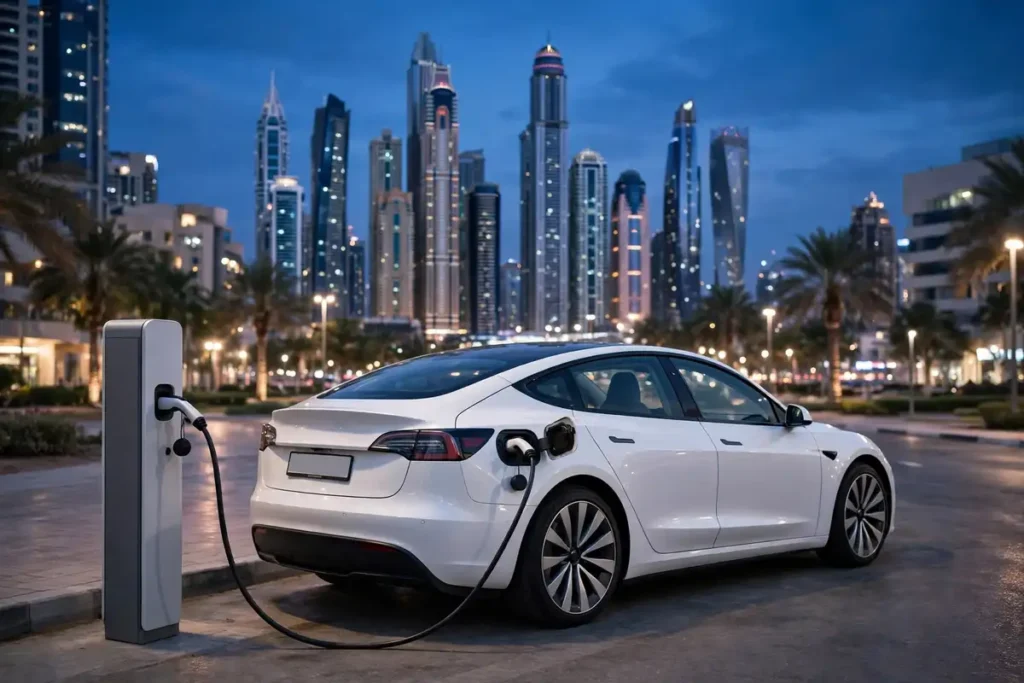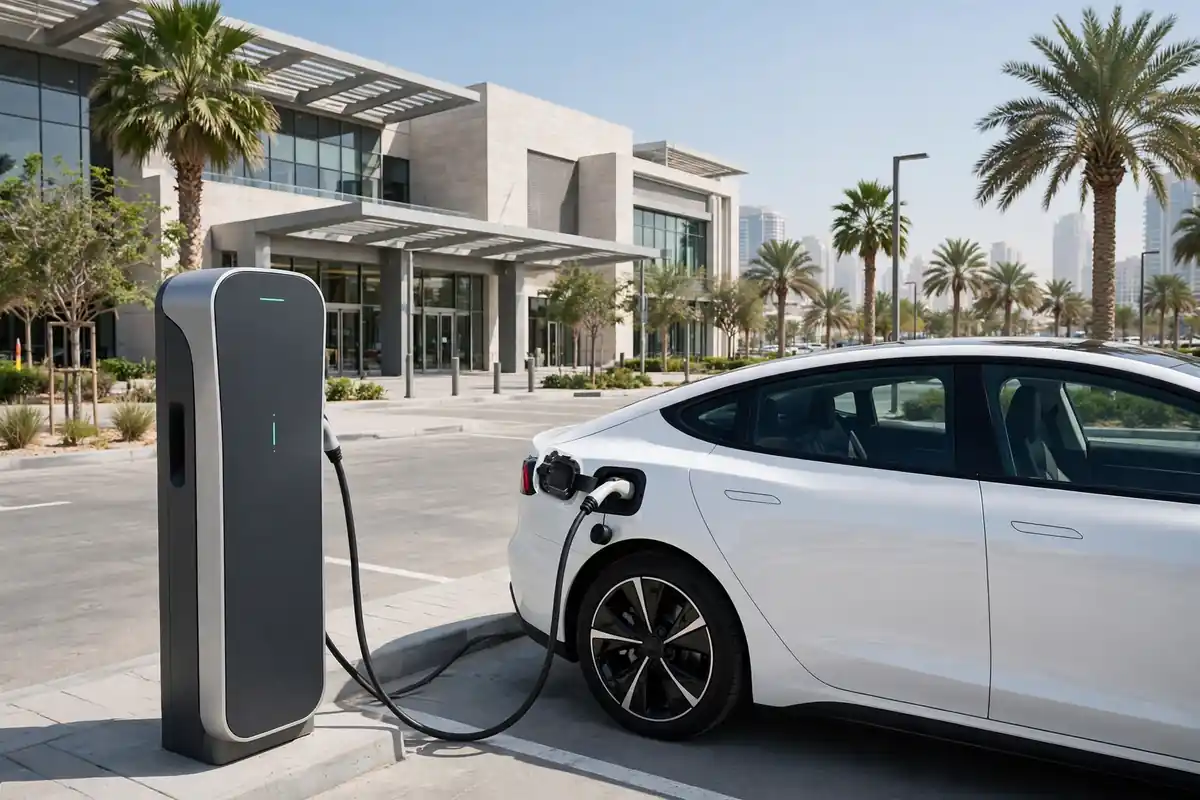
Electric car charging stations UAE now run on one national tariff, so the price is the same at every public charger in the country. A slow AC charger costs AED 0.70 per kWh plus VAT, and a fast DC charger costs AED 1.20 per kWh plus VAT. Free public charging ended in September 2024, and the paid tariff has run since then.
Dubai has the biggest network, run by DEWA through its Green Charger programme. Abu Dhabi has its own network under TAQA Distribution, and a national network called UAEV covers the northern emirates. Your phone finds the nearest charger, and most chargers take a card, an app, or a QR scan.
Quick Answer: Electric car charging stations UAE cost AED 0.735 per kWh with VAT on AC and AED 1.26 per kWh with VAT on DC. DEWA runs the Dubai network with more than 1,860 charge points. Find chargers in the DEWA app, the UAEV app, or on Google Maps.
BoloSara24 checked the tariff and the DEWA charger types on the DEWA EV page and the UAE government energy page on 29 November 2026. Prices can change, so read the tariff screen in the app before you plug in.
Electric Car Charging Stations UAE Prices
The UAE Cabinet set one fee for public EV charging in Cabinet Resolution No. 81 of 2024. The same base rates apply at every public station, no matter which firm runs it.
| Charger type | Base rate | With 5% VAT |
|---|---|---|
| AC, slow or Level 2 | AED 0.70 per kWh | AED 0.735 per kWh |
| DC, fast or express | AED 1.20 per kWh | AED 1.26 per kWh |
A 60 kWh battery shows what the tariff means in real money. A full charge from near empty costs about AED 44 on an AC charger and about AED 76 on a DC fast charger. Home charging costs less, since it runs on your normal home power bill at home rates.
The Cabinet can amend the fees, so the app screen at the charger is the final price. Don't trust a price you saw last month. Read it before you plug in, and check the same screen again on a long trip, since a new operator can join the network with the same tariff but a different app.
Where to Find Electric Car Charging Stations UAE
DEWA runs the Dubai network through its EV Green Charger programme. The programme started in 2014 as the first public EV charging network in the Middle East. By early 2026 it had more than 1,860 charging points across Dubai.
Chargers sit at malls, petrol stations, government buildings, hotels, homes, and DEWA offices. You will find them in most busy districts, from Downtown and Dubai Marina to Deira and Dubai Silicon Oasis, and along Sheikh Zayed Road. Chargers at petrol stations run 24 hours a day. Chargers at DEWA Customer Happiness Centres run from 7:30 am to midnight, Sunday to Saturday.
Find a charger in the DEWA smart app or on the DEWA site under EV Green Charging Stations. The app shows live charger spots and which ones are free, so you don't drive to a busy charger. Google Maps lists many chargers too, and the UAEV app covers the national network in the northern emirates.
Fees: UAEV is the national charging network, set up in May 2024 by the Ministry of Energy and Infrastructure and Etihad Water and Electricity. It plans 1,000 chargers across the country by 2030, with an app to find stations and a 24-hour call centre for drivers. Its first chargers went into the northern emirates, with Dubai and Abu Dhabi to follow.
Abu Dhabi runs its own network under TAQA Distribution, with the Charge AD programme adding 1,000 stations at 400 spots across Abu Dhabi Island, Al Ain, and Al Dhafra. The same national tariff applies there too, so the price is the same as in Dubai.
Electric Car Charging Stations UAE Types and Speeds
DEWA has four charger types, and the speed gap between them is wide. Pick the charger by how much time you have, not by which one is closest.
| Charger type | Power | Socket |
|---|---|---|
| Ultra-fast | 150 kW DC | Type 2 |
| Fast | 43 kW AC, 50 kW DC | Type 2, CHAdeMO, CCS |
| Public | 2 x 22 kW AC | Double Type 2 |
| Wall-box | 22 kW AC | Single Type 2 |
A DC fast charger can add most of a charge in 30 to 50 minutes, so it suits a motorway stop or a quick top up. A full AC charge takes several hours, so it suits a mall visit, a workday, or an overnight stop. A wall-box charger at home fills the car overnight while you sleep.
Your car sets the real speed too. A car that takes only 50 kW won't charge faster on a 150 kW charger, and an older car with a CHAdeMO port needs a charger with that socket. BoloSara24 suggests you check your car port type before your first public charge, and save the charger types that fit your car in the app.
Tip: Charge to 80% at a fast charger and move on. The last 20% fills slowly on most cars, and another driver may wait for the plug. A short top up at 80% saves you time and keeps the queue moving.
How to Pay at Electric Car Charging Stations UAE
Two ways to pay exist on the DEWA network. Registered users hold a Green Charger card, and DEWA bills the charge to their DEWA account. DEWA issues the card and delivers it within three working days of you opening an EV account.
Guest mode suits visitors and rental drivers. You scan the QR code on the charger, pick a charging pack or amount, and pay by card or Apple Pay. You don't need an account, and no card is posted to you.
Good to Know: Some chargers add an idle fee when your car stays plugged in after the charge ends. The fee pushes drivers to free the plug for the next car. Move your car as soon as the app says the charge is done, and check the tariff screen for the idle rule at that charger.
Hassan drives a family EV in Dubai and charges at home each night. He pays home power rates on his DEWA bill, so a full charge costs him far less than a public DC charge. On a Friday trip to Abu Dhabi he stops at a DC fast charger on the highway, adds 40 kWh in about half an hour, and pays about AED 50. He plans the stop in the app before he leaves, so he doesn't wait for a free plug.
Home Charging for Electric Cars in UAE
Home charging is the cheapest way to run an EV in the UAE. DEWA bills home charging on your normal DEWA bill at home power rates. A full 60 kWh charge at home costs about AED 18 to AED 28, against AED 44 on a public AC charger and AED 76 on public DC.
A home charger needs a DEWA-approved electrical contractor to fit it. DEWA technical rules start the job with an enrolled consultant or contractor, and a flat in a tower needs the owner or developer no-objection for the electrical work. Ask your building management first, since some towers already have shared chargers in the car park.
New green buildings in Dubai must set aside 5% of parking bays for green vehicles. That rule comes from the Dubai Green Building Regulations, and it means more towers now have charger bays ready to use. Check your tower car park before you pay for a private charger.
Note: The UAE National Electric Vehicles Policy aims for electric cars to reach 50% of all cars on UAE roads by 2050. The policy also aims to cut energy use in transport by 20% and to build a national charger network with one central list of stations. More chargers will open each year, so the map in your app is worth a fresh look before each long trip. BoloSara24 updates this page when DEWA adds chargers or changes the tariff.
Do you rent your home? Ask your landlord in writing before you fit a charger, and keep the approval with your tenancy papers. A charger fitted without approval can cost you the deposit when you move out.
For the power bill side, the DEWA bill payment guide explains how to pay online. The DEWA transfer guide covers moving your DEWA account to a new home. If you plan to buy an EV, the car loan guide lists loan steps. The used car guide helps when you buy a second hand EV. The rent a car guide lists rental cars, some of them electric.
Frequently Asked Questions
How much does it cost to charge an electric car in UAE?
Public AC charging costs AED 0.70 per kWh plus VAT, which is AED 0.735 in total. Public DC fast charging costs AED 1.20 per kWh plus VAT, which is AED 1.26 in total. A 60 kWh charge costs about AED 44 on AC and about AED 76 on DC.
Where are electric car charging stations in UAE?
DEWA runs more than 1,860 charge points in Dubai at malls, petrol stations, government buildings, and hotels. Abu Dhabi has its own network, and UAEV covers the northern emirates. Find them in the DEWA app, the UAEV app, or on Google Maps.
Is EV charging free in UAE?
No. Free public charging for non-commercial users ended on 30 September 2024. Since then the national tariff applies at every public charger, and home charging runs on your normal home power bill.
What is the DEWA Green Charger in UAE?
It is the public EV charging programme run by DEWA in Dubai. It started in 2014 and has four charger types: ultra-fast, fast, public, and wall-box. Registered users pay with a Green Charger card, and guests pay by QR code.
How long does it take to charge an electric car in UAE?
A DC fast charger can add most of a charge in 30 to 50 minutes. A full AC charge takes several hours, so it suits a mall visit or an overnight stop. Your car port type and battery size set the real time.
Can I charge an electric car at home in UAE?
Yes. A home charger is fitted by a DEWA-approved contractor and billed on your normal DEWA bill at home rates. A flat needs the owner or developer no-objection for the electrical work, so ask your building management first.
Official Sources
- EV Charging, DEWA: Green Charger network, charger types, guest mode, and charging costs.
- Energy Efficiency, UAE Government Portal: National Electric Vehicles Policy, UAEV, and the unified charging tariff.
Disclaimer
BoloSara24 is an independent guide and is not linked to DEWA, TAQA, UAEV, or any government body. Tariffs, charger spots, and app features change, so confirm them in the DEWA or UAEV app before you travel. This page gives general facts only and is not legal, financial, or immigration advice.
Last Updated: 29 November 2026.