Shared accommodation Dubai UAE gives workers a low cost place to live in the city. You rent a bed space or a room in a flat. You share the kitchen and the bathroom with other people. This BoloSara24 guide explains the new rules and the costs. It covers the legal points you must check before you pay a deposit. BoloSara24 checked each fact on the official pages listed at the end.
Quick Answer: Shared housing in Dubai now needs a Dubai Municipality permit under Law No. 4 of 2026. Only the owner or a licensed operator can let rooms or bed spaces. A tenant cannot sublet a room or a bed. Fines run from AED 500 to AED 500,000. Each person must get at least 5 square metres of bedroom space.
What shared accommodation Dubai UAE means
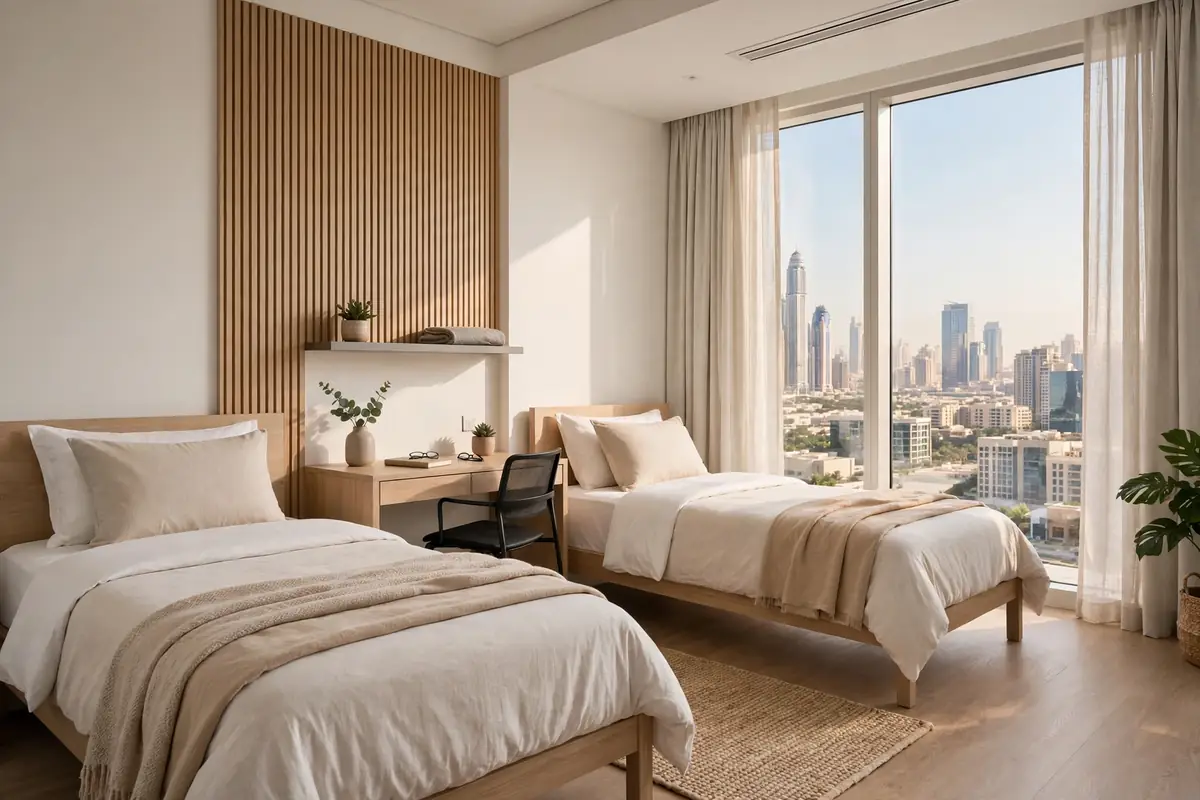
Shared accommodation means a home where people who are not one family live side by side. Each person rents a room or a bed space. All residents share the kitchen, the bathroom, and the living area. You will see ads for bed spaces in areas like Al Rigga, Al Barsha, and International City. The rent is low, and that is why many new workers pick this option first.
A bed space is one bed in a shared room. A room is a private bedroom in a shared flat. A partition room is a room made by adding a wall inside a flat or a living area. The law treats all three as shared accommodation Dubai UAE when the home is let to more than one household. You must know which type you rent, because the rules on space and safety apply to all of them.
Shared accommodation Dubai UAE is not the same as a hotel or a holiday home. A holiday home is a whole flat let to guests for short stays, and it needs a DET permit. Shared housing is a home where residents live for months at a time. You can read our guide on short term rental in Dubai UAE if you want to compare the two options.
The new law for shared accommodation Dubai UAE
Dubai issued Law No. 4 of 2026 to regulate shared housing. The law covers the occupancy and the management of shared homes in the emirate. It came into force on 8 September 2026. The Dubai Government announced the law through the Dubai Media Office, and Dubai Municipality now runs the permit system.
The law sets three clear rules. First, no person can use a unit for shared housing without a permit from Dubai Municipality. Second, only the owner or an authorised establishment can let a shared unit. Third, the unit must meet space, safety, and health standards. The law also says that collective labour accommodation falls under separate rules and is not part of this law.
Important: A tenant can’t sublet any part of the home. If you rent a flat and then let a bed to someone else, you break the law. The owner must give the let, or a licensed operator must run it. Ask who owns the flat before you pay.
Who can let a shared home
Only two parties can let shared housing in Dubai. The owner of the property can let it direct. A licensed establishment can also let it if the owner authorises it. The establishment must hold a licence to lease and manage real estate units. A tenant has no right to let a room or a bed to another person.
Ask the person who shows you the room for proof. Ask for the title deed or the owner details. Ask for the Dubai Municipality shared housing permit for the building. A real owner or a licensed operator will show these papers. If the person refuses, walk away and look for another place. You’ll find a legal room if you keep looking.
Permit rules and approved areas
Every building used for shared housing must hold a permit from Dubai Municipality. The permit is issued for one year. The owner can ask for a two year permit, and the Municipality can agree. Renewal must be filed at least 30 days before the permit ends. Permits are issued and renewed through the Build in Dubai platform.
Dubai Municipality has named more than 44 areas where buildings may be used for shared housing. The first named areas include Al Souq Al Kabeer and Al Ras. They also include Al Warqa 1, Al Barsha 1, Al Muraqqabat, and Al Rigga. More areas will be added once they are approved. A building outside an approved area can’t get a shared housing permit.
Each building must take one category only. A building is for individual accommodation or for family accommodation. It cannot mix the two. Each family needs a separate bedroom with its own bathroom. The guide also limits land along some main roads to family housing only. Check the area and the category before you sign anything.
Note: Buildings already used for shared housing have one year from 8 September 2026 to meet the new rules. The grace period ends on 8 September 2027. The grace period does not excuse building violations or unsafe changes. It only gives owners time to fix papers and standards.
Space, safety, and facility standards
The Dubai Municipality guide sets a clear space rule. Each person must get at least 5 square metres of bedroom space. A small room cannot hold four beds and still meet this rule. Count the beds and measure the room in your head before you agree. If the room feels packed, it is likely over the limit.
Safety checks come before a permit is issued. The building must meet Dubai Civil Defence rules for fire alarms and firefighting systems. It must also meet SIRA rules for CCTV. These checks protect you if a fire breaks out at night. Don’t live in a place with blocked exits, no fire alarm, or locked windows.
Costs of shared accommodation Dubai UAE
Bed space rent in Dubai varies by area, room size, and the number of people in the room. BoloSara24 doesn’t publish a rent figure here. Rents change fast, and no official page lists a fixed rate for bed spaces. Ask for the full monthly cost in writing before you pay. The cost must cover rent, DEWA, and any service charge, or the ad must state what is extra.
Most bed space lets ask for a deposit. The deposit is often one month of rent. Ask for a receipt for every payment you make. Pay by bank transfer or cheque when you can, so you have proof. Cash with no receipt is a risk you do not need.
| Cost item | What to check |
|---|---|
| Monthly rent | Get the full amount in writing, with DEWA included or listed as extra |
| Deposit | Ask for a receipt and the refund terms in writing |
| DEWA and internet | Ask who pays and how the cost is split |
| Service charge | Ask if the building charges a fee and who pays it |
| Notice period | Ask how many days of notice you must give before you leave |
Tip: Never pay a full year in advance for a bed space. A month to month deal is safer for a new worker. You can move if the place is bad. You also lose less money if the let turns out to be illegal.
Tenancy registration and Ejari
Dubai Municipality permit data is linked by computer to the Dubai Land Department. Tenancy contracts for buildings and villas set for shared housing are registered on that basis. The Dubai Land Department runs the electronic lease register, and Ejari is the tenancy registration system for Dubai.
You can read our guide on how to check Ejari status online in UAE to learn how the system works. Keep a copy of your contract and your payment receipts. Keep the owner or operator contact details on your phone. These papers help you if a dispute arises later. See our guide: how to apply for Emirates ID in UAE.
Fines for breaking the rules
The law sets fines from AED 500 to AED 500,000 for breaches. The fine depends on how serious the breach is. A repeat breach within one year can double the fine, up to a cap of AED 1 million. The fine can fall on the owner, the operator, or the person who lets the unit without a permit.
How to check a bed space before you pay
Use this check before you hand over any money. First, meet the owner or the licensed operator in person. Second, ask for the shared housing permit and the title deed. Third, check the area is on the approved list. Fourth, count the beds and check the space rule of 5 square metres per person. Fifth, test the fire alarm and look at the exits.
Then read the contract. The contract must name the landlord, the resident count, and the space per person. It must state the rent, the deposit, and the notice period. If there is no written contract, do not pay. A verbal promise is hard to prove if things go wrong.
Checklist: Permit shown. Title deed shown. Area approved. Space rule met. Fire alarm works. Exits clear. Written contract in hand. Receipt for deposit. DEWA split clear. Notice period agreed. If any item fails, keep looking. Dubai has many legal options, and a bad room is not worth the risk.
Common mistakes workers make
The first mistake is to pay a deposit on the first visit. Take time to check the papers and the place. The second mistake is to trust a photo on social media. Photos hide partitions, damp walls, and crowded rooms. Visit the flat in person and visit at night if you can.
Example: A worker pays AED 1,000 as a deposit for a bed in a partitioned room. The tenant who took the money has no permit and no right to let. The owner finds out and asks all residents to leave in a week. The worker loses the deposit and has no contract to show. This is why you must check the owner and the permit first.
Summary of shared accommodation Dubai UAE rules
Shared accommodation Dubai UAE is legal with a permit. The unit must hold a Dubai Municipality permit. The owner or a licensed operator must let it. The law is Law No. 4 of 2026, in force since 8 September 2026. Each person needs 5 square metres of bedroom space. Fines run from AED 500 to AED 500,000. Existing units have until 8 September 2027 to meet the rules.
BoloSara24 says: check the permit, the owner, the area, and the space before you pay. Get a written contract and a receipt for every payment. Never sublet a bed. You can find more UAE property guides on BoloSara24. BoloSara24 will update this guide when Dubai Municipality names new approved areas or changes the rules.
Frequently Asked Questions
Is shared accommodation legal in Dubai?
Yes, it is legal when the unit holds a Dubai Municipality permit under Law No. 4 of 2026. Only the owner or a licensed operator can let it. A unit with no permit is not legal shared housing.
Can a tenant sublet a bed space in Dubai?
No, a tenant cannot sublet any part of the home. The law gives the right to let only to the owner or an authorised establishment. A tenant who lets a bed breaks the law.
How much space must each person get in shared housing?
Each person must get at least 5 square metres of bedroom space under the Dubai Municipality guide. Families must also have a separate bedroom with its own bathroom.
What is the fine for illegal shared housing in Dubai?
Fines run from AED 500 to AED 500,000. A repeat breach within one year can double the fine, up to AED 1 million. The fine depends on how serious the breach is.
Which areas allow shared housing in Dubai?
Dubai Municipality has named more than 44 approved areas. The first named areas include Al Souq Al Kabeer and Al Ras. They also include Al Warqa 1, Al Barsha 1, Al Muraqqabat, and Al Rigga. More areas will be added once approved.
Do I need an Ejari contract for a bed space?
Tenancy contracts for shared housing are linked to the Dubai Land Department register. Ask the owner or operator if your tenancy will be registered. A registered contract gives you proof of address for your Emirates ID and bank file.
Official Sources
- Dubai Government Protocol, Law No. 4 of 2026 announcement: Dubai Government notice that sets out the shared housing law, the permit rule, and the fine range.
- Dubai Land Department: DLD home page for property services, tenancy registration, and the Dubai REST app.
- Dubai Land Department, All Services: DLD service list that covers property registration, title deed checks, and property status enquiries.
Disclaimer: This guide gives general information only. It is not legal advice. Rules can change. Check the official pages above first. Speak to Dubai Municipality before you sign a contract or pay a deposit.
Last Updated: 29 November 2026.