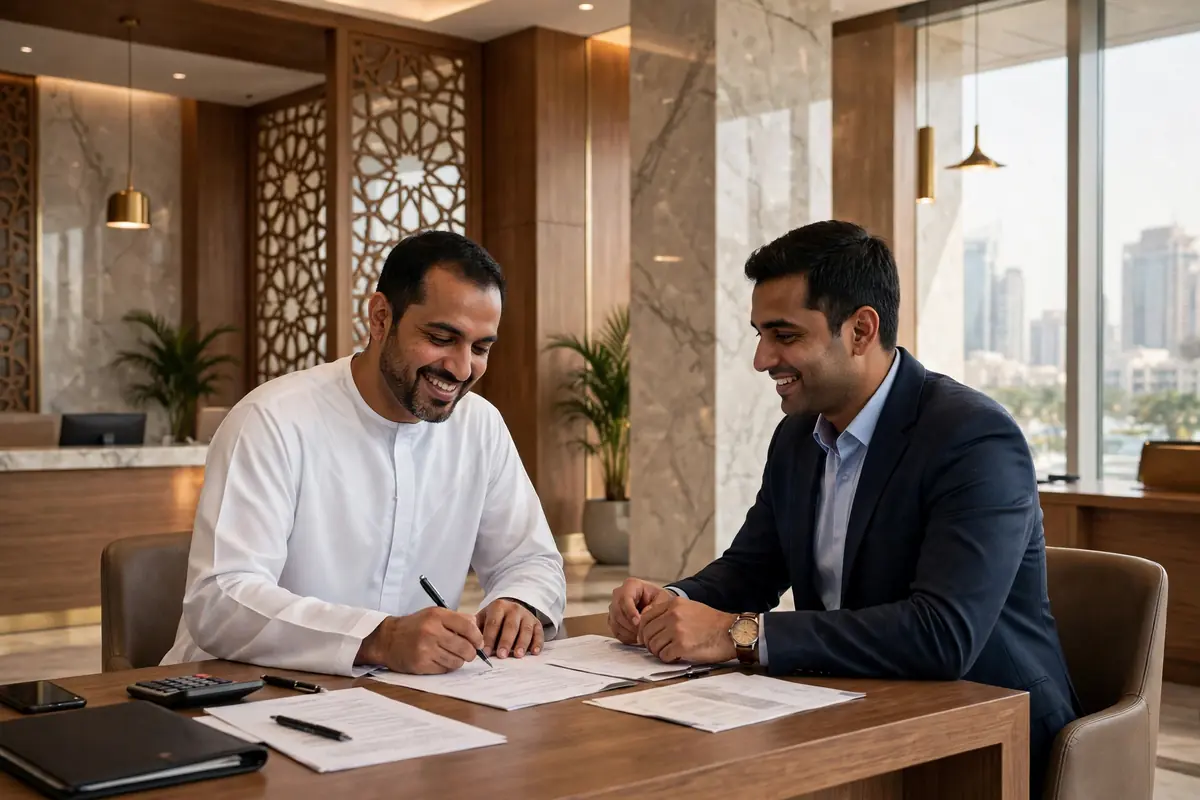
Murabaha finance UAE Islamic banks offer is a cost-plus sale, not a loan. The bank buys an asset first. It then sells that asset to you at its cost plus a fixed profit. You pay the total price in instalments. The price stays fixed from the day you sign.
BoloSara24 checked the Emirates Islamic personal finance page and its Key Facts Statement on 29 November 2026. The bank states its personal finance is based on Murabaha. The bank sells EI Funding Certificates to the customer at cost plus profit. Each certificate is valued at USD 10 and sits in Nasdaq Dubai. The flat profit rate runs from 2.00% to 10.00% a year. Those facts are the base for this page.
Quick Answer: Apply at an Islamic bank or an Islamic window of a normal bank. You need a salary of at least AED 7,500 a month at Emirates Islamic, a valid visa and three months of bank statements. The bank buys the certificates, sells them to you at cost plus profit, and you sell them for cash. You pay the fixed total in monthly instalments for up to 48 months.
How Murabaha finance UAE banks run it
A Murabaha deal has three steps. The bank buys the asset. The bank sells it to you. You pay over time. The bank must own the asset before it sells it to you. That order is what makes the deal a sale, not a loan.
In a personal finance deal, the asset is a set of certificates. Emirates Islamic sells you EI Funding Certificates. These certificates stand for a share in Sharia-compliant assets like sukuk, shares and real estate. Each one is worth USD 10. The bank sells them to you at the finance amount plus the agreed profit. You then sell the certificates through a broker. The cash lands in your account.
In a car deal, the asset is the car. The bank buys the car from the dealer. It sells the car to you at the dealer price plus its profit. You drive the car and pay the bank in instalments.
The total price is fixed at signing. The profit cannot rise later. The bank can’t tie the price to a market index after the deal is signed. That fixed price is the key fact to check in your offer letter. Ask the bank to show the total profit sum in dirhams, not just a rate. BoloSara24 checked the Emirates Islamic and FAB pages named at the end of this page on 29 November 2026.
Who can apply
Islamic banks serve salaried staff and self-employed people. The exact gates change from bank to bank. Emirates Islamic sets the bar at a minimum salary of AED 7,500 a month for UAE nationals and expats. You need at least one month of service or your first salary credit into your Emirates Islamic account. You must be at least 21 years old. That’s the floor. The top age at the end of the term is 65 for UAE nationals and 60 for expats.
FAB Islamic sets its own gates. Its Islamic personal finance starts at a profit rate of 5.40% fixed a year. It offers up to AED 5 million. It asks for a minimum salary of AED 7,000 a month. It gives up to 365 days before the first instalment for some customers. Compare the gates at two banks before you pick one.
Khalid is a 34-year-old teacher in Sharjah. He earns AED 12,000 a month. He needs AED 80,000 for a home repair. He applies for Murabaha personal finance at Emirates Islamic. His salary clears the AED 7,500 bar. His age fits the 21 to 60 range for expats. The bank offers him 48 months. His total price is fixed on the day he signs. He knows the full cost before he takes the cash.
Self-employed applicants face more checks. The bank asks for a trade licence, bank statements and proof of income. A salaried applicant with a steady salary credit moves faster.
What murabaha finance UAE costs
The cost of Murabaha finance has four parts. The profit is the main part. The processing fee is the second part. Takaful cover is the third part. The late payment fee is the fourth part, and it goes to charity, not to the bank.
Emirates Islamic lists a flat profit rate from 2.00% to 10.00% a year in its Key Facts Statement. The annual percentage rate runs from 2.38% to 10.38% a year. Your own rate sits inside that range. It depends on your salary, your employer and your credit record. Ask for your own rate in writing before you sign.
| Cost part | Emirates Islamic figure |
|---|---|
| Flat profit rate | 2.00% to 10.00% a year |
| Annual percentage rate | 2.38% to 10.38% a year |
| Processing fee | 0.7875% of the amount, min AED 525, max AED 2,625 |
| Late payment fee | AED 210, paid to charity |
| Early settlement fee | 1.05% of the balance or AED 10,500, whichever is less |
| Top term | 48 months, 60 months for Ministry of Defence staff |
The processing fee is non-refundable. You pay it even if you pull out after approval. That’s the rule. The late fee of AED 210 applies when a monthly payment lands late. It goes to charity under Sharia rules. The bank doesn’t keep it as income.
Tip: Ask for the total profit sum in dirhams on the offer letter. A low rate on a long term can still cost more than a higher rate on a short term. The total sum is the number that matters.
Papers you need to apply
Gather the papers before you visit the bank. A full file moves faster than a half file.
- Completed application form from the bank
- Copy of a valid passport with a UAE residence visa
- Emirates ID copy
- Last three months of bank statements
- Salary transfer letter or salary certificate for salaried staff
- Liability letter if you settle a debt with another bank
- Trade licence and income proof for self-employed applicants
The bank runs its checks on the file. It checks your salary credit, your credit record and your current debts. Emirates Islamic states the process takes 7 to 10 working days after approval in its help pages. Keep your phone close. The bank may call to confirm a fact in your file.
How to apply step by step
- Pick an Islamic bank. Compare the profit rate, the top amount and the first instalment date.
- Read the Key Facts Statement. It lists the rate, the fees and the risks in plain form.
- Fill the application form. State the amount you need and the term you want.
- Send the papers. Upload them in the app or hand them to the branch desk.
- The bank checks your file. It may ask for one more paper or a call.
- The bank sends the Murabaha offer letter. It lists the certificates, the cost, the profit and the instalments.
- Read the offer letter line by line. Check the total price and the monthly sum.
- Sign the offer. The bank sells you the certificates at cost plus profit.
- Sell the certificates through the broker. The cash lands in your account.
- Pay the monthly instalment on the same date each month.
Do you know your total price before you sign? If the offer letter hides it, ask for it in writing. A Murabaha deal with no clear total price is a deal to walk away from. Don’t sign it.
Murabaha or a normal loan: the real differences
A normal loan gives you cash. You pay it back with interest. The interest can change if the rate is not fixed. A Murabaha deal gives you an asset first. You pay a fixed total price. The price cannot change after signing.
A late payment on a normal loan adds interest to your debt. A late payment on a Murabaha deal brings a fixed charity fee in most UAE banks. The debt itself does not grow with interest. Emirates Islamic charges AED 210 to charity for a late payment. The bank cannot add profit to a late sum.
A Murabaha deal must link to a real asset. In personal finance that asset is a certificate or a share. In car finance it is the car. The asset link is the Sharia test. Ask the bank to name the asset in your deal.
Home finance often uses a different deal. Many UAE Islamic banks use Ijara or diminishing Musharaka for homes. Check which deal your home offer uses before you sign.
Mistakes that cost applicants money
Borrow more than you need. A bigger amount means a bigger profit sum. Take only the sum your plan needs. A AED 20,000 extra on a 48-month term costs far more than AED 20,000.
Skip the Key Facts Statement. It holds the rate, the fees and the early settlement charge. Read it before you sign the offer. A surprise fee after signing is too late to fix.
Settle early without checking the fee. Early settlement costs 1.05% of the balance or AED 10,500 at Emirates Islamic, whichever is less. Check if the saving beats the fee before you pay early.
Miss a payment date. A missed payment brings a AED 210 charity fee and a mark on your credit record. Set a standing order for the instalment date. A standing order never forgets.
Take a Murabaha deal from a bank with no Sharia board note. Ask for the Sharia certificate for the product. FAB Islamic and Emirates Islamic both publish Sharia notes for their products. A real Islamic product carries a real Sharia approval.
Murabaha is one Islamic product among many. Our Islamic personal finance in UAE guide covers the wider range. Car buyers can read car finance in UAE for electric cars. Takaful insurance from UAE banks covers the finance term. Check personal loan eligibility in UAE before you compare a loan with a Murabaha deal. Home buyers can read home loans for non-residents in UAE. Savers can read our save for Hajj in UAE guide.
Frequently Asked Questions
Is Murabaha finance UAE halal?
Yes, when a licensed Islamic bank runs it under its Sharia board. The bank buys a real asset and sells it to you at a known cost plus profit. It charges no interest. Ask for the product Sharia certificate before you sign.
What is the minimum salary for Murabaha finance in UAE?
It changes by bank. Emirates Islamic asks for AED 7,500 a month. FAB Islamic asks for AED 7,000 a month. Other banks set their own bar. Ask your bank for its current gate before you apply.
How much Murabaha finance can I get in UAE?
It changes by bank and by salary. Emirates Islamic offers up to AED 4 million for UAE nationals and AED 3 million for expats in its personal finance. FAB Islamic offers up to AED 5 million. Your own amount depends on your salary and your debts.
How long does Murabaha finance take to approve?
Emirates Islamic states 7 to 10 working days for the process after approval in its help pages. The full time depends on your papers. A full file moves faster than a file with gaps.
Can I settle Murabaha finance early?
Yes. You can settle early at most UAE Islamic banks. Emirates Islamic charges 1.05% of the balance or AED 10,500, whichever is less. Check the fee in your own Key Facts Statement before you pay.
Does Murabaha finance need a salary transfer?
Most UAE Islamic banks ask for a salary transfer or a salary credit into their account. Emirates Islamic asks for at least one month of service or the first salary credit into its account. Ask your bank if it accepts a non-transfer case and what it costs.
Official Sources
- Emirates Islamic Personal Finance. Emirates Islamic states its personal finance is based on Murabaha, with a minimum salary of AED 7,500 and a top age of 65 for nationals and 60 for expats at maturity.
- Emirates Islamic Key Facts Statement Personal Finance. Emirates Islamic lists a flat profit rate of 2.00% to 10.00% a year, a processing fee of 0.7875% and an early settlement fee of 1.05% or AED 10,500.
- Emirates Islamic Islamic Banking Support. Emirates Islamic explains the Murabaha structure of its personal finance and its EI Funding Certificates valued at USD 10 each.
- FAB Islamic Finances. First Abu Dhabi Bank lists Islamic personal finance with profit rates from 5.40% fixed a year, amounts up to AED 5 million and a minimum salary of AED 7,000.
- FAB Islamic Personal Banking. First Abu Dhabi Bank states its Islamic banking is guided by Shariah rules like Murabaha, Ijarah and Mudaraba.
Disclaimer
BoloSara24 is an independent site. It has no link with the UAE government, the Central Bank of the UAE, or any bank named here. Facts were checked on the official pages cited on 29 November 2026. Profit rates, fees and terms change. Confirm the current rate and the Key Facts Statement with your own bank before you apply. This page gives general facts only. It isn’t legal or financial advice.
Last Updated: 29 November 2026.