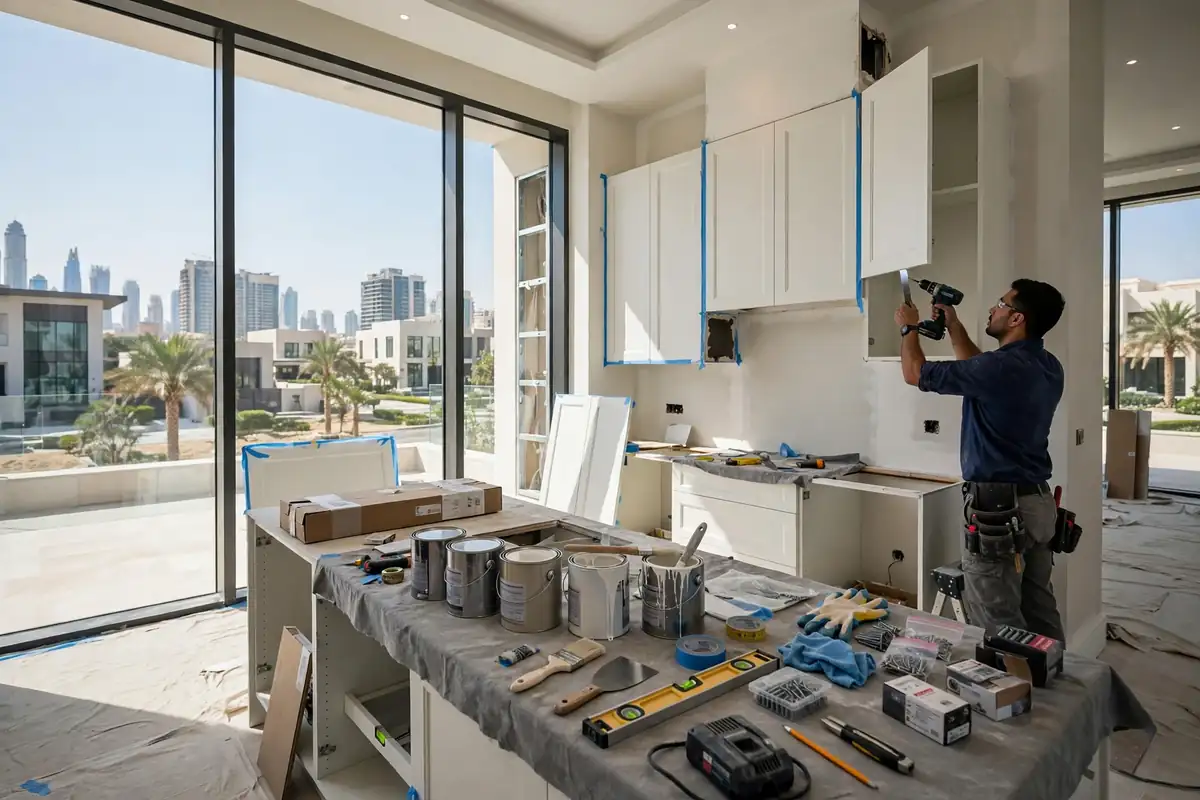
Your kitchen is ten years old. The bathroom leaks. The villa needs a new floor. The cash in your account covers half the job. This page shows how to get home improvement loan UAE, what it costs, and what papers the bank wants. BoloSara24 checked the bank pages on 29 November 2026.
Quick Answer: For a home improvement loan UAE banks offer two paths: a personal loan or a mortgage top-up. HSBC lends AED 25,000 to AED 750,000 for 12 to 48 months. Its representative rate is 7% APR. You need a salary of AED 7,500 a month with an approved employer. Other employers need AED 12,500 a month. You must be 21 to 65 years old. Your salary must move to HSBC. A mortgage top-up suits big structural work. A personal loan suits a fast cosmetic job.
Two ways to borrow for a renovation
Banks offer two paths. Pick the one that fits your job.
A personal home improvement loan is unsecured. The bank lends cash. No property papers. No valuation. The money lands in your account. You'll pay the contractor yourself. The loan runs 12 to 48 months. The Central Bank caps personal loans at 48 months. The loan suits jobs up to AED 750,000 at HSBC.
A mortgage top-up is secured on your home. The bank adds to your current mortgage. The rate is lower than a personal loan. The term can run for years. The bank asks for a valuation and fresh property papers. Sharjah Islamic Bank lists home improvement finance on a ready property. It lends 65% of value for UAE nationals and 60% for expatriates. A top-up suits a big extension or a full villa rebuild.
Which path wins? A small job under AED 100,000 suits a personal loan. A big job over AED 300,000 suits a top-up. It's the lower rate that saves you more than the slow paperwork costs.
Note: The Central Bank caps your total debt burden at 50% of your monthly income. Your mortgage, car loan, card limits and the new loan payment must fit inside that half. A bank that sees you over the cap won't lend.
What a home improvement loan UAE costs
HSBC shows a clear example on its own page. A loan of AED 150,000 over 48 months costs AED 3,574.56 a month at 7% APR. Total interest for the term is AED 21,579. Total processing fees are AED 1,575. The example covers a Premier customer at a listed company who moves their salary to HSBC. Your own rate may differ.
Other banks quote flat rates from about 2.49% to 4.25%. Those flat rates equal reducing rates of about 4.99% to 8.20%. A flat rate looks small. A reducing rate tells the truth. Ask the bank for the reducing rate and the APR in writing.
Processing fees run at about 1% of the loan. The Central Bank caps the fee at AED 2,500 plus VAT. Early settlement costs up to 1% of the amount left, capped at AED 10,000. A late payment draws a fee as well. Read the Key Facts Statement before you sign. The bank must give you that sheet. It lists every fee in plain words.
Ahmed earns AED 18,000 a month in Dubai. He wants a new kitchen for AED 80,000. His bank offers AED 80,000 over 36 months at 7% APR. His monthly payment is about AED 2,470. His other debts take AED 3,000 a month. His total debt burden is about 30% of his pay. The bank approves the loan in three days.
Tip: Get three contractor quotes in writing before you ask the bank for money. A loan sized on one quote can fall short. A loan sized on three quotes fits the real job.
Who can get a home improvement loan in UAE
The BoloSara24 team read these rules on the HSBC page. You must be a UAE national or a resident. You must be 21 to 65 years old. You must earn at least AED 7,500 a month if your employer sits on the HSBC approved list. You must earn at least AED 12,500 a month with other employers. You must hold or open an HSBC current account and move your salary into it.
Other banks set their own lines. Emirates NBD asks for a minimum salary of AED 5,000 for its personal loan. It asks for no minimum length of service. Your salary must move to Emirates NBD. FAB asks for a minimum salary of AED 7,000 and six months with your employer. Each bank checks your credit record with the Al Etihad Credit Bureau.
Self-employed residents can apply too. The bank asks for a trade licence and bank statements instead of a salary certificate. Sharjah Islamic Bank lists a minimum income of AED 30,000 a month for self-employed mortgage finance.
Your employer matters. Banks keep an approved list. A salary from a listed firm wins a lower rate. A salary from an unlisted firm can still win approval at a higher rate.
Papers the bank asks for
Gather these before you apply. A full file moves in days.
- Original Emirates ID and a copy
- Passport copy with the residence visa page
- Latest salary certificate or salary transfer letter
- Latest three months of bank statements showing salary credits
- Contractor quotation for the renovation work
- Title deed copy for a mortgage top-up
- Valuation certificate for a mortgage top-up
- Trade licence for self-employed applicants
The contractor quotation matters most for a renovation loan. The bank wants to see what the money buys. A quote with a full breakdown wins trust. A one-line quote raises questions. Ask your contractor for labour, materials and timeline on one page.
Checklist:
- Emirates ID
- Passport copy
- Salary certificate
- Three months of statements
- Contractor quotation
- Title deed for a top-up
How to get home improvement loan UAE step by step
Follow these steps in order. Each step cuts the wait.
Step 1: Price the job. Get three written quotes from licensed contractors. Pick the middle quote. The cheapest quote can hide extra costs.
Step 2: Check your debt burden. Add your mortgage, car loan and card payments. Add 5% of your card limits. The total must stay under half your monthly pay.
Step 3: Check your credit report. Buy your score from the Al Etihad Credit Bureau for AED 10.50. A full report costs AED 84. Fix any error before you apply. Our guide on how to check credit score in UAE shows the steps.
Step 4: Pick the loan type. A personal loan suits a fast job. A mortgage top-up suits a big job. Ask both desks for a written quote with the APR.
Step 5: Apply in the app or at the branch. Fill every field with the same spelling as your Emirates ID. Attach the contractor quotation. A file with the quotation moves faster.
Step 6: Answer the verification call. The bank calls your registered mobile number. It may ask about your employer and your salary. Answer in person.
Step 7: Sign and take the money. Read the Key Facts Statement first. Check the rate, the monthly payment, the fees and the early settlement charge. Sign only when every number matches the quote.
Permits: get the paper before the hammer
A loan pays for the work. A permit lets the work start. Don't mix the two up.
Paint and new floors need no permit from Dubai Municipality. A new kitchen in the same place needs a no-objection certificate from your developer. A new layout, a moved wall or new plumbing needs a Dubai Municipality building permit as well. Your contractor applies through the Dubai Building Permit System. Only a licensed contractor can file it. Fees for interior work run from AED 2,000 to AED 10,000.
In Emaar and Nakheel communities, the master developer must approve the work first. The owners association must also agree to structural changes. Start the paper trail before you order materials.
Warning: Never start structural work without a permit. The building management can stop the job. The municipality can fine you. The bank can ask for its money back if the work breaks the rules.
Mistakes that cost you money
Borrowing too much is the first mistake. A loan of AED 200,000 for a job worth AED 120,000 leaves AED 80,000 spare. That cash earns nothing. It still draws interest. Borrow the job cost plus 10% for surprises. Don't borrow more.
Skipping the contractor contract is the second mistake. Pay in parts. Half on order. A quarter at the middle. A quarter on finish. A contractor paid in full on day one has no reason to hurry.
Ignoring the rate type is the third mistake. A flat rate of 2.5% sounds cheap. It equals a reducing rate near 5%. Compare reducing rates only. Compare APRs when the fees differ.
Forgetting the permit is the fourth mistake. A stopped job still draws loan interest. The monthly payment starts even if the work stops.
Do you know your total debt burden today? Add your payments now. For the best loan rates across banks, read our guide on the best personal loan rates in UAE. For a home loan check, read our guide on how to calculate home loan eligibility in UAE. For mortgage rates, see the best mortgage rates in UAE.
Example: Fatima borrowed AED 120,000 for a bathroom and kitchen refresh in Abu Dhabi. Her contractor quoted AED 110,000. She kept AED 10,000 spare. The work found old pipes that needed AED 6,000 extra. Her spare covered it. The job finished in five weeks.
The bottom line for renovators
A home improvement loan in UAE is a personal loan or a mortgage top-up. Price the job with three quotes. Check your debt burden and your credit score. Pick the loan that fits the job size. Read the Key Facts Statement. Get the permit before the work starts. Pay the contractor in parts. That's how to get home improvement loan UAE without regret. BoloSara24 checks the bank pages each month so the rates here stay fresh.
Frequently Asked Questions
How much can I borrow with a home improvement loan in UAE?
HSBC lends AED 25,000 to AED 750,000 for a home improvement loan. Personal loans can reach 20 times your monthly salary. A mortgage top-up can reach 60% of the home value for expatriates and 65% for UAE nationals.
What salary do I need for a home improvement loan in UAE?
HSBC asks for AED 7,500 a month with an approved employer and AED 12,500 with other employers. Emirates NBD asks for AED 5,000 a month for its personal loan. Your salary must move to the bank that lends you the money.
How long does a home improvement loan in UAE take to approve?
A personal loan can be approved in two to four working days with a full file. A mortgage top-up takes longer because the bank orders a valuation. A file with a contractor quotation and fresh papers moves fastest.
Do I need a permit to renovate my home in UAE?
Paint and new floors need no permit. A new kitchen layout, a moved wall or new plumbing needs a Dubai Municipality building permit. Your developer must also give a no-objection certificate. Only a licensed contractor can file the permit.
Can I get a home improvement loan in UAE without a salary transfer?
Most banks ask you to move your salary to them. A high credit score can win better terms at some banks. Emirates NBD lists no salary transfer need for applicants with a high AECB score. Ask your bank what your score wins you.
What documents do I need for a home improvement loan in UAE?
You need your Emirates ID, passport copy with visa page, salary certificate and three months of bank statements. Add a contractor quotation for the work. A mortgage top-up also needs a title deed copy and a valuation certificate.
Official Sources
- HSBC UAE, Home Improvement Loan: lists the AED 25,000 to AED 750,000 range, 12 to 48 months, 7% APR example and salary rules.
- Emirates NBD, Salary Transfer Loans for Expats: lists the AED 5,000 minimum salary and no minimum length of service.
- First Abu Dhabi Bank, Personal Loans: lists FAB personal loan rules and documents.
- Central Bank of the UAE: the regulator that sets the 50% debt burden cap and the 48-month personal loan cap.
- Dubai Municipality: the authority for building permits in Dubai.
- Al Etihad Credit Bureau: the bureau that holds your credit score and report.
- UAE Government Portal, Banking in the UAE: lists the documents banks ask for and IBAN rules.
Disclaimer: BoloSara24 is an independent guide. It is not a bank, a lender, a regulator, or a government body. It has no link with the UAE government, the Central Bank, Dubai Municipality, or any bank named here. Rates, fees and loan terms change. Confirm every figure with the bank before you apply. This guide gives general facts only. It is not legal, financial, or immigration advice.
Last Updated: 29 November 2026.