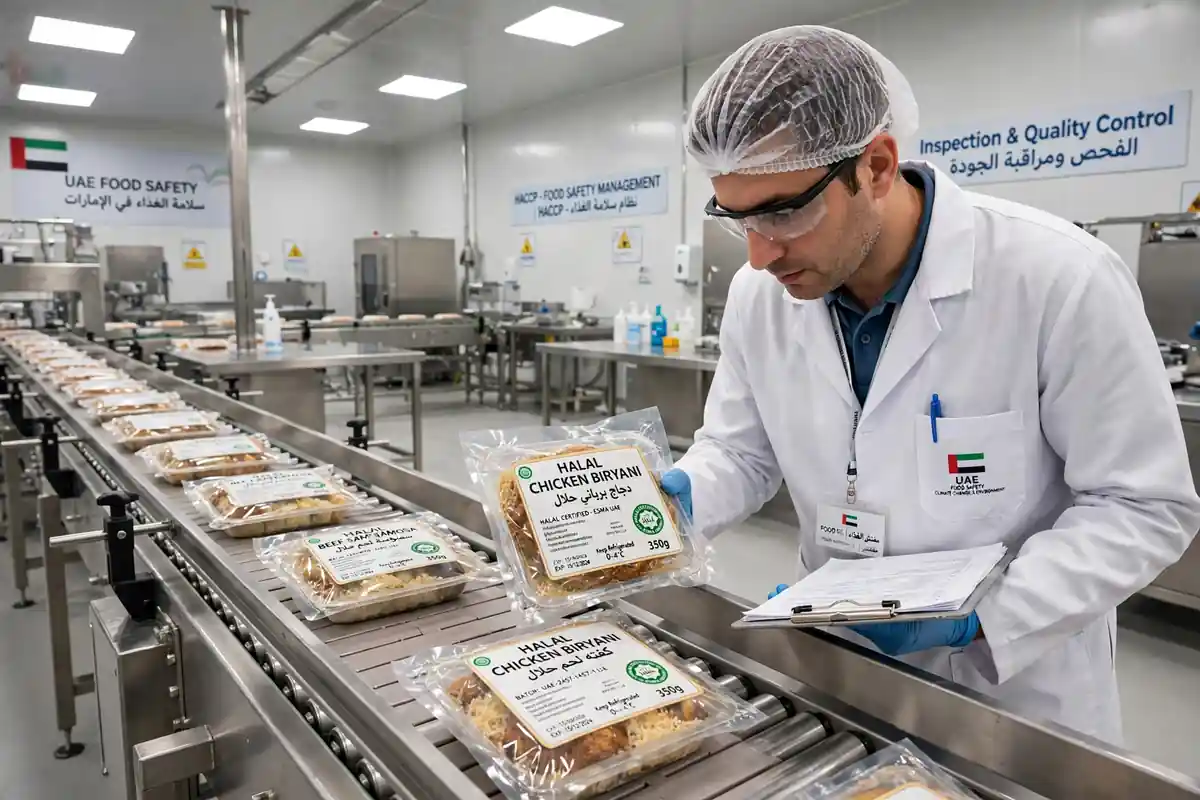
The mark is not a sticker you buy. A licensed body checks your food, your ingredients and your kitchen. It audits your site. It issues the paper only when you pass. That check is the whole point of the mark.
BoloSara24 checked the MoIAT halal page and the MoIAT list of registered halal bodies on 29 November 2026. The MoIAT page names Cabinet Resolution No. 10 of 2014 as the base law. It names UAE.S 2055-1 for food and UAE.S 2055-4 for cosmetics. The facts in this post come from those pages. Fees from certifiers change, so get a written quote before you pay.
Quick Answer: You get a halal certificate UAE from a certification body that MoIAT has registered. Pick your products and your scope first. Choose a body from the MoIAT registered list. Send your ingredient lists and your process notes. The body reviews the papers and then audits your site. Pass the audit and you get the paper. The paper is often valid for one year. The Halal National Mark is a separate MoIAT mark for your pack.
What a Halal Certificate UAE Covers
A halal certificate UAE is a paper that says your product meets halal rules. It covers the final product and the raw goods that go into it. It covers the way you make it, store it and move it. It does not cover a claim you make on your own. Only a registered body can issue it.
Food is the top use. UAE.S 2055-1 sets the rules for halal food. Cosmetics and personal care fall under UAE.S 2055-4. Meat needs halal slaughter proof. Animal goods need proof that the animal was slaughtered in the halal way. Pork and alcohol fail the test. Cross contact with pork or alcohol can fail the test too.
Think of Mariam, a 34 year old owner in Dubai. She makes dates stuffed with nuts in a small unit in Al Quoz. Her dates sell well in local shops. A big supermarket chain asks for a halal paper before it lists her brand. Her recipe has no pork and no alcohol. She still needs the paper.
Think of Ravi, a 45 year old importer in Sharjah. He brings frozen chicken from Brazil. Each shipment needs a halal slaughter paper that names the plant. His UAE buyer also wants his firm to hold a halal paper for the brand. The shipment paper and the brand paper are two different papers. He needs both.
Who Needs the Paper
You need the paper when you sell food as halal in the UAE. You need it when you make food in the UAE for sale as halal. You need it when you import food and call it halal at the border. You need it when a shop, a hotel or an export buyer asks for it.
Do you sell food with no halal claim? You may not need the paper. Plain food with no halal claim can sell without it. The moment you print halal on the pack or the menu, the paper must back the claim. That is the rule in Cabinet Resolution No. 10 of 2014.
Pick a Registered Body First
Not every certifier counts in the UAE. The body must sit on the MoIAT list of registered halal certification bodies. The MoIAT page lists bodies by country with issue dates and expiry dates. Check the list on the day you pay. A body can leave the list.
The body must also hold accreditation from a body MoIAT accepts. The Emirates International Accreditation Centre, known as EIAC, is one such body. The GCC Accreditation Center, known as GAC, is another. The MoIAT page names UKAS, A2LA and JAS-ANZ too. Ask the body for its accreditation paper and its MoIAT registration number.
A consultant is not a certifier. A consultant can prep your papers and train your staff. The consultant cannot issue the paper. The certifier must stay apart from your firm. That split keeps the audit honest.
Tip: Ask three bodies for a quote. Ask each one for its MoIAT registration number and its scope. Pick the body that covers your product type. A cheap quote from a body outside the MoIAT list is wasted money.
Papers You Need Before You Apply
Start with your trade licence. The body needs a valid UAE trade licence with a matching activity. Add your Emirates ID and your passport copy if you are the owner. Add the tenancy contract for your unit or shop.
List every ingredient in each product. List the supplier for each ingredient. Add the halal paper for each meat or animal ingredient. Add the spec sheet for each additive and flavour. A missing supplier paper is the most common gap.
Draw your process flow. Show each step from goods in to pack out. Show where meat is stored. Show where cleaning happens. Show where waste goes. The auditor will walk this flow on site.
Write your halal assurance notes. Name the person who checks incoming goods. Name the person who checks labels. Name the person who trains new staff. Small firms can name one person for all three jobs. The name must be real.
Add your food safety papers if you have them. A HACCP plan or an ISO 22000 paper helps a lot. It is not a must in every case, but auditors ask for it more and more. Keep lab test reports for any product with a cross contact risk.
How to Get a Halal Certificate UAE Step by Step
Step 1. Fix your scope. List the products you want on the paper. List the pack sizes. List the site that makes them. A wide scope costs more. A tight scope is cheaper and faster.
Step 2. Pick a registered body from the MoIAT list. Send the body your product list and your site details. Ask for a quote in writing. Ask for the time it will take.
Step 3. Send the application and the papers. The body reviews your ingredient lists and your process notes. It may ask for more papers. Answer each query in full. A short answer can add a week.
Step 4. Fix the gaps the body finds. The body may flag an ingredient with no halal proof. It may flag a shared line that also runs pork goods. Change the supplier or change the line. Do not argue the point. Fix it.
Step 5. Host the site audit. The auditor walks your unit. The auditor checks storage, labels and staff knowledge. The auditor may take samples. The auditor may ask staff simple questions. Train your staff to answer in plain words.
Step 6. Close the audit findings. The auditor may list small fixes. Fix each one and send proof. A photo of a new label or a new storage sign can close a point. Send the proof fast.
Step 7. Get the paper. The body issues the halal certificate UAE when all points close. Check the names, the products and the dates on the paper. Ask for a fix at once if a name is wrong.
How Long It Takes and What It Costs
Time rests on your prep. A small firm with clean papers can finish in four to eight weeks. A firm with gaps can take 12 weeks or more. The audit itself takes a day or two. The paper review takes the rest of the time.
Cost rests on your size and your scope. Small firms often pay AED 5,000 to AED 15,000 for the first paper. Larger plants pay more. A restaurant paper can sit in the AED 3,000 to AED 8,000 band. These are guide bands from the market, not a MoIAT fee list. Get a written quote from your body.
MoIAT charges the certifier, not you, for its own registration. The MoIAT service page lists AED 1,000 per domain and AED 1,000 for the registration paper. The service time is 10 working days. That fee is for the body, not for your brand paper. Do not mix the two fees.
Renewal comes each year. The body runs a watch audit before it renews the paper. Keep your records clean through the year. A messy file at renewal costs more than a clean file at the first audit.
Mistakes That Fail the Audit
A supplier with no halal paper is the top fail. Your meat supplier must hold a valid paper. Your gelatin supplier must hold one too. Check each supplier paper date. An expired paper fails you.
A shared line is the next fail. A line that runs pork goods in the morning and halal goods in the afternoon needs a full clean and a record. No record means no pass. Keep a clean log with dates and names.
A label with a wrong claim fails too. A pack that says halal but names a non halal ingredient will fail. Check each label against the recipe. Check the Arabic text as well as the English text.
Staff who cannot answer fail the audit. The auditor will ask a packer where the halal meat sits. The auditor will ask a cleaner what soap they use. Train every worker, not just the manager. A one hour talk can save the audit.
Note: A paper from a body outside the MoIAT list does not back a halal claim in the UAE. It may look real. It may come from a known body abroad. If MoIAT has not registered that body, the paper carries no weight here. Check the list first.
The Bottom Line
A halal certificate UAE is a check, not a purchase. You pick a registered body. You show clean ingredients and a clean process. You pass a site audit. You get the paper. You renew it each year.
Start with the MoIAT list. Pick a body that covers your product type. Gather supplier papers before you apply. Train your staff before the audit. A clean file is the fastest file. BoloSara24 will keep this post fresh as MoIAT updates its list and its rules.
Read more on BoloSara24 about how to register a trademark in UAE. If you sell food in Dubai, read how to get a tourism licence in UAE for the licence side. For shop basics, read how to open a business bank account in UAE and consultancy business in UAE. For import steps, read how to clear customs in UAE.
Frequently Asked Questions
Is a halal certificate UAE a must for all food in the UAE?
No. Food with no halal claim can sell without the paper. Food that you call halal must hold a paper from a MoIAT registered body. Meat and animal goods need halal slaughter proof in any case.
How long does a halal certificate UAE take?
A small firm with clean papers can finish in four to eight weeks. A firm with gaps can take 12 weeks or more. The site audit takes a day or two. The paper review takes the rest of the time.
How much does a halal certificate UAE cost?
Small firms often pay AED 5,000 to AED 15,000 for the first paper. A restaurant paper can sit in the AED 3,000 to AED 8,000 band. These are market guide bands. Get a written quote from your body before you pay.
Who can issue a halal certificate UAE?
Only a certification body that MoIAT has registered can issue it. The body must also hold accreditation from EIAC, GAC or another body MoIAT accepts. Check the MoIAT registered list before you pay any fee.
How long is a halal certificate UAE valid?
Most papers are valid for one year. The body runs a watch audit before renewal. Keep your supplier papers and your cleaning logs clean through the year to renew with no fuss.
Is the Halal National Mark the same as the certificate?
No. The paper comes from a registered body. The Halal National Mark comes from MoIAT and lets you show halal status on your pack. The mark is optional. Ask MoIAT about it once your paper is in hand.
Official Sources
MoIAT halal programme page: Cabinet Resolution No. 10 of 2014, the UAE.S 2055 standards and the Halal National Mark.
MoIAT registered halal certification bodies list: The live list of bodies MoIAT has registered, with dates and status.
MoIAT halal body registration service: AED 1,000 per domain, AED 1,000 for the registration paper and 10 working days.
Disclaimer
BoloSara24 is an independent guide. It has no link with the UAE government, MoIAT, EIAC, GAC or any certification body. The facts here were checked on the official pages named in the sources on 29 November 2026. Rules, fees and lists can change. Confirm the current list and the current terms on the official page before you apply. This post is general information only. It is not legal advice or a promise of a certificate.
Last Updated: 29 November 2026.